
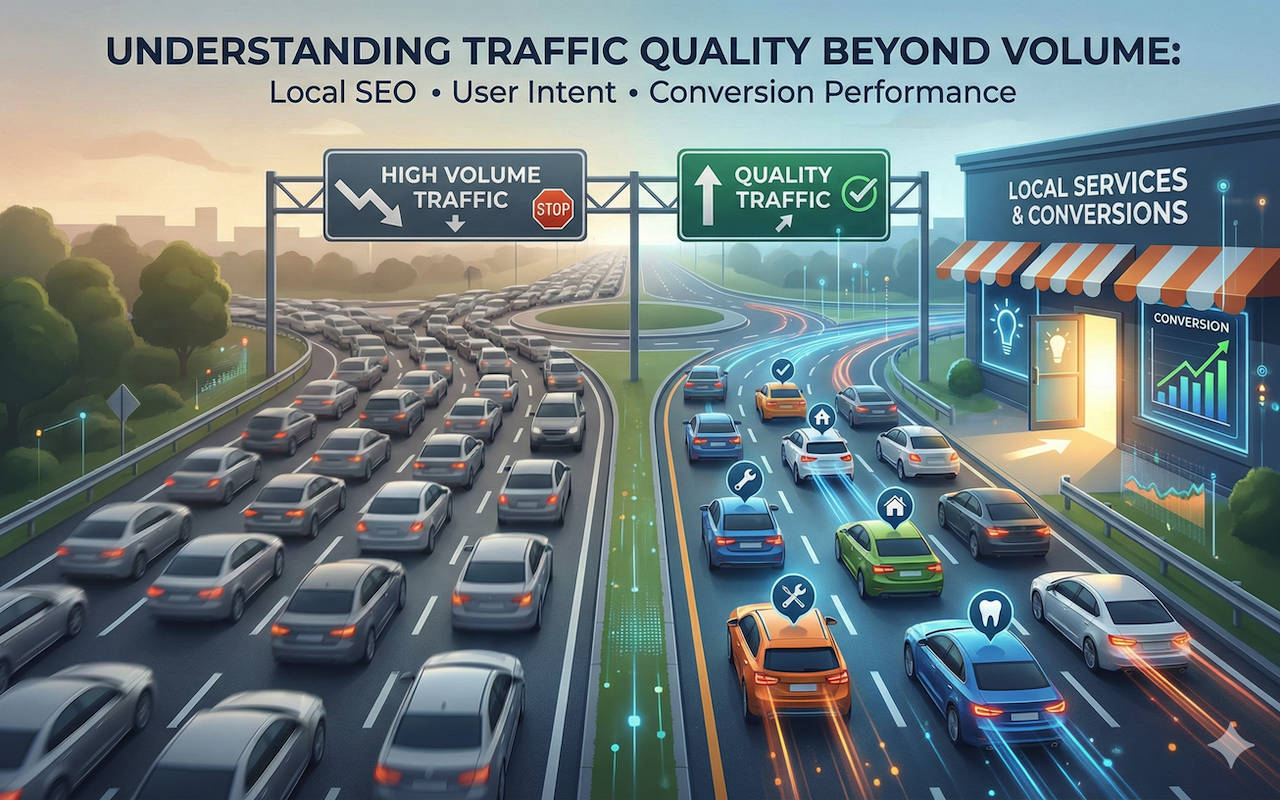
Understanding Traffic Quality Beyond Volume
Traffic quantity often dominates reporting dashboards across local businesses, yet volume alone rarely explains why conversion rates stagnate despite steady traffic growth. Traffic quality measures how closely visitors match the right audience for a service when guided by a well-planned local SEO strategy. Alignment between user intent and website content determines conversion performance, and not every visitor arrives ready to become a paying customer. Evaluating traffic quality involves examining factors such as:
- Visitor intent and engagement with website content
- Source relevance and geographic alignment
- User behavior across multiple pages
- Technical accessibility and mobile optimization
Search Engines and Intent Matching
Search engines prioritize relevance based on search algorithms and user intent. Local searches usually reflect immediate needs tied to services and locations, while user intent can vary widely between educational content and transactional queries. Search results reward pages that satisfy intent rather than inflate traffic numbers. Visibility improves when content aligns with what potential customers actively seek, and a well-defined local SEO strategy ensures that intent-driven queries surface the most relevant service pages at the right moment.
Role of Local SEO in Traffic Quality
Local SEO focuses on attracting visitors with service-specific intent rather than broad exposure. Optimization efforts refine how local search results present a business. Search rankings improve when on-page SEO supports clarity and relevance. Qualified leads increase when keyword research targets service-driven phrases. Local companies benefit when visibility reaches users prepared to act. Leveraging local SEO insights enhances targeting accuracy and improves conversion performance by ensuring the right audience engages with the website.
Organic Traffic Versus High Quality Traffic
Organic traffic represents visits earned through unpaid search results, yet quality matters more than volume within these sources. High-quality traffic comes from users matching service needs and timing. Traditional SEO that focuses purely on rankings without intent alignment underperforms. SEO success depends on attracting and converting visitors, not just any visitors. Key indicators of high-quality traffic include:
- Traffic from local searches relevant to services
- Returning users showing intent to engage
- Visitors navigating multiple pages
- Users are completing desired actions, such as filling out forms or requesting a quote.
Conversion Rates and User Experience
Conversion rates reflect how effectively traffic moves through the conversion process once users land on web pages. User experience plays a decisive role at this stage, as clear design fosters trust and reduces friction. Mobile users expect fast interaction and simple navigation, making mobile optimization a critical factor in how traffic and conversions relate. Essential considerations for improving conversion rates include:
- Site speed and responsiveness on mobile devices
- Clear calls to action and visible pricing information
- Trust signals such as testimonials and professional visuals
- Well-structured landing pages guiding visitors toward desired actions
Importance of Mobile Devices
Mobile devices dominate local searches across service industries. Mobile-friendly layouts support usability across all screen sizes, and responsive design ensures a consistent experience for mobile users. Site speed directly affects engagement, especially on mobile connections. Core web vitals influence both search engine visibility and user satisfaction, reinforcing the connection between performance and conversion outcomes.
Website Content and Engagement Signals
Website content guides visitors toward a desired action. Compelling content quickly clarifies the value proposition. Educational content builds credibility during early decision stages, while high-quality content supports trust signals and sustained user engagement. Content marketing attracts visitors who value expertise and clarity rather than casual browsing. To optimize content effectiveness, focus on:
- Providing interactive elements such as calculators or appointment forms
- Publishing educational resources relevant to local service searches
- Highlighting unique value propositions and service differentiators
- Using high-quality visuals to enhance trust and clarity
Landing Pages and Conversion Focus
Landing pages serve as focused entry points for targeted traffic. Page structure matters when guiding users toward calls to action. Visual cues help visitors understand next steps, while interactive elements increase engagement when used sparingly. Pricing page clarity influences conversion rates during service evaluation phases. Features that improve landing page effectiveness include:
- Strategic placement of calls to action
- Concise, compelling messaging highlighting benefits
- Straightforward navigation between service pages and informational content
- Optimization for mobile users to reduce friction
Importance of Content Marketing
Content marketing remains a cornerstone of digital marketing for local businesses aiming to boost online visibility and attract meaningful website traffic. Consistently producing high-quality, relevant content allows businesses to connect with their target audience and address specific service needs. Effective content marketing generates qualified leads while nurturing trust and credibility, both of which support higher conversion rates and strengthen search engine visibility. Examples of successful content tactics include:
- Blogging about common service concerns or questions
- Sharing case studies or success stories
- Providing downloadable educational resources
- Leveraging local SEO insights to improve visibility in search results
On-Page SEO and Page SEO Factors
On-page SEO ensures relevance between target keywords and website content by aligning page structure with search intent. Meta tags communicate a page's topical focus to search engines, and meta descriptions shape expectations before users click. Page SEO strengthens traffic quality when messaging accurately reflects user intent, directly contributing to higher conversion rates. Proper on-page SEO supports:
- Alignment of headings and content with target keywords
- Optimization of meta descriptions for click-through rates
- Internal linking between relevant pages to encourage exploration
- Clear visual hierarchy improves user engagement
Off-Page SEO and Authority Signals
Off-page SEO strengthens credibility through external authority signals. Responsible link building reinforces trust for both users and search engines. Search rankings stabilize when relevance and authority align. A balanced SEO strategy depends on coordination between on-page and off-page efforts, helping local businesses attract the right audience and maximize conversion performance.
Analytics and Measuring Traffic Quality
Google Analytics provides insight into web traffic behavior beyond surface metrics. Segmentation reveals which sources generate qualified leads. Behavior flow highlights friction within the conversion process. User engagement metrics outperform raw traffic numbers. Continuous improvement relies on data-driven evaluation informed by patterns of user intent, device usage, and source relevance.
Evaluating Conversion Performance
Conversion performance reflects effectiveness across multiple pages. Incremental improvements compound gains over time. Analysis identifies which visitors become satisfied customers. Metrics reveal why some traffic fails to convert. Refinement focuses resources on high-quality traffic sources, ensuring that the website consistently attracts the right audience and maximizes business results.
Website Design and Trust Development
Website design influences perceived professionalism and credibility. Trust signals reassure users evaluating services online. High-quality photos humanize local service offerings. Well-designed website layouts reduce cognitive load and improve navigation. Consistency across web pages builds confidence and encourages visitors to complete desired actions, resulting in higher conversion rates.
Effective Use of Calls to Action
Calls to action guide visitors toward becoming paying customers. Placement and clarity reduce hesitation during the conversion process. Alignment with user intent increases the likelihood of completing the desired action. Tracking performance enables continuous optimization. Clear pathways improve outcomes for both visitors and business owners by transforming traffic into satisfied customers.
Digital Marketing and Traffic Strategy
Digital marketing integrates SEO efforts with content planning. Generating traffic without intent alignment wastes resources. Attracting visitors requires precision rather than scale. Drive traffic initiatives succeed when relevance leads strategy. Online visibility improves when high-quality traffic is prioritized over raw numbers, ensuring sustained conversion performance.
From Visitors to Paying Customers
Paying customers emerge from effective alignment across channels. Conversion process clarity reduces friction. Desired action completion increases with intuitive navigation. More customers result from targeting the right audience. Business owner goals align with traffic quality optimization, resulting in measurable growth and long-term success.
Long-Term Impact on Local Businesses
Local businesses thrive when traffic quality improves steadily. Search engine visibility supports sustainable growth—online sales increase when qualified leads dominate funnels. Building brand awareness through consistent value delivery ensures ongoing engagement. Continuous improvement sustains competitive advantage over time, making quality traffic and strategic optimization essential for lasting business success.
Conclusion
Traffic quality, not traffic volume, is what ultimately drives conversions for local service websites. When user intent, local SEO strategy, content relevance, and user experience align, visitors are more likely to take meaningful action.
By focusing on intent-driven traffic, optimizing for local search visibility, and continuously refining the user journey through data and design, local businesses can turn website visits into measurable growth. Over time, this approach creates a sustainable competitive advantage built on relevance, trust, and conversion efficiency.
Featured Image generated by Google Gemini.
Share this post
Leave a comment
All comments are moderated. Spammy and bot submitted comments are deleted. Please submit the comments that are helpful to others, and we'll approve your comments. A comment that includes outbound link will only be approved if the content is relevant to the topic, and has some value to our readers.





Comments (0)
No comment