
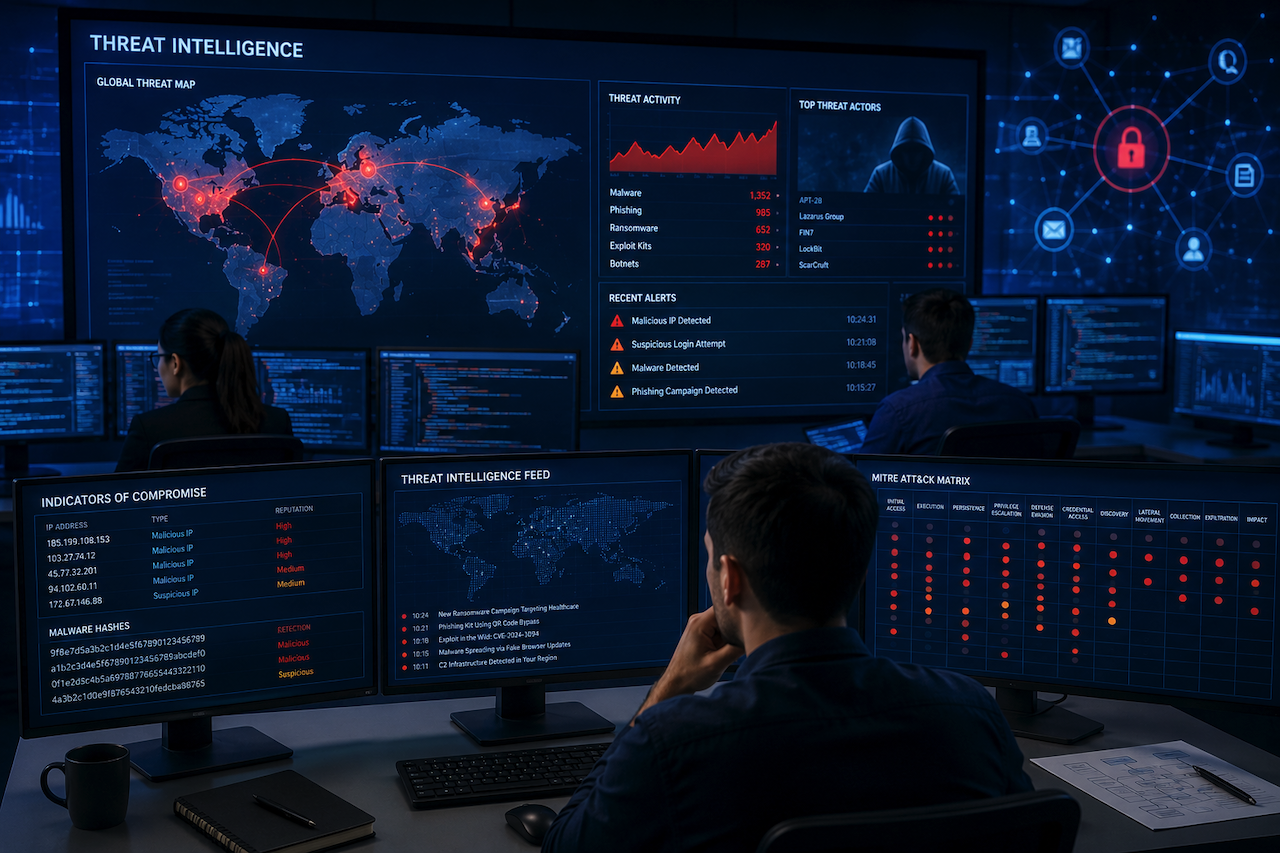
Traditional security measures such as firewalls, antivirus software, and basic security policies are no longer sufficient to protect organizations from modern cyber threats. Today's threat landscape includes ransomware groups, nation-state attackers, and zero-day vulnerabilities that can compromise systems before security teams have time to react.
As cyberattacks become more frequent, organizations need a proactive approach to cybersecurity, but that raises an important question: how can security teams identify and stop threats before they affect the network? This blog answers the same question by exploring threat intelligence, a critical component of modern cyber threat monitoring solutions.
What is Threat Intelligence?
Threat intelligence is information collected, processed, and analyzed to understand threat actors, their motives, targets, and attack methods. It helps organizations identify potential threats, assess risks, and make informed cybersecurity decisions based on actionable insights rather than assumptions.
Types of Threat Intelligence
Threat intelligence isn't one-size-fits-all. It comes in four different types, each serving a different audience and purpose, namely:
1. Strategic Threat Intelligence
Threat intelligence is evidence-based knowledge about existing and emerging threats. It helps organizations understand attack methods, identify indicators of compromise, and take informed actions to improve cybersecurity defenses.
2. Tactical Threat Intelligence
It focuses on the Tactics, Techniques, and Procedures (TTPs) that adversaries use to carry out attacks. By understanding these methods, security teams can anticipate potential threats and implement appropriate defensive measures.
3. Operational Threat Intelligence
This type of intelligence delivers real-time, actionable information about active campaigns and includes current Indicators of Compromise (IOCs), such as malicious domains, malware hashes, and phishing email subjects. It's primarily consumed by SOC managers and incident responders dealing with threats as they unfold.
4. Technical Threat Intelligence
This type of intelligence focuses on the technical characteristics of threats, such as malware, exploit code, indicators of compromise (IOCs), and attacker infrastructure. It helps security teams detect threats and take timely defensive action.
The Threat Intelligence Lifecycle
Threat intelligence follows a structured process rather than being generated spontaneously. Most threat intelligence programs operate through a continuous lifecycle consisting of six stages: Direction, Collection, Processing, Analysis, Dissemination, and Feedback. Each stage plays a distinct role in transforming raw data into actionable intelligence.
- Direction: The process begins by defining intelligence requirements, business objectives, and the stakeholders who will use the intelligence.
- Collection: Relevant data is gathered from internal systems, open-source intelligence (OSINT), commercial feeds, industry sharing groups, and other sources.
- Processing: Raw data is organized, filtered, normalized, and prepared for analysis so that it can be evaluated effectively.
- Analysis: Analysts examine the processed information, identify patterns and risks, and transform data into actionable intelligence.
- Dissemination: Intelligence findings are delivered to the appropriate stakeholders, such as security teams, executives, incident responders, or risk managers.
- Feedback: Stakeholders provide feedback on the usefulness and relevance of the intelligence, helping refine future collection and analysis efforts.
Together, these stages create a continuous cycle that enables threat intelligence programs to adapt to evolving threats and changing organizational requirements.
Current Cybersecurity Threats
Understanding why threat intelligence matters requires understanding what organizations are up against, and frankly, the current picture is sobering:
The Numbers Speak for Themselves
According to IBM's Cost of a Data Breach research, the global average cost of a data breach reached $4.88 million in 2024. These figures underscore the critical need for proactive, intelligence-driven security.
The Major Threat Categories
Organizations face a diverse range of cyber threats that vary in scale, complexity, and impact. Some of these threats include:
- Ransomware-as-a-Service (RaaS): Ransomware-as-a-Service has turned ransomware into a scalable, franchise-style business model. Affiliate-driven models enable threat groups to rapidly expand campaigns, reuse proven tools, and tailor attacks to specific targets. According to Check Point Research, global ransomware incidents surged 32% year-over-year in 2025, with manufacturing alone absorbing a 56% spike.
- Phishing and Social Engineering: Phishing and social engineering remain the most common entry points for attacks. These attacks are getting smarter by leveraging AI to craft highly personalized, convincing lures that bypass traditional filters.
- Supply Chain Attacks: Supply chain attacks are particularly dangerous because they exploit trust. When attackers compromise a third-party vendor, they gain access to every downstream customer. The 2024 attacks against Snowflake customer environments, for example, were traced back to infostealer malware that harvested employee credentials on enterprise-licensed environments, as discussed by the Cloud Security Alliance.
- Cybercrime-as-a-Service: Cybercrime-as-a-Service has significantly lowered entry barriers. Today, even unskilled actors can launch sophisticated attacks by purchasing tools, exploits, and even access to corporate networks on underground marketplaces.
Why Threats Evolve Faster Than Traditional Defenses
The core problem with traditional, perimeter-based security is that it assumes the threat is outside. But modern attackers operate from the inside out using valid credentials, legitimate software, and trusted channels. As noted by Cyware, without threat intelligence, "security teams operate reactively, responding to incidents after they occur." In a business environment where attackers move in hours and defenders respond in days, that gap is simply not acceptable.
How Threat Intelligence Works in Practice
So, how does threat intelligence actually function on the ground? Let's pull back the curtain and look at the mechanics.
Sources of Threat Intelligence
Threat intelligence is only as good as its sources. Organizations typically draw from a mix of three categories:
- Internal Sources: These are often the most directly relevant sources of threat intelligence and include security tool logs and alerts, incident response findings, malware samples from internal environments, and threat hunting discoveries. They reflect the actual threats facing the organization.
- Open-Source Intelligence (OSINT): This category draws from publicly available information such as security blogs, vulnerability databases, malware repositories, social media, and dark web monitoring. Tools such as Shodan, VirusTotal, and GitHub monitoring can help uncover attacker reconnaissance activities and potential misconfigurations before they are exploited.
- Commercial Threat Intelligence Services: These services provide curated and analyzed threat data, often including attribution analysis, sector-specific insights, and reduced false positives. They can be particularly valuable for organizations that lack the internal resources needed to process large volumes of raw threat data.
Integrating Intelligence into the Security Stack
Threat intelligence doesn't live in isolation; it's most powerful when it's woven into the security tools your team already uses, for example:
- SIEM (Security Information and Event Management): SIEM platforms become dramatically more effective when enriched with threat intelligence. As ZeroFox explains, with intelligence integration, a SIEM is better prepared to recognize emerging threats before they reach the network. If threat intelligence reveals a vulnerability being exploited in a particular industry, organizations can prioritize patching before seeing exploitation attempts in their own environments.
- SOAR (Security Orchestration, Automation, and Response): When a Threat Intelligence Platform (TIP) identifies a known malicious IP address, SOAR can automatically block it, isolate affected endpoints, and escalate incidents to analysts without requiring manual intervention.
- Firewalls, EDR Systems, and DNS Filters: These security controls can consume real-time IOC feeds, allowing known malicious domains, IP addresses, and file hashes to be blocked automatically once they are identified.
IOCs vs. TTPs: Two Layers of Intelligence
Threat intelligence becomes most valuable when it helps organizations understand both the immediate signs of an attack and the broader methods adversaries use. These insights are commonly divided into two complementary layers:
- Indicators of Compromise (IOCs): These are specific artifacts associated with known attacks, such as malicious IP addresses, file hashes, domain names, and email headers. They are tactical, time-sensitive, and immediately actionable. A threat intelligence feed that identifies an IP address as part of a ransomware command-and-control server, for example, can prompt the immediate isolation of an affected endpoint.
- Tactics, Techniques, and Procedures (TTPs): Mapped to frameworks such as MITRE ATT&CK, TTPs provide deeper insight into adversary behavior. They describe methods of initial access, lateral movement, data exfiltration, and other attack activities. While IOCs can become outdated quickly as attackers change infrastructure, TTPs tend to evolve more slowly, making them a more durable and strategic source of intelligence.
Key Benefits for Organizations
According to The Review Hive, threat intelligence can provide a range of operational and strategic benefits for organizations. The following advantages are among the most commonly cited:
- Proactive Defense: Rather than waiting to respond to an incident, threat intelligence enables security teams to anticipate adversary behavior, identify gaps in defense systems, and mitigate them before attackers can exploit them.
- Faster Incident Response: When an alert arrives already enriched with malware family information, MITRE ATT&CK mapping, and threat actor attribution, analysts can spend minutes on triage instead of hours. That speed directly translates into reduced damage, lower breach costs, and faster recovery.
- Informed Decision-Making at Every Level: Threat intelligence helps organizations make better security decisions by providing clear insight into current threats, potential risks, and priority areas for investment. As a result, security resources can be allocated more effectively.
- Supply Chain and Third-Party Risk Awareness: Threat intelligence programs provide visibility into third-party risks by detecting compromised vendor credentials, vulnerable software components, and other threats that may expose the organization to risk.
Best Practices for Building a Threat Intelligence Program
Follow these principles to separate mature programs from those that struggle:
- Start with Your Threat Profile: Before you can defend yourself effectively, you need to know who is targeting your organization. Understand which threat actors focus on your industry, the techniques they use, and the assets most likely to be targeted. A financial institution, for example, faces different adversaries than a healthcare provider or manufacturing company.
- Define Clear Intelligence Requirements: Threat intelligence programs often struggle when they attempt to monitor everything for everyone. Work with stakeholders, executives, IT teams, and compliance officers to identify specific intelligence requirements and business questions. Clear objectives help focus the entire lifecycle.
- Choose the Right Mix of Sources: Balance internal telemetry with external intelligence feeds. Combine commercial intelligence services for attribution and depth, OSINT for breadth, and ISAC participation for sector-specific insights. No single source provides a complete picture of the threat landscape.
- Integrate Intelligence into the Security Stack: Intelligence that remains isolated in reports delivers limited value. Integrate threat intelligence feeds with SIEM, SOAR, and EDR platforms so that relevant context is automatically applied to alerts and response workflows.
- Foster a Culture of Sharing: Participate in ISACs, government-private sector information-sharing initiatives, and trusted industry communities. Sharing relevant intelligence helps strengthen collective defense efforts and often results in receiving valuable intelligence in return.
End Note
The cybersecurity landscape has become too complex, too fast-moving, and too adversarial for reactive defenses alone. But threat intelligence changes the equation. It transforms raw, overwhelming threat data into focused, actionable insights that help security teams detect threats faster, respond more effectively, make smarter investment decisions, and stay one step ahead of adversaries.
That said, the benefits of threat intelligence are only realized when it's treated as a program, not a product. It requires clear requirements, the right sources, skilled analysts, integration with your security stack, and a commitment to continuous improvement.
Featured Image generated by ChatGPT.
Share this post
Author

Read the latest articles from Atif Sharif
How Real-Time Accounting Data Improves Decision-Making for Businesses

June 8, 2026
For decades, corporate financial management operated primarily on retrospective reporting cycles, relying on monthly or quarterly closes to evaluate performance and allocate capital. While this model remains necessary for compliance, relying on it for daily operations poses a distinct structural challenge: it for [...]
Learn moreBest Project Management Certifications Ranked by Career Value

May 6, 2026
There are few things more universally employable than project management. Planning and delivering work in a structured way is a skill required for anything from software development and construction to marketing. Because of the high demand for the skill, project management certifications are among the most effect [...]
Learn moreLeave a comment
All comments are moderated. Spammy and bot submitted comments are deleted. Please submit the comments that are helpful to others, and we'll approve your comments. A comment that includes outbound link will only be approved if the content is relevant to the topic, and has some value to our readers.


Comments (0)
No comment