
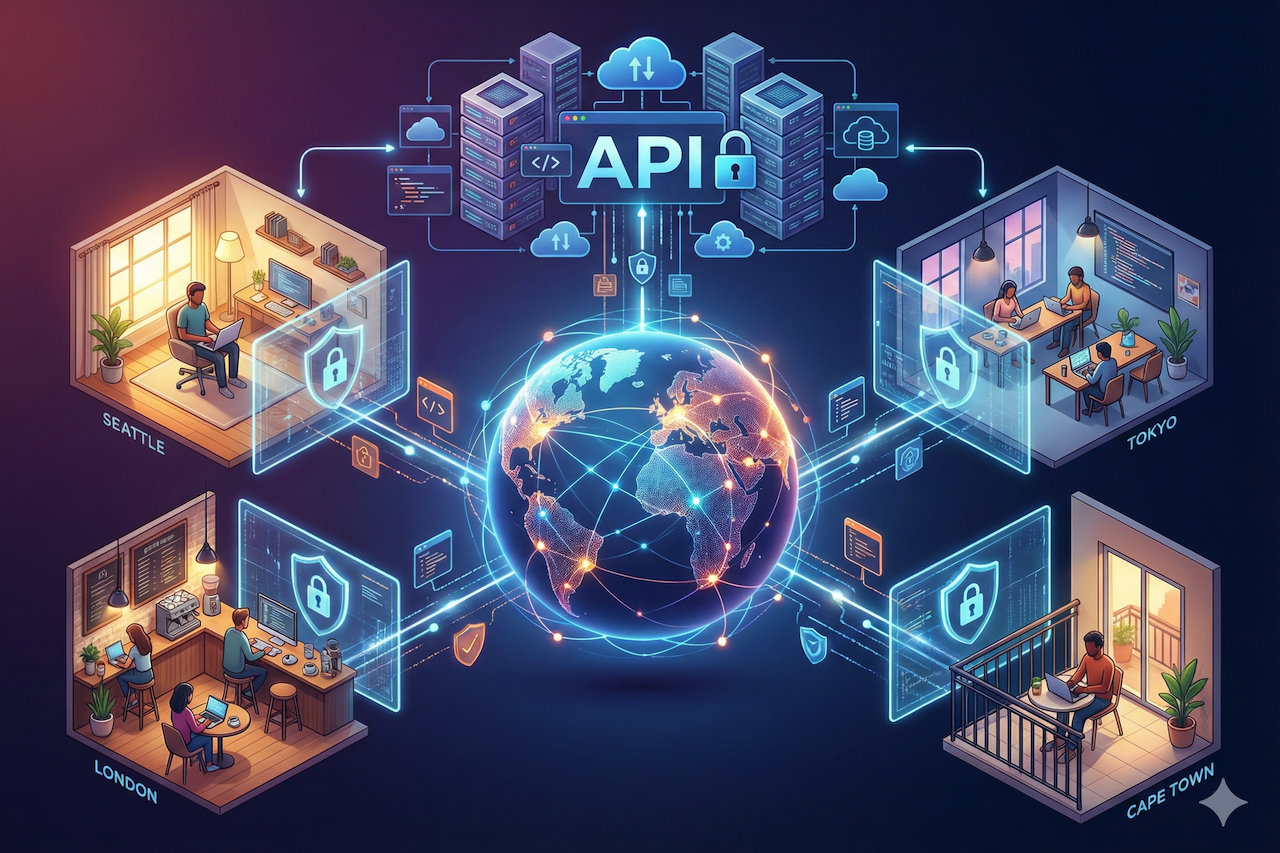
The move to distributed development has forced teams to rethink their entire technical stack. Five years ago, most development agencies and SaaS companies operated from a single office. Security meant controlling who walked through the door and what they could access once inside. Today, those same teams work from home offices, coworking spaces, and coffee shops across different continents. The old security model doesn't apply.
What's less obvious is how this shift affects the tools teams build with. When your developers are distributed, the infrastructure you choose determines whether security becomes a constant battle or something that happens by default. The difference comes down to how well your stack handles distributed access, automated workflows, and knowledge preservation without creating new vulnerabilities.
Why Traditional Infrastructure Fails Remote Teams
Most development tools were designed for co-located teams. They assume fast, trusted networks. They expect everyone to be online at the same time. They rely on quick conversations to resolve ambiguity. None of these assumptions holds when your team spans time zones.
The security implications go beyond access control. When developers work remotely, every service integration becomes a potential weak point. A developer's home network isn't a corporate network. Their laptop might connect to production systems from an airport or hotel. API credentials get stored in local environments that IT departments can't monitor or control.
Traditional approaches to this problem involve adding layers: VPNs, endpoint detection, mandatory security training, and regular audits. These help, but they also slow teams down and create friction at every step. Developers spend time fighting security theater instead of building products.
The better approach starts with choosing infrastructure that treats distributed access as the default case, not an exception to be managed.
The API-Driven Security Model
For development teams and creative platforms that serve global users or clients, the infrastructure decision matters more than most teams realize. If you're building products for multiple clients or end users, you need complete isolation between projects. Customer data can't leak across workspace boundaries. Access controls need to work consistently regardless of where team members are located.
This is where API-first infrastructure shows its value. Instead of giving developers direct access to client environments, you expose capabilities through well-defined APIs. Authentication, authorization, and audit logging happen at the API layer. Individual developers never touch production credentials directly.
Consider how distributed creative teams operate. A design team building image-editing workflows for clients might rely on tools like Picsart photo editor to deliver visual assets at scale. The traditional approach involves passing credentials and asset libraries back and forth between team members, hoping everyone works from the right version and accesses only what they're supposed to. An API-first model eliminates that exposure — access is scoped, logged, and revoked centrally, without requiring developers to manage permissions for every collaborator across every project manually.
The security benefits compound over time. When a developer leaves, revoke their API key so they immediately lose all access. When you onboard a new client, workspace isolation happens by default. When you need to audit what happened in a specific project, the logs are already there.
This model also makes geographic security enforcement easier. API requests include origin information. If a developer's credentials suddenly start making requests from a new country, you can detect and investigate immediately. Tools like IP geolocation services can help flag anomalous access patterns by cross-referencing request origins against expected locations, a natural fit for teams already thinking carefully about distributed infrastructure. You can restrict API access by region if needed. These protections work the same way whether your team has five developers or fifty.
The Documentation Security Problem
Security discussions around remote development usually focus on access controls and infrastructure, but another risk gets less attention: institutional knowledge that exists nowhere except in people's heads. When critical decisions only live in unrecorded Slack threads or informal video calls, your entire team becomes vulnerable to context loss.
This isn't just an inconvenience. When future developers don't understand why certain architectural decisions were made, they're more likely to introduce security vulnerabilities by accident. When there's no record of how a particular system should be configured, mistakes happen during deployments or migrations.
The standard solution is better documentation, but documentation requires discipline that most teams don't maintain under deadline pressure. Developers need to remember to write things down, keep docs up to date, and organize information so future team members can find it. This rarely happens consistently.
Better tools solve this automatically. A meeting transcription app that captures technical discussions without requiring manual note-taking removes the friction. When your architecture review meetings are automatically transcribed and indexed, future developers can search for context instead of interrupting current team members with questions they've answered ten times before.
For distributed teams, this becomes even more valuable. When your team spans time zones, you can't rely on synchronous communication to transfer knowledge. The team members working in Asia need access to the same context as the team in Europe, even though they never overlap. Automated transcription and summarization make this possible without requiring someone to stay up for meetings in the middle of the night.
The security angle is subtle but real. When developers understand the full context behind security decisions, they're more likely to maintain those protections as the system evolves. When that context gets lost, security gradually degrades through well-intentioned changes that don't account for the original threat model.
Practical Implementation for Distributed Teams
Start by auditing your current infrastructure for services that weren't designed for distributed teams. Look for systems where developers need direct access to production environments, credentials that can't be scoped to specific workspaces, or tools that lack comprehensive audit logs. These are your highest-risk areas.
For client work, move toward infrastructure that enforces isolation by default. If you're building applications or workflows for customers, choose platforms that handle workspace separation at the infrastructure layer rather than relying on developer discipline. The best systems make it impossible to accidentally access the wrong client's data because the API won't allow cross-workspace requests in the first place.
Review your knowledge management practices. How much context exists only in unrecorded conversations? What happens when a senior developer leaves and takes years of architectural decisions with them? If you don't have good answers to these questions, you need systems that automatically preserve knowledge. Look for tools that transcribe and index technical discussions without requiring manual effort.
Pay attention to geographic patterns in your API access logs. Where do requests originate? Are there sudden changes that might indicate compromised credentials? IP geolocation data is particularly useful here, mapping request origins to known team locations lets you spot anomalies that raw logs alone won't surface. Modern API platforms can help automate this analysis, but you need to be looking at the data in the first place.
Test your access revocation procedures. When someone leaves, how quickly can you cut off all their access? How confident are you that you've found every credential they had access to? If this process takes more than a few minutes, your infrastructure is too fragmented.
The Long-Term Distributed Model
Distributed development isn't a temporary accommodation anymore. Teams that optimize for remote work as the default case will have a structural advantage over those still trying to recreate office dynamics through constant video calls and manual processes.
The infrastructure choices you make today determine how well your team operates five years from now. API-first systems that handle security and isolation automatically scale better than manually configured environments. Tools that preserve context without requiring extra work maintain that advantage as teams grow and people change.
For development agencies and platforms building client projects, these decisions matter even more. Your infrastructure directly affects your ability to take on new clients, maintain security across growing teams, and preserve the institutional knowledge that makes your service valuable.
The teams that succeed long-term are those that choose tools designed for distributed work from the ground up, not adapted from office-era assumptions. They enforce security at the infrastructure layer rather than relying on developer discipline. They capture context automatically rather than relying on someone to remember to document important decisions.
Remote development is here to stay. The question is whether your infrastructure is ready for it.
Featured Image generated by Google Gemini.
Share this post
Leave a comment
All comments are moderated. Spammy and bot submitted comments are deleted. Please submit the comments that are helpful to others, and we'll approve your comments. A comment that includes outbound link will only be approved if the content is relevant to the topic, and has some value to our readers.


Comments (0)
No comment