
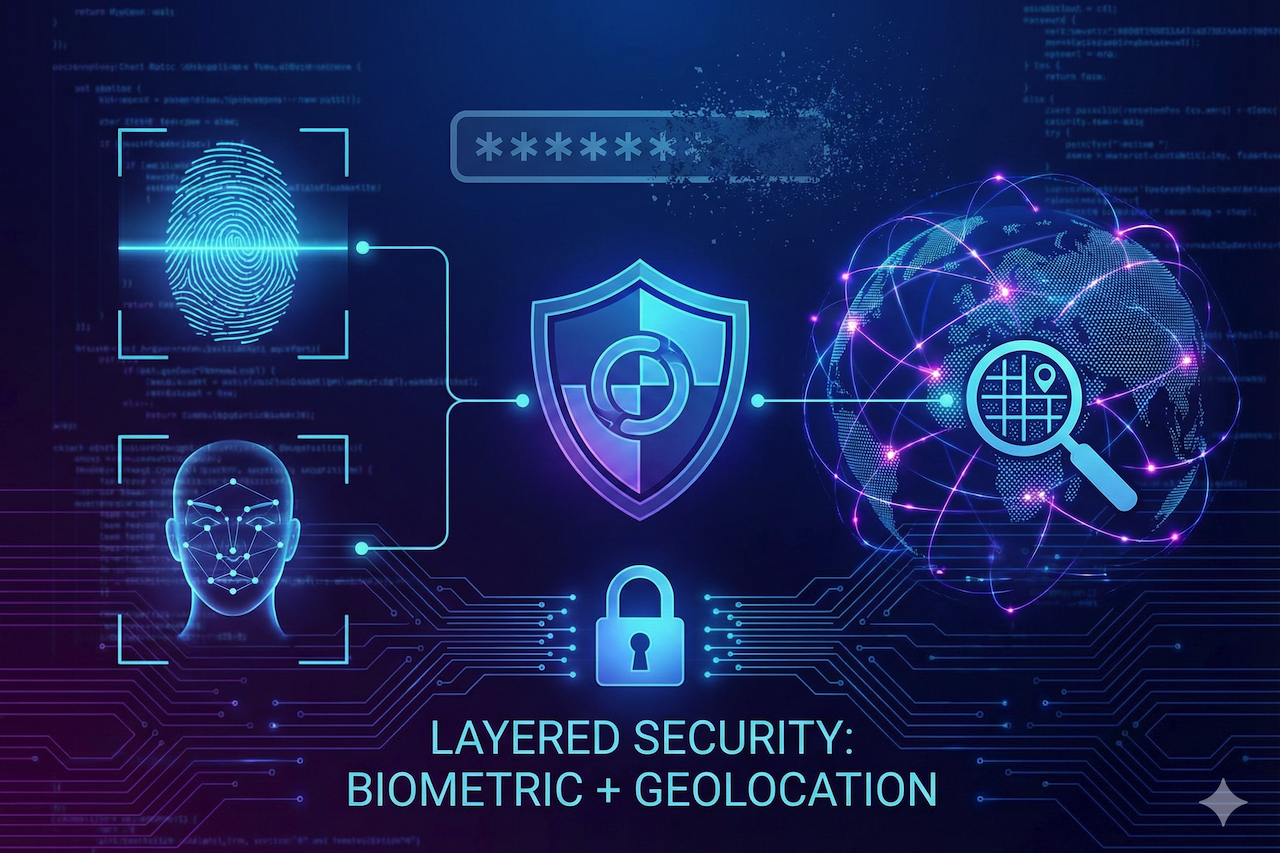
Passwords have been the cornerstone of digital security for decades. Yet in 2024 alone, over 10 billion credentials were exposed in data breaches worldwide. Credential stuffing attacks, phishing campaigns, and brute-force tools have turned passwords from a security solution into a liability. The question is no longer whether passwords are enough; it's what comes next.
The answer lies in layering multiple authentication signals. Two of the most promising, biometric verification and IP-based geolocation checks, work in fundamentally different ways, and that's exactly what makes them powerful together.
Why Passwords Keep Failing
The core problem with passwords is simple: they're something you know, and knowledge can be stolen. A phishing email tricks you into entering your password on a fake site. A data breach at one service exposes credentials you've reused elsewhere. An attacker runs a dictionary attack against a weak password and gets in within minutes.
Even "strong" passwords face structural issues. Users reuse them across services, write them down, or choose predictable patterns. Password managers help, but adoption remains low; studies estimate that only about 30% of internet users rely on one.
Multi-factor authentication (MFA) was supposed to fix this. And it helps, but traditional MFA methods like SMS codes are increasingly vulnerable to SIM swapping and real-time phishing proxies. The industry is moving toward authentication factors that are harder to intercept, harder to replicate, and harder to engineer out of someone socially.
Biometric Authentication: Verifying Who You Are
Biometric authentication identifies users by their physical characteristics - a fingerprint, a face, an iris pattern, or a voice. Unlike a password, you can't accidentally share your face with a phishing site. Unlike an SMS code, your fingerprint can't be intercepted in transit.
Facial recognition is the fastest-growing biometric modality, driven by its convenience: users look at their phone or webcam. But convenience creates a target. Attackers have developed increasingly sophisticated spoofing techniques, holding up a printed photo, replaying a video, or even wearing 3D silicone masks to fool recognition systems.
This is where liveness detection becomes critical. Liveness detection algorithms determine whether a biometric sample is from a live human rather than a presentation attack. They look for micro-movements, skin texture, depth information, and other signals that distinguish a real face from a photo, screen, or mask.
The effectiveness of liveness detection depends heavily on the data used to train these systems. Models need exposure to a wide variety of spoofing attack types, ranging from simple photo prints to high-fidelity 3D masks, across diverse demographics and lighting conditions. Without representative training data, a system might catch basic attacks but fail against more sophisticated ones.
Industry standards like iBeta Level 1 and Level 2 certifications provide benchmarks for how well a liveness detection system resists presentation attacks. Achieving these certifications signals that a system has been rigorously tested against defined attack vectors.
IP-Based Authentication: Verifying Where You Are
While biometrics answer the question "Is this the right person?", IP-based authentication answers a different one: "Is this person where we'd expect them to be?"
Every device connected to the internet has an IP address, and that address carries geolocation data typically accurate to the city level. Authentication systems can use this signal in several ways:
- Baseline comparison: If a user typically logs in from New York, a sudden login attempt from a different continent is a red flag.
- Impossible travel detection: If a user authenticated from London 30 minutes ago and now attempts to log in from Tokyo, the system can flag or block the attempt.
- Risk scoring: IP reputation databases track addresses associated with VPNs, proxies, data centers, and known malicious activity. A login from a residential IP address in the user's home city is low risk; a login from an anonymous proxy is high risk.
- Geo-fencing: Some applications restrict access to specific geographic regions, blocking any IP addresses outside the allowed zones.
IP-based checks are lightweight; they add almost no friction to the user experience. The user doesn't have to do anything; the system silently evaluates the geolocation context in the background.
The Power of Combining Both Layers
Each method alone has blind spots. Biometrics can be spoofed if liveness detection is weak. IP checks can be bypassed with VPNs or compromised devices in the "right" location. But combining them creates a system where an attacker would need to defeat both simultaneously, a dramatically harder challenge.
Consider a practical scenario: a banking application.
- A user opens the app and initiates a login.
- The system checks the device's IP address. It matches the user's typical city and comes from a residential ISP with low risk.
- The app requests a face scan. The front camera captures the user's face, and the liveness detection module confirms it's a live person, not a photo or video replay.
- Both checks pass. The user is in.
Now consider an attack scenario:
- An attacker in another country has the user's stolen credentials.
- The IP check flags the login attempt as unfamiliar geolocation, data center IP, and high risk.
- The system escalates to biometric verification.
- The attacker holds up a photo of the victim, but liveness detection catches the flat, static image and rejects the attempt.
The attacker would need to spoof their geolocation simultaneously (using a residential proxy in the victim's city) AND defeat the liveness detection system (with a high-quality 3D mask or a deepfake video). This raises the cost and complexity of an attack far beyond what most threat actors are willing to invest.
Adaptive Authentication: Making It Seamless
The real sophistication comes from making this multi-layer approach adaptive. Not every login needs the same level of scrutiny.
- Low-risk scenario: Familiar device, familiar IP, familiar time of day. The system might allow access with just a quick face scan, no extra steps.
- Medium-risk scenario: Familiar device but unfamiliar IP (user is traveling). The system requires biometric verification plus a confirmation on a trusted device.
- High-risk scenario: Unfamiliar device, unfamiliar IP, unusual time. The system requires biometric verification with enhanced liveness detection, a trusted device confirmation, and possibly a temporary cooldown period.
This risk-based approach keeps security tight without frustrating legitimate users. Most of the time, the process is invisible; the IP check happens silently, and the face scan takes 2 seconds. Friction only increases when the risk warrants it.
Challenges to Consider
No security system is without trade-offs.
- Privacy: Biometric data is highly sensitive; once compromised, you cannot change your face. Systems must securely store biometric templates (mathematical representations, not raw images), ideally on-device rather than in centralized databases. Regulations such as GDPR and BIPA impose strict requirements on the collection and storage of biometric data.
- Accuracy vs. inclusivity: Biometric systems must work reliably across diverse skin tones, ages, and lighting conditions. This requires training on diverse, representative datasets that reflect real-world populations.
- VPN and proxy usage: Legitimate users sometimes use VPNs for privacy, which can trigger false positives in IP-based checks. Smart systems address this by weighing IP signals alongside other factors rather than automatically blocking VPN usage.
- Deepfakes: AI-generated video deepfakes represent a growing challenge for liveness detection. The arms race between deepfake generators and detection systems is ongoing, making continuous model updates and high-quality, up-to-date training data essential.
Where This Is Heading
The trajectory is clear: authentication is becoming continuous, layered, and invisible.
Behavioral biometrics, analyzing typing patterns, mouse movements, and device handling, will add yet another layer that's almost impossible to replicate. Combined with facial recognition and IP geolocation, it creates a three-dimensional security profile.
Passkeys and FIDO2 standards are eliminating passwords in favor of device-bound cryptographic keys paired with biometric unlocks. Apple, Google, and Microsoft are all pushing adoption.
Zero-trust architectures treat every access request as potentially hostile, continuously evaluating trust signals, including biometric verification and network context, rather than granting blanket access after a single login.
The common thread: no single factor is trusted on its own. Security is built from multiple independent signals, each covering the others' weaknesses.
Conclusion
The era of the password as a standalone security measure is ending. Biometric authentication verifies identity with something an attacker can't easily steal or replicate. IP-based geolocation adds a contextual layer that's invisible to the user but immediately flags anomalies. Together, they form a multi-layer defense that's significantly harder to defeat than any single method.
For organizations evaluating their authentication strategy, the question isn't whether to adopt multi-layer security; it's how quickly they can move beyond passwords and into a system that treats identity verification as a continuous, multi-signal process. The tools exist. The standards are maturing. The gap is in implementation.
Featured Image generated by Google Gemini.
Share this post
Leave a comment
All comments are moderated. Spammy and bot submitted comments are deleted. Please submit the comments that are helpful to others, and we'll approve your comments. A comment that includes outbound link will only be approved if the content is relevant to the topic, and has some value to our readers.


Comments (0)
No comment