

Best IPv4 Leasing Providers in 2026: Top 7 Companies Compared

Leasing IPv4 addresses costs roughly $0.50 to $1.50 per IP per month in 2026. That's a lot cheaper than buying, which runs $40 to $60 per address on the transfer market. For most businesses, leasing is the smarter move. You skip the capital expense and keep flexibility as IPv6 adoption slowly catches up.
Below are the 7 IPv4 leasing providers worth considering this year, ranked by standalone availability, pricing transparency, IP hygiene, and platform maturity.
Top IPv4 Leasing Providers at a Glance
| Rank | Provider | Best For | Starting Price (/24) | Standalone Lease |
|---|---|---|---|---|
| 1 | ServerMania | Transparent pricing and standalone blocks | $128/mo | Yes |
| 2 | IPv4.Global | Enterprise-scale inventory | Quote only | Yes |
| 3 | IPXO | Self-serve marketplace | Market-based | Yes |
| 4 | LARUS | First-party long-term leasing | Quote only | Yes |
| 5 | Prefix Broker | RIPE region expertise | Quote only | Yes |
| 6 | IPTrading | Custom broker deals | Quote only | Yes |
| 7 | GTT | Bundled with connectivity | Quote only | Bundle-friendly |
Our pick: ServerMania is the only provider on this list with fully published pricing across every block size from /24 to /19, no server purchase required.
Why IPv4 Leasing Matters in 2026
IPv4 addresses are scarce. ARIN ran out of its free pool in 2015, and transfer market prices have climbed past $50 per address. IPv6 was supposed to solve this, but adoption has been slow, and most business-critical traffic still runs over IPv4.
Leasing bridges the gap. Instead of tying up capital by buying addresses, you rent them monthly for as long as you need. The differences between protocols, often explained in an IPv4 vs IPv6 guide, also help illustrate why IPv4 continues to dominate across most business environments.
Common use cases include VPN and proxy providers requiring clean, geo-targeted IPs, ad tech and martech companies running distributed campaigns, hosting resellers expanding customer pools, email service providers needing dedicated sender IPs, ISPs provisioning customer services, and cloud platforms scaling public-facing workloads.
How We Ranked These Providers
Every provider was evaluated against 7 criteria, reflecting broader IPv4 market considerations.
- Standalone leasing: Can you lease without buying hosting or transit?
- Pricing transparency: Are rates published or quote-only?
- IP hygiene: Are blocks pre-screened against blocklists?
- Block size range: Minimum /24, maximum /19 or larger?
- Geographic coverage: ARIN, RIPE, and APNIC availability?
- Lease term flexibility: Monthly, quarterly, and annual options?
- Setup speed: Time from signup to announceable IPs?
1. ServerMania: Best Overall
Starting price: $128/month for a /24
Standalone leasing: Yes
Setup speed: 24 to 48 hours
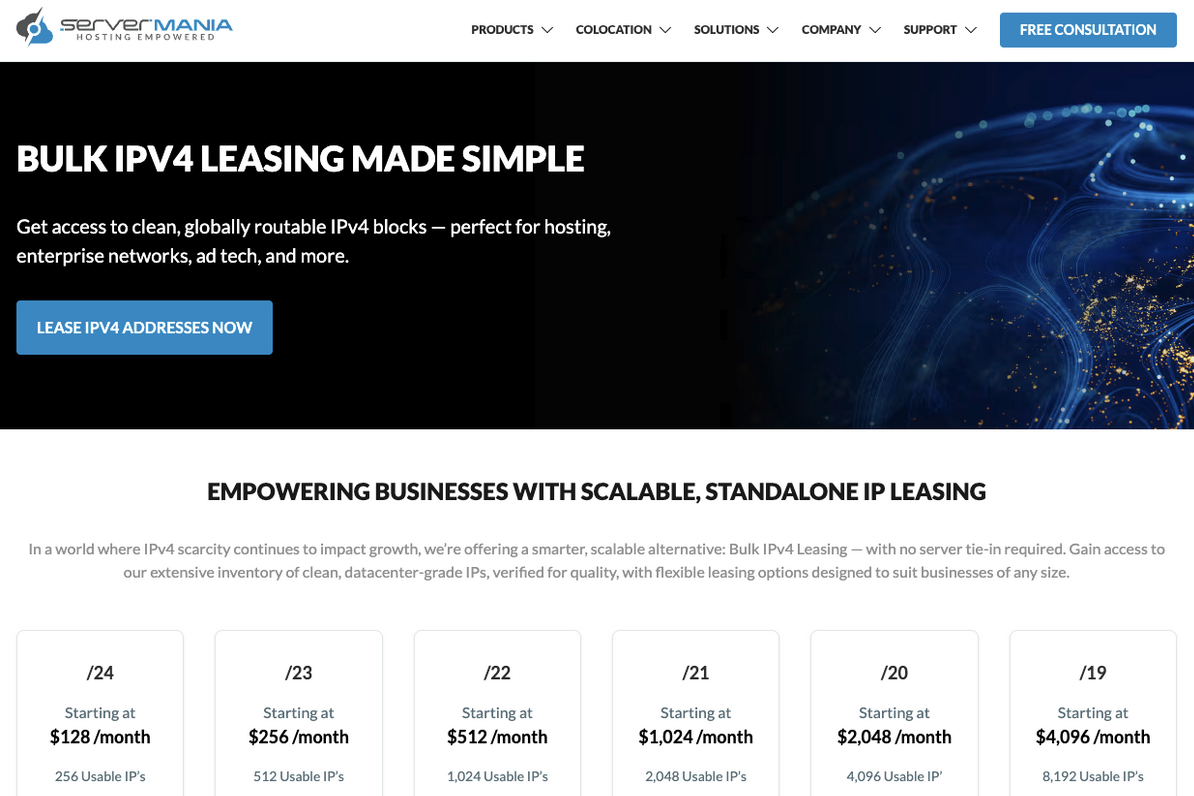
ServerMania is one of the few providers on this list that publishes pricing across multiple block sizes without requiring a sales inquiry. Many other providers rely on quote-based pricing or bundle IP addresses with hosting services, whereas ServerMania offers standalone leasing options.
Pricing
| Block Size | Usable IPs | Starting Price |
|---|---|---|
| /24 | 256 | $128/mo |
| /23 | 512 | $256/mo |
| /22 | 1,024 | $512/mo |
| /21 | 2,048 | $1,024/mo |
| /20 | 4,096 | $2,048/mo |
| /19 | 8,192 | $4,096/mo |
Longer-term commitments (quarterly and annual) further reduce the effective cost.
Key Features
- Pre-screened IPs: Blocks are checked against major blocklists before delivery.
- Standalone leasing: No server purchase required; IPs can be used with existing infrastructure.
- Global coverage: Availability across North America, Europe, and Asia with geo-targeting options.
- Flexible terms: Monthly, quarterly, and annual lease options.
- SMTP policy: Clear Port 25 disclosure to support email-related use cases.
Best For
- VPN and proxy providers
- Ad tech and martech companies
- Hosting resellers
- Internet service providers (ISPs)
- Businesses needing clean IPv4 blocks without hosting lock-in
2. IPv4.Global: Best for Enterprise Scale
Starting price: Quote only
Standalone leasing: Yes
Setup speed: 3 to 7 days
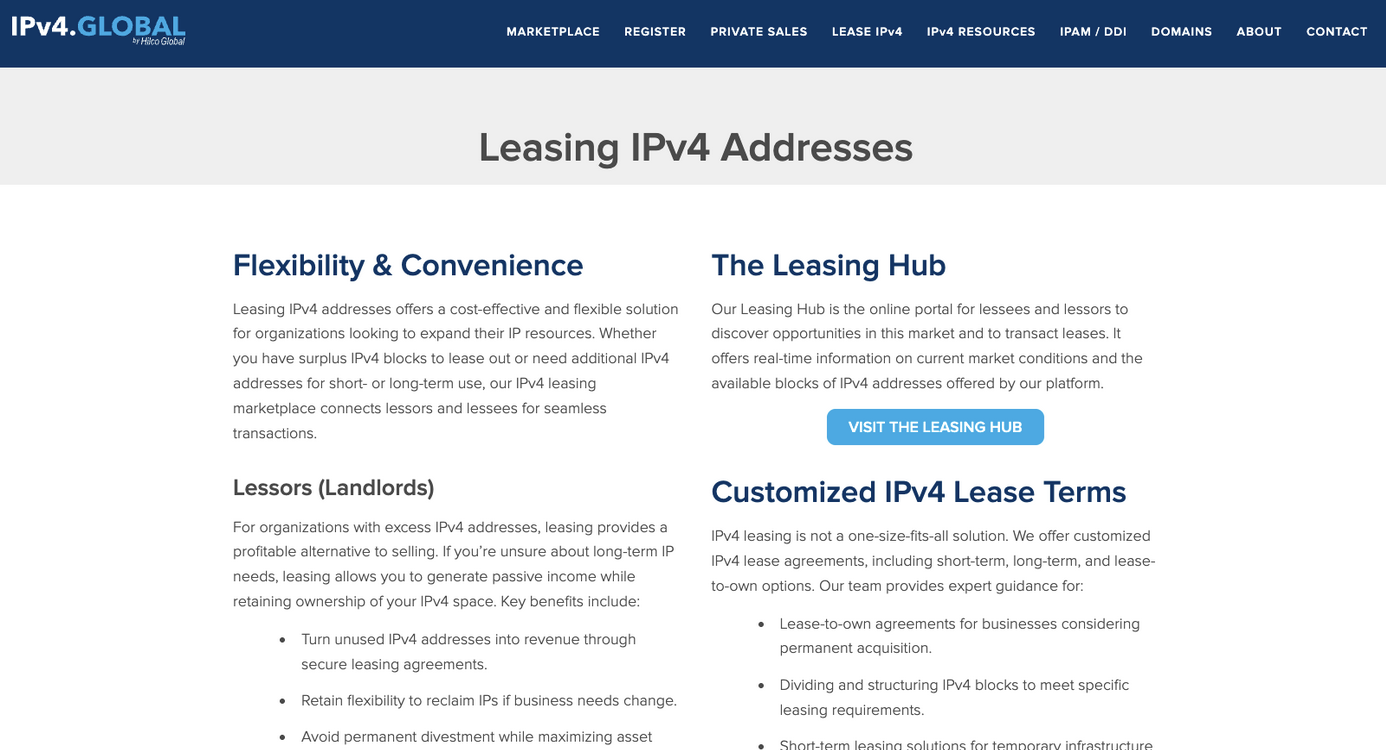
IPv4.Global, operated by publicly traded Hilco Streambank, is the largest player in the space by transaction volume. They run both a transfer marketplace and a leasing hub, and publish a widely cited IPv4 price index used as a market benchmark.
Strengths
- Deepest inventory in the industry
- Market transparency via the published price index
- Lease-to-own options for businesses planning long-term migration—escrow-backed transactions for buyer protection
Weaknesses
- Minimum commitments favor larger buyers
- Heavier onboarding process than marketplace competitors
- Pricing requires direct contact with the sales team
Best For
- Enterprise network operators
- Carriers
- Large hosting companies with high annual IP spend
3. IPXO: Best Self-Serve Marketplace
Starting price: Market-based (varies by block)
Standalone leasing: Yes
Setup speed: Under 24 hours
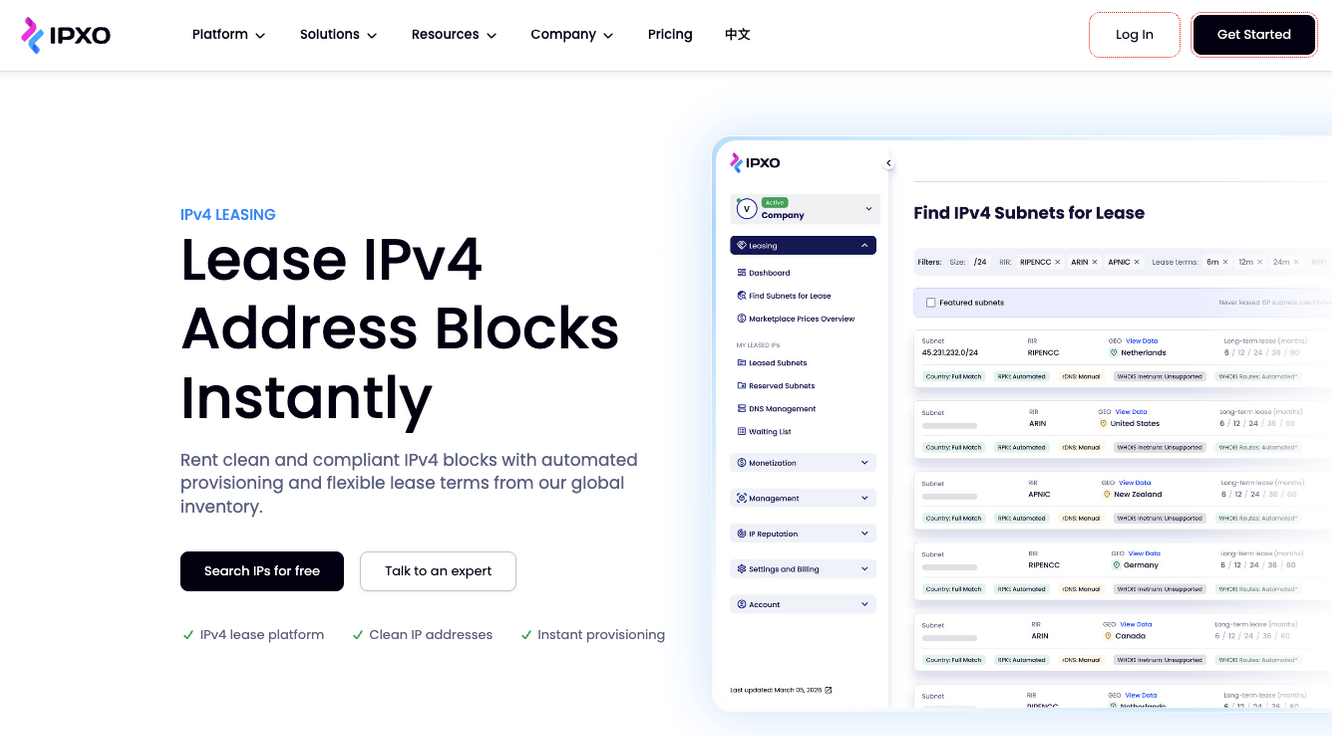
IPXO turned IP leasing into a true marketplace. You create an account, filter inventory by size, RIR, geolocation, and price, and transact directly. LOA and ROA generation, WHOIS updates, and rDNS management all happen inside the platform.
Strengths
- Instant self-serve signup and transaction
- Automated compliance handling for LOA, ROA, and WHOIS
- Filter inventory by RIR, geolocation, and price—fast deployment, usually within 48 hours
Weaknesses
- Inventory availability varies day to day
- Less suited to long-term supply guarantees
- Limited hand-holding for complex deployments
Best For
- Technical buyers with defined requirements
- Teams preferring self-serve platforms
- Users avoiding sales-driven onboarding
4. LARUS: Best for Long-Term Continuity
Starting price: Quote only
Standalone leasing: Yes
Setup speed: 3 to 5 days
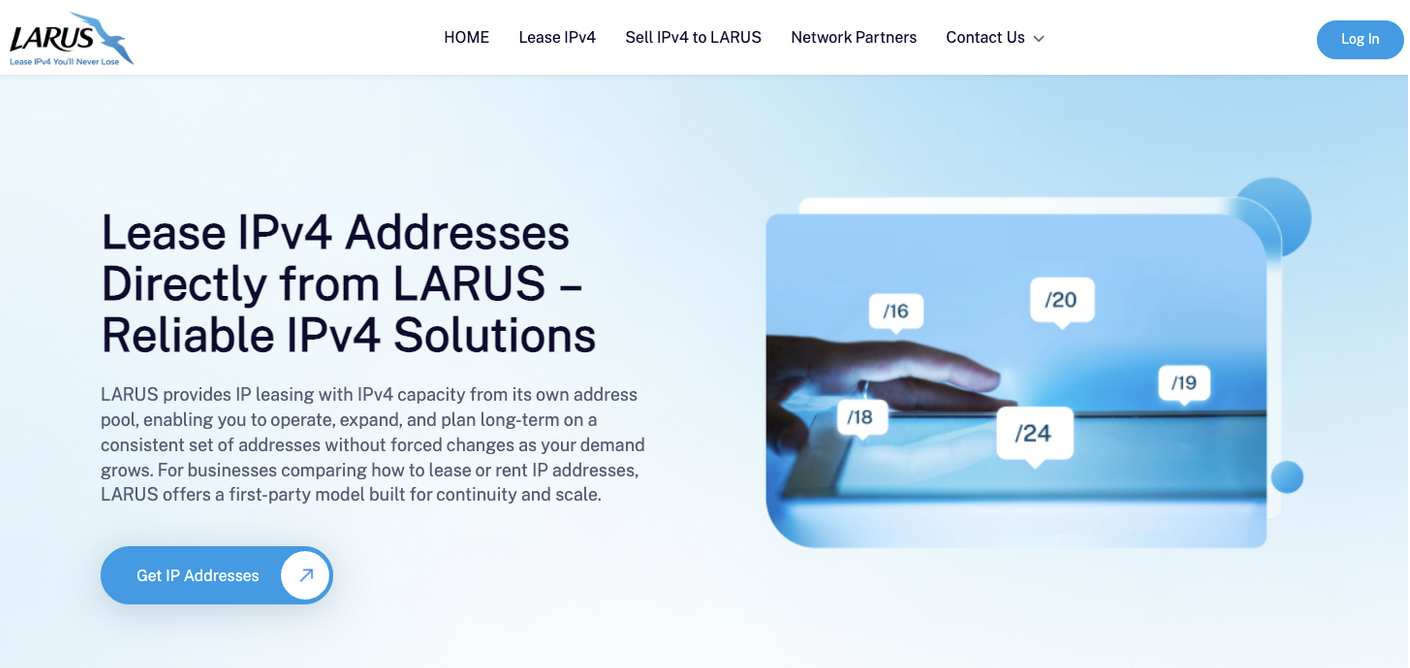
LARUS operates a first-party leasing model. They own the address pool they lease from, rather than brokering third-party IPs. This matters for multi-year deployments because third-party leases can get disrupted if the underlying holder exits the market.
Strengths
- First-party ownership eliminates middleman risk
- Stable, predictable multi-year supply
- Expansion within the same address structure, which avoids renumbering headaches later
Weaknesses
- Pricing not published publicly
- Slower onboarding than marketplace competitors
Best For
- Network operators planning multi-year deployments
- Teams prioritizing long-term continuity
- Organizations less sensitive to setup speed
5. Prefix Broker: Best for the RIPE Region
Starting price: Quote only
Standalone leasing: Yes
Setup speed: 24 hours
Prefix Broker is a European-headquartered broker with deep roots in the RIPE NCC community. They have been involved in shaping current RIR transfer policies and delivering leased blocks with a full compliance setup within 24 hours of the first payment.
Strengths
- Deep RIPE region expertise
- Full compliance handling for LOA, ROA, and database objects
- Fast 24-hour turnaround
- Strong broker relationships across the European market
Weaknesses
- European focus means less ARIN and APNIC inventory
- Broker-style model, not self-serve
Best For
- European operators
- Compliance-sensitive buyers
- Teams prioritizing broker expertise over platform automation
6. IPTrading: Best for Custom Deals
Starting price: Quote only
Standalone leasing: Yes
Setup speed: 2 to 5 days
IPTrading is one of the older names in IPv4 brokerage, leaning into relationship-driven deals. Expect personalized pricing, custom structures, and flexibility on non-standard requests, at the cost of less automation.
Strengths
- Flexible custom deal structures
- Experienced broker team
- Strong for unusual geographic or RIR mixes
Weaknesses
- No self-serve platform
- Longer transaction timelines
- Pricing opacity
Best For
- Buyers with non-standard requirements
- Organizations needing custom deal structures
- Teams considering lease-to-own options
7. GTT: Best for Existing GTT Customers
Starting price: Quote only
Standalone leasing: Bundle-friendly
Setup speed: 5 to 10 days
GTT is primarily a Tier-1 network provider; its IPv4 leasing complements its transit and connectivity services. Useful if you're consolidating vendors. Less compelling as a pure-play IPv4 option.
Strengths
- Bundled with Tier-1 connectivity
- Operational consolidation for existing GTT customers
- Strong support for carrier-grade deployments
Weaknesses
- Not competitive as a standalone leasing option
- Pricing oriented toward connectivity customers
Best For
- Existing GTT connectivity customers
- Organizations adding IPv4 to existing network services
Full Comparison Table
| Feature | ServerMania | IPv4.Global | IPXO | LARUS | Prefix Broker | IPTrading | GTT |
|---|---|---|---|---|---|---|---|
| Published pricing | Yes | Partial | Yes | No | No | No | No |
| Standalone leasing | Yes | Yes | Yes | Yes | Yes | Yes | Bundle |
| Self-serve signup | Partial | Partial | Yes | No | No | No | No |
| Pre-screened IPs | Yes | Yes | Yes | Yes | Yes | Yes | Yes |
| Min block size | /24 | Varies | Varies | Varies | /24 | Varies | Varies |
| ARIN region | Yes | Yes | Yes | Yes | Partial | Yes | Yes |
| RIPE region | Yes | Yes | Yes | Yes | Yes | Yes | Yes |
| APNIC region | Yes | Yes | Yes | Yes | Partial | Yes | Yes |
| Monthly terms | Yes | Partial | Yes | No | Yes | Partial | No |
| Setup speed | 24 to 48h | 3 to 7 days | Under 1 day | 3 to 5 days | 24h | 2 to 5 days | 5 to 10 days |
| Email/SMTP friendly | With disclosure | Yes | Partial | Partial | Yes | Yes | Yes |
How Much Does IPv4 Leasing Cost in 2026?
Market rates in 2026 generally fall in this range:
| Block Size | Typical Monthly Cost | Cost Per IP |
|---|---|---|
| /24 (256 IPs) | $128 to $384 | $0.50 to $1.50 |
| /23 (512 IPs) | $256 to $768 | $0.50 to $1.50 |
| /22 (1,024 IPs) | $512 to $1,536 | $0.50 to $1.50 |
| /21 (2,048 IPs) | $1,024 to $3,072 | $0.50 to $1.50 |
| /20 (4,096 IPs) | $2,048 to $6,144 | $0.50 to $1.50 |
| /19 (8,192 IPs) | $4,096 to $12,288 | $0.50 to $1.50 |
A few factors push prices up or down. RIPE blocks often carry a premium over ARIN. Location-specific IP allocations may carry a premium compared to non-targeted inventory.
Bottom Line
IPv4 leasing has matured into a legitimate infrastructure category in 2026, with meaningful differentiation between providers.
For most businesses, ServerMania is one of the strongest picks thanks to transparent pricing, standalone blocks, and clean IPs. Enterprise-scale operators should look at IPv4.Global for inventory depth and market data. Self-serve technical buyers will prefer IPXO's marketplace automation. LARUS is the right call for multi-year commitments where continuity matters. Prefix Broker may be relevant for organizations operating within the RIPE region.
Whatever you choose, IPv4 leasing is a bridge, not a destination. Lease what you need today, and start planning your IPv6 readiness in parallel.
 FAQs
FAQs
A /24 block (256 addresses) typically costs between $128 and $384 per month in 2026, working out to $0.50 to $1.50 per IP. ServerMania offers /24 leases starting at $128/month, which is among the lowest published rates in the market.
Yes. Several providers offer standalone IPv4 leasing with no server purchase required, including ServerMania, IPv4.Global, IPXO, and LARUS. Standalone leasing is useful when you already have infrastructure and need address space, or when you want flexibility to use leased IPs across multiple providers.
Setup times vary by provider. Marketplaces like IPXO can deliver in under 24 hours. Direct providers like ServerMania and Prefix Broker typically take 24 to 48 hours. Traditional brokers like IPv4.Global, LARUS, and IPTrading run 3 to 7 days. Connectivity-bundled providers like GTT can take 5 to 10 days.
Buying makes you the registered holder. The block becomes an asset on your balance sheet and can be resold later. Leasing gives you usage rights for the duration of the contract term, while the original holder retains ownership. Leasing converts capital expenses into operating expenses, which is more attractive for businesses with uncertain long-term IPv4 needs or those planning an eventual IPv6 migration.
Reputable providers pre-screen blocks against major blocklists (Spamhaus, SORBS, Barracuda) before delivery. That said, always verify IP reputation yourself using tools like MXToolbox, Spamhaus lookup, or Talos Intelligence before deployment.
Sometimes, but with strict conditions. Most providers require upfront disclosure of Port 25 SMTP activity and reserve the right to terminate service in response to spam complaints. If email deliverability is your primary use case, work with a provider that explicitly supports it and offers IPs with a clean mail reputation.
A /24 provides 256 IP addresses, which is the smallest block you can announce via BGP. That suits small hosting operations and single-project deployments. A /23 to /22 (512 to 1,024 IPs) works for mid-size hosting companies and growing VPN services. A /21 to /20 (2,048 to 4,096 IPs) fits larger hosting providers and established proxy networks. A /19 or larger is typically what ISPs, major cloud platforms, and large ad tech operations need.
You need the ability to announce the block via BGP on your network, either directly or through your upstream provider. If you don't have this capability, look for providers that can assist with technical setup or consider bundled hosting options.
Related Articles

June 30, 2026
Why IP Geolocation Is Often Wrong (and How Leased IPv4 Changes It)
Run your own address through an IP lookup tool and there’s a fair chance the result is off — sometimes by a city, sometimes by a country, occasionally by a continent. This isn’t a...
Read More
October 10, 2010
Find IP addresses of a private network
You have a private or public network with servers and workstations that are assigned static and dynamic IP addresses (either private or public IPs). You assigned them the static IP...
Read More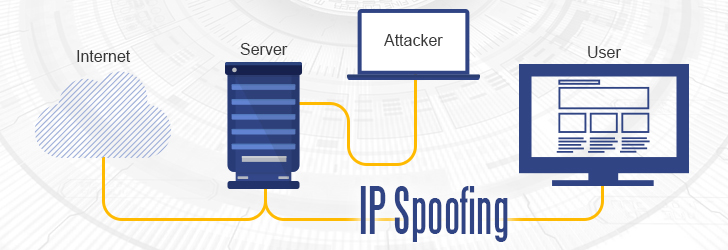
January 3, 2008
What is IP Spoofing and how to avoid it?
IP Spoofing is a technique used to gain unauthorized access to machines, whereby an attacker illicitly impersonates another machine by manipulating IP packets. IP Spoofing involves...
Read More
Comments
Comments are available to signed-in users and are moderated to keep the discussion useful and respectful. Spam, automated submissions, and low-value promotional comments are removed. Outbound links may be approved when they are relevant and genuinely helpful to readers, but they are displayed as plain text rather than clickable hyperlinks.
No comments have been published yet.
Please sign in to submit a comment.