

The global pool of IPv4 addresses has been officially exhausted for over a decade. Since IANA distributed its last free blocks in 2011, businesses have been forced to turn to the secondary market to acquire the IP addresses they need. And in 2026, with AI infrastructure, cloud expansion, and broadband initiatives like BEAD funding driving demand higher than ever, choosing the right IPv4 broker has never been more important.
But not all brokers are created equal. The wrong choice can lead to blocked IP addresses, failed transfers, compliance headaches, and thousands of dollars wasted. This guide ranks the best IPv4 brokers operating across ARIN, RIPE, and APNIC to help you make a secure and informed purchase.
Why Choosing the Right IPv4 Broker Matters
Buying IPv4 addresses is not like purchasing a typical digital asset. Every transfer must comply with the policies of the relevant Regional Internet Registry (RIR), whether that is ARIN in North America, RIPE NCC in Europe, or APNIC in the Asia-Pacific region. A qualified broker handles the entire process, from pre-approval and seller verification to contract management and WHOIS updates.
Perhaps the biggest risk buyers face is acquiring IP addresses with a poor reputation. Industry estimates suggest that 50 to 60 percent of IP addresses appear on at least one global blocklist. A blocked subnet can cripple email deliverability, hurt online performance, and damage your brand. That is why working with a broker who provides thorough blocklist screening and IP cleaning is essential.
If you are new to the concept of IP addresses and how they work, understanding the fundamentals can help you make smarter decisions when entering the IPv4 market.
The Best IPv4 Brokers in 2026
1. IPv4 Connect — Best Overall for Secure IPv4 Transfers
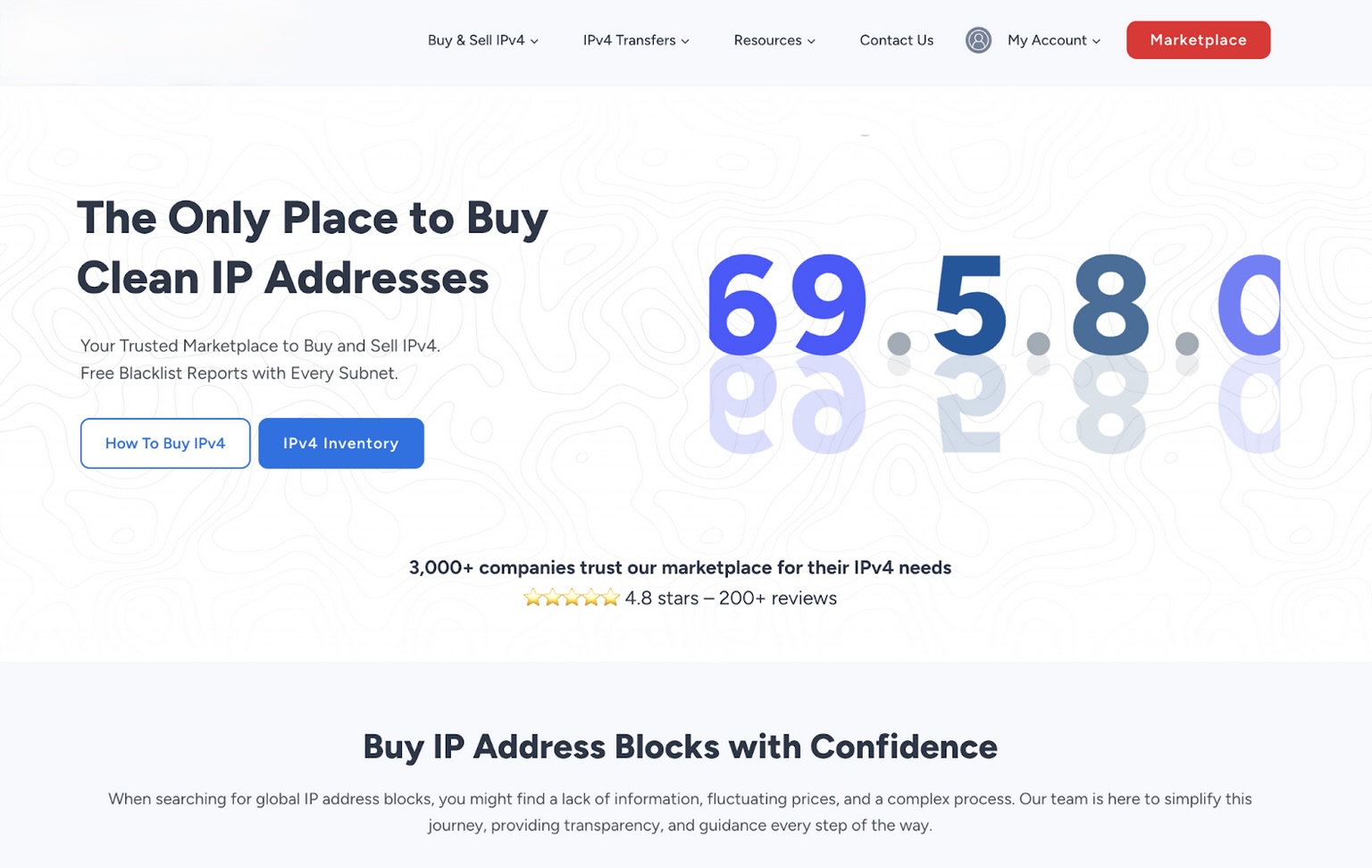
IPv4 Connect stands out as the leading marketplace for buying and selling IPv4 address blocks in 2026. Backed by nearly two decades of expertise in global IPv4 and IPv6 connectivity solutions, the platform is trusted by thousands of clients across 60+ countries. It has built a strong reputation for transparency and reliability.
What sets IPv4 Connect apart is its commitment to IP integrity. Every subnet listed on the platform is screened against 100+ global IP blocklists using proprietary in-house software. The team meticulously cleans each IP block, removing old BGP announcements, stale route records, and outdated DNS entries before any transfer. They also offer geo-location support to help buyers ensure their IP blocks are accurately mapped to the correct region, which is critical for content delivery, ad targeting, and regulatory compliance.
IPv4 Connect operates as an official IPv4 facilitator across ARIN, RIPE, APNIC, and LACNIC regions. The platform publishes fixed prices on its e-commerce marketplace, eliminating the guesswork of auction-based models. It also offers a fully managed transfer process that typically completes in two to three weeks, including pre-approval assistance, contract management, and direct coordination with internet registries. With 50 to 80 transfers completed every month and a team that regularly works alongside RIR policy makers, IPv4 Connect delivers a level of hands-on support that few competitors can match. The platform even provides email alerts when matching inventory becomes available, keeping buyers informed without the need to check listings constantly.
2. IPTrading — Best for Experience and Policy Expertise
IPTrading brings over 30 years of experience to the IPv4 market, with founders whose involvement in internet infrastructure dates back to the ARPANET era in the late 1970s. The company has earned a reputation for low commission rates, which it attributes to the steady flow of both buyers and sellers seeking its services.
As an ARIN Qualified Facilitator since 2011, IPTrading has deep expertise in navigating complex transfer policies across all major registries. The team has brokered over 1,000 private IPv4 transfers with organizations in more than 75 countries. They also played an active role in shaping transfer policy, having authored the ARIN interregional transfer policy and brokered the world's first interregional IPv4 transfer in 2012.
3. IPv4 Market Group — Best for Structured, High-Value Transactions
IPv4 Market Group has been in business since 2011 and has completed over 760 transactions, moving more than 42.5 million IP addresses valued at over $600 million USD. The company's president led the first major commercial IPv4 transfer while serving as a director at Nortel, when Microsoft acquired 666,624 IPv4 addresses for $7.5 million, a landmark deal for the industry.
The company provides standardized processes, asset purchase agreement templates, and fiduciary escrow services. For organizations handling large or complex transactions, their structured approach and deep market data can help reduce risk and streamline negotiations.
4. Prefix Broker — Best for Fast, Auction-Free Purchases
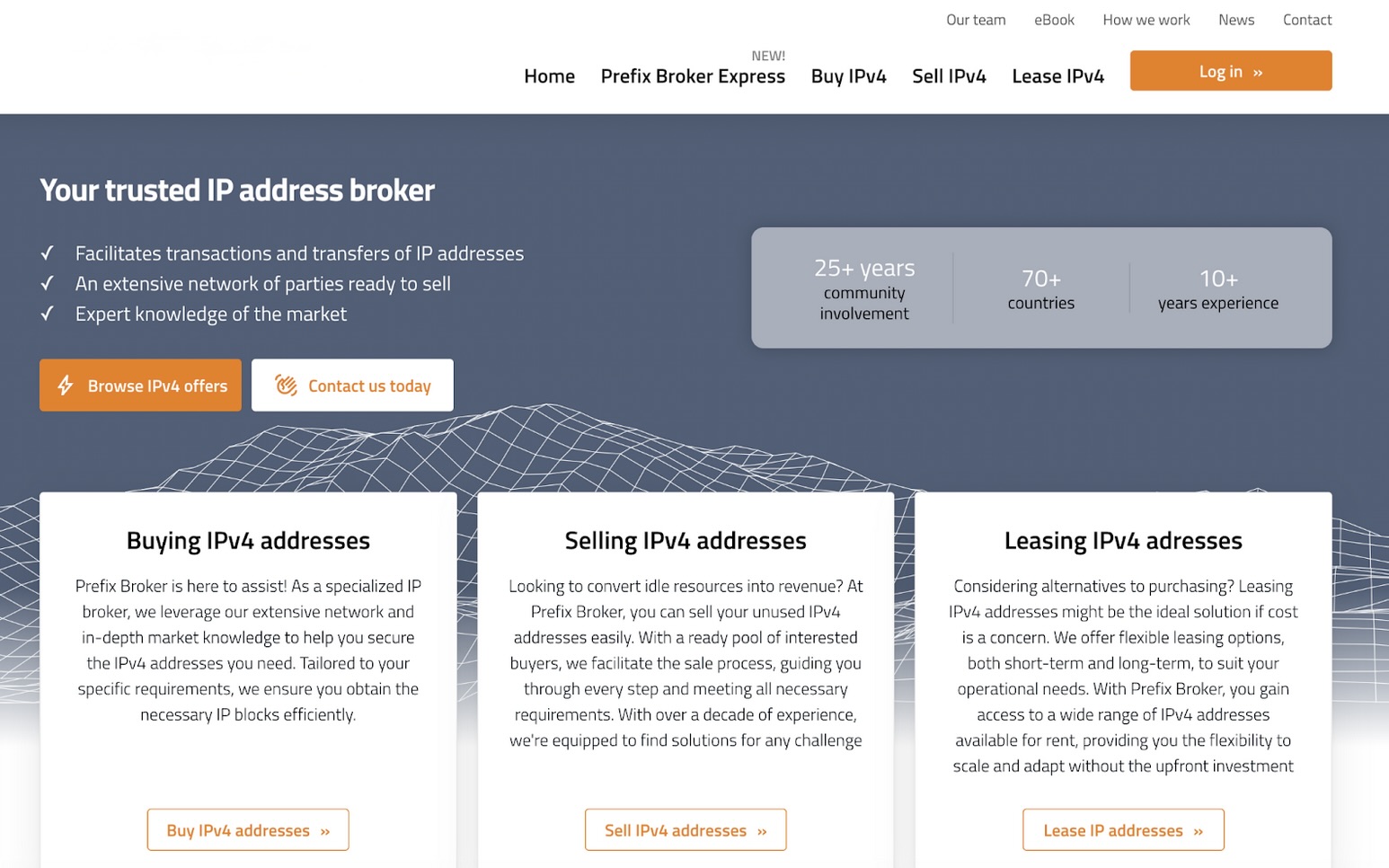
Prefix Broker offers a streamlined, auction-free platform for buying IPv4 addresses, with deep expertise in the RIPE region and additional coverage in ARIN and APNIC. Prices are listed transparently in EUR, and the platform is designed for speed. Buyers can register, select a block, and complete their purchase quickly without waiting for bids to close.
The company conducts rigorous seller vetting and compliance checks, and aims to have new IPv4 addresses operational within 24 hours of payment. Prefix Broker is a solid choice for organizations that need addresses fast and prefer a straightforward buying experience.
5. IPXO — Best for IPv4 Leasing
IPXO takes a different approach by focusing primarily on IPv4 leasing rather than outright sales. The platform manages over 6 million IPv4 addresses and automatically handles approximately 97 percent of incidents.
For businesses that need temporary IPv4 space or want to avoid the capital expense of purchasing, IPXO offers leasing rates averaging around $0.40 per IP per month. They operate across all major RIR regions and provide a live market stats dashboard for real-time pricing transparency.
6. Connexly — Best for Enterprise-Grade Transfers
Connexly is a Silicon Valley-based IPv4 broker with over 2 decades of experience in networking. The company is an ARIN-qualified facilitator and serves a broad range of global enterprises across the technology, financial, legal, healthcare, education, and government sectors.
Their focus on clean IPv4 allocations across ARIN, RIPE, and APNIC, combined with their deep enterprise expertise, makes them a strong option for organizations that require a high level of compliance and technical support during the transfer process.
What to Look for in an IPv4 Broker
When evaluating IPv4 brokers, keep these key factors in mind.
- Registry qualifications: This should be a top priority when selecting an IPv4 broker. Look for brokers who are ARIN Qualified Facilitators or registered with APNIC. This certification signals that the broker has met strict requirements and understands the nuances of each registry’s transfer policies.
- Blocklist screening: This is non-negotiable. Any reputable broker should scan IP blocks against multiple blocklists before listing them for sale. Buying a “dirty” subnet is one of the most expensive mistakes a company can make.
- Transparent pricing: This saves time and reduces risk. Brokers who publish their prices openly allow you to compare options and budget effectively, rather than entering blind negotiations or unpredictable auctions.
- Transfer support: This matters more than most buyers realize. The process of transferring IPv4 addresses between organizations involves documentation, registry approvals, and technical cleanup. A broker who manages this end-to-end can save weeks of back-and-forth with the RIR.
Understanding IPv4 Pricing in 2026
The IPv4 market has shifted significantly over the past two years. Purchase prices currently range from approximately $15 to $52 per address, depending on block size and region. Smaller blocks, such as /24 subnets, tend to command a premium due to higher demand from small and mid-sized businesses, while larger blocks have experienced price corrections as additional supply has entered the market.
For organizations that do not need permanent ownership, leasing remains a viable alternative, with monthly rates hovering around $0.38 to $0.45 per IP across most regions. The APNIC region tends to be more expensive, with rates sometimes exceeding $0.60 per IP due to tighter supply conditions.
Demand drivers in 2026 include AI data center expansion, broadband deployment under the BEAD program, and the continued reliance on IPv4 for legacy system compatibility. While IPv6 adoption is growing, most networks still require dual-stack connectivity, meaning IPv4 will remain essential for years to come.
Final Thoughts
The IPv4 market is maturing, but the stakes remain high. Buying IP addresses from an unqualified source can lead to compliance failures, blocked subnets, and wasted capital. By choosing a trusted broker with proven registry experience, rigorous IP screening, and a fully managed transfer process, you protect your investment and your network.
Among the brokers evaluated, several providers stood out for offering transparent pricing, comprehensive blocklist screening, geolocation support, and global coverage across ARIN, RIPE, and APNIC regions. Organizations such as ISPs and enterprises expanding their infrastructure or scaling cloud operations should focus on working with qualified brokers that demonstrate strong compliance, operational experience, and reliable transfer support. Starting with a reputable and experienced facilitator can help reduce risk and streamline the acquisition process in 2026.
Featured Image generated by Google Gemini.
Share this post
Author

Leave a comment
All comments are moderated. Spammy and bot submitted comments are deleted. Please submit the comments that are helpful to others, and we'll approve your comments. A comment that includes outbound link will only be approved if the content is relevant to the topic, and has some value to our readers.
 DNS Lookup
 Search a Person
 Inspect suspicious links
 Data Breach Check





Comments (0)
No comment