

Warm-Up Email Strategies to Avoid IP Blacklisting and Improve Domain Reputation
It goes without saying that emails are a primary tool for communication, marketing, and outreach in the business world. However, sending large volumes of email comes with its own set of challenges.
For starters, one of the most significant hurdles email marketers face is deliverability, which determines whether emails land in the inbox instead of the dreaded spam folder.
A key factor in achieving high deliverability is managing IP reputation. When a sender uses an IP address with a poor sending reputation, there is a risk of being blocked or blacklisted by major email service providers (ESPs). This makes it harder for your emails to reach recipients.
But fortunately, there’s a solution: ip warmup.
What Is IP Warmup?
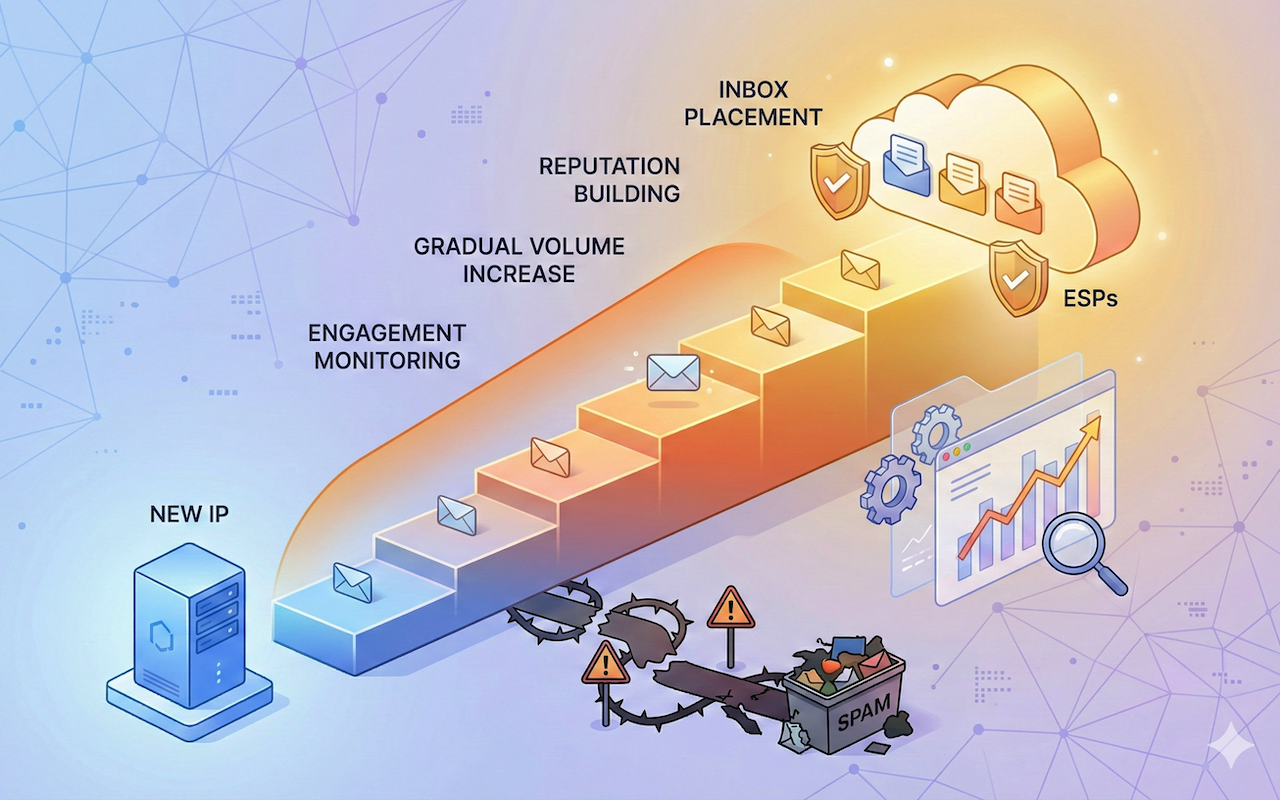
IP warmup is the process of gradually increasing the number of emails sent from a new or dormant IP address. It’s important to do this gradually to build a reputation with email service providers like Gmail, Outlook, and Yahoo, among others.
When emails are sent, these ESPs look at your sender reputation to decide whether your emails should be allowed to land in the inbox or if they should be sent back or marked as spam.
Sending too many emails too quickly from a new IP address can raise red flags with ESPs, resulting in your IP being flagged or blacklisted. To avoid this, it’s essential to implement an email warmup process.
Why IP Warmup Matters for Deliverability
A new or inactive IP doesn’t have an existing sender history to evaluate. It lacks the trust needed for successful delivery. ESPs don’t know whether your emails will be spam or legitimate, so they err on the side of caution.
Without proper IP warmup, your email campaigns can quickly be rerouted to the spam folder. Senders can soon be blacklisted. When these scenarios happen, your sender reputation goes down, which can cause the following issues:
- Poor inbox placement: ESPs may start rerouting your succeeding emails to the spam folder instead of the inbox. This reduces the visibility and effectiveness of your campaigns.
- Increased bounce rates: As your reputation continues to suffer, more emails will bounce back. This leads to wasted resources and lower engagement.
- Blacklisted domains and email addresses: A poor sender reputation can lead to your domain being blacklisted. Once your domain is blacklisted, it’s even harder to send emails and get your messages across.
A Step-By-Step Approach to Warm Up an IP Effectively
Effective IP warmup isn’t about sending thousands of emails overnight; it's about gradually building your reputation through careful, strategic sending. Here’s a step-by-step guide to warming up your IP the right way:
1. Start Slow and Gradual
When starting from scratch, it’s important not to rush the process. Begin by sending a small number of emails each day (e.g., 10–50) and gradually increase the volume over a few weeks. The goal is to avoid triggering spam filters, which can happen when too many emails are sent too quickly.
2. Focus on High-Quality Lists
The quality of your email list matters as much as volume. Send emails to engaged recipients who are likely to open and interact with your content. Strong engagement signals (such as opens and clicks) help build a positive reputation with email service providers (ESPs).
3. Monitor Your Reputation and Engagement
As you ramp up sending volume, track sender reputation and email performance. Monitor key metrics such as:
- Bounce rates: High bounce rates are a red flag for ESPs and often indicate invalid or outdated contacts.
- Spam complaints: A high number of complaints suggests messages are not relevant or expected, which can reduce inbox placement.
- Open and click-through rates: Strong engagement indicates your emails are relevant and welcomed by recipients.
4. Avoid Spamming Your Recipients
The purpose of IP warmup is to build trust with both ESPs and recipients, not to overwhelm inboxes. Keep messages relevant and useful, and avoid unnecessary frequency. Personalization and clear value can help maintain healthy engagement.
5. Gradually Increase Sending Volume
Increase volume in measured steps while monitoring performance. As your IP builds trust, you can send larger batches. If bounce rates rise or engagement drops, reduce volume and address underlying issues before scaling again.
Protect Your IP and Improve Your Domain Reputation to Get Your Message Across
IP warmup is one component of a broader deliverability strategy. Sustainable results depend on:
- Clean and permission-based mailing lists
- Consistent sending schedules
- Clear identification and authentication (SPF, DKIM, DMARC)
- Ongoing monitoring of engagement and complaints
Whether warmup is managed manually or supported by automation, the underlying principle remains the same: reputation is built through predictable, responsible behavior over time. Some organizations choose to support this process with dedicated email warmup tools, such as Warmy.io, to help manage volume ramp-up, simulate engagement, and monitor, while others prefer manual control.
Final Thoughts
IP warmup is not a technical shortcut or a one-time task. It is a risk-management practice designed to align sending behavior with how mailbox providers evaluate trust.
Organizations that approach warmup deliberately tend to experience fewer delivery disruptions, more stable inbox placement, and stronger long-term sender reputation. In high-volume email environments, patience and consistency often deliver better results than aggressive scaling.
Featured Image generated by Google Gemini.
Related Articles

March 19, 2025
How Email Marketers Can Use IP Data to Improve Deliverability and Security
Email marketing success depends on multiple factors, and IP reputation plays a crucial role in ensuring messages reach inboxes instead of spam folders. Marketers who understand how...
Read More
June 21, 2024
How to Create Free Business Email with Domain: 6 Easy Methods
In the modern business landscape, having a professional email address is essential. It not only enhances your credibility but also fosters trust with clients and partners. While ma...
Read More
May 14, 2024
Mastering Email Tracking: Insights and Strategies for Effective Communication
Email tracking is not just a technical capability; it's a strategic asset in the modern marketer's toolkit. Whether you're a freelancer managing personal outreach or a large corpor...
Read More
Comments
Comments are available to signed-in users and are moderated to keep the discussion useful and respectful. Spam, automated submissions, and low-value promotional comments are removed. Outbound links may be approved when they are relevant and genuinely helpful to readers, but they are displayed as plain text rather than clickable hyperlinks.
No comments have been published yet.
Please sign in to submit a comment.