
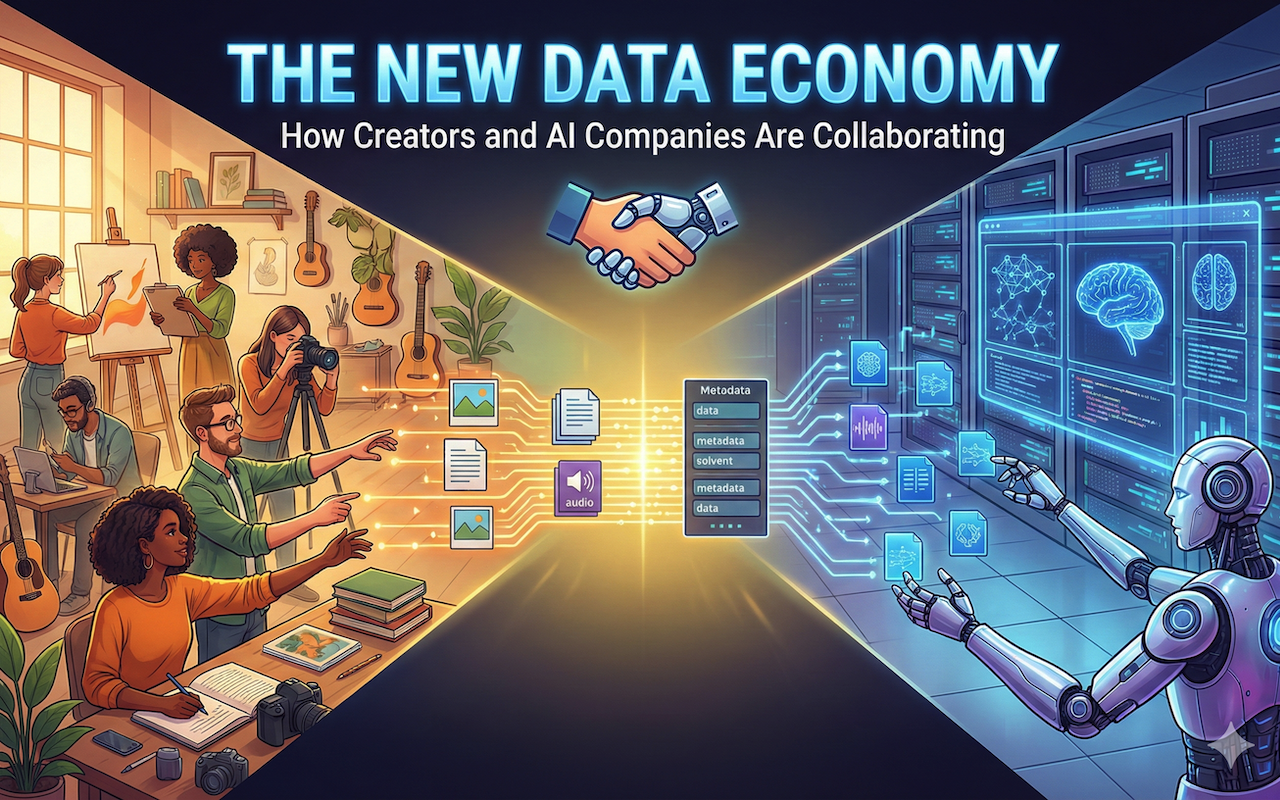
For the last three years, the generative AI boom has felt like a smash-and-grab. Large language models vacuumed up the open internet without asking permission. But the dust is settling, and we are witnessing the end of the wild west of scraping the web.
On top of that, models trained on their own synthetic output eventually collapse. They start hallucinating, forgetting, and degrading. To keep AI sharp, tech giants need a steady IV drip of something they can’t generate themselves. That’s authentic, sometimes messy, but ultimately human-created data.
The Pivot: Quality Over Quantity
In the early days (circa 2022), the goal was volume. Now, the goal is provenance. An image generator trained on random, low-res JPEGs scraped from social media will never compete with a model trained on legally cleared, metadata-rich photography.
For AI companies, the human-in-the-loop strategy is no longer just a PR buzzword. We’re seeing a real pivot toward ethical data licensing from platforms that verify ownership and package content for AI training.
The Creator’s Leverage
If you are a creator, start looking at your leverage. Your eye, that specific, subjective taste you’ve honed over the years, is now a scarce asset class.
AI can mimic style, but it struggles with intent. It doesn't know why a shadow falls across a face in a way that evokes melancholy; it just predicts pixel distribution. That gap is your value.
1. New Rules
The new economy operates on specific technical briefs. AI developers may require hundreds of images of hands holding transparent glass in direct sunlight to train a model to understand light refraction.
This is how freelance photography can evolve. Value now comes from the ability to follow detailed data briefs, ensuring diversity in lighting, angles, and subjects so the model learns the underlying concept.
2. New Roles
The fear that AI will replace jobs is real, but the more immediate reality is that roles are changing. The market increasingly needs operators who understand concepts such as semantic segmentation and style consistency.
Freelance digital artist work is shifting as well. Tasks may involve creating large sets of controlled variations, such as multiple versions of the same subject in a defined vector style, to help fine-tune a model’s visual consistency, an area where AI still struggles on its own.
3. Legal Literacy
It is important to understand which platforms claim ownership of creative styles and which ones protect them. The World Intellectual Property Organization (WIPO) is currently examining these frameworks, but until international standards are established, carefully reviewing terms and conditions remains a creator’s best safeguard.
The Intermediary Solution
OpenAI doesn't want to negotiate with ten million individual painters, and a freelance illustrator doesn't have the time to audit Google's training sets.
This is where we are seeing the rise of aggregator platforms that handle legal clearance and distribution for AI training projects. These platforms take engineers' technical needs, such as the need for a dataset with distinct variance, and turn them into creative briefs for digital artists.
The Verdict
We are building a system where human creativity is the premium fuel that powers the machine. AI companies get the high-fidelity, bespoke data they need to stop their models from collapsing, and creators get paid for high-skilled technical work.
 FAQs
FAQs
Stock photography focuses on aesthetics and commercial appeal, while AI training missions emphasize variance and metadata. A typical AI brief may require the same object to be photographed from multiple angles, under different lighting conditions, and across several backgrounds.
This is a common concern, but the current data economy distinguishes between style training and concept training. Most paid AI training projects focus on concept training, such as teaching a model to recognize specific objects.
Style training, which teaches an AI to mimic a creator’s unique aesthetic, is treated as a separate legal category. Ethical platforms increasingly offer explicit opt-ins or style protection mechanisms to ensure creators are compensated when their style is used.
Compensation is shifting from per-image pricing to per-mission or per-asset-class models. While a single generic image may have limited value, a complete, verified dataset can command significantly higher rates, especially when proper releases and metadata are included.
In most cases, yes. Unlike traditional commercial photography, which often requires exclusivity, AI data licensing is typically non-exclusive. This allows creators to license the same dataset to multiple AI platforms or labs, provided the terms permit it.
Featured Image generated by Google Gemini.
Share this post
Leave a comment
All comments are moderated. Spammy and bot submitted comments are deleted. Please submit the comments that are helpful to others, and we'll approve your comments. A comment that includes outbound link will only be approved if the content is relevant to the topic, and has some value to our readers.
Comments (0)
No comment