
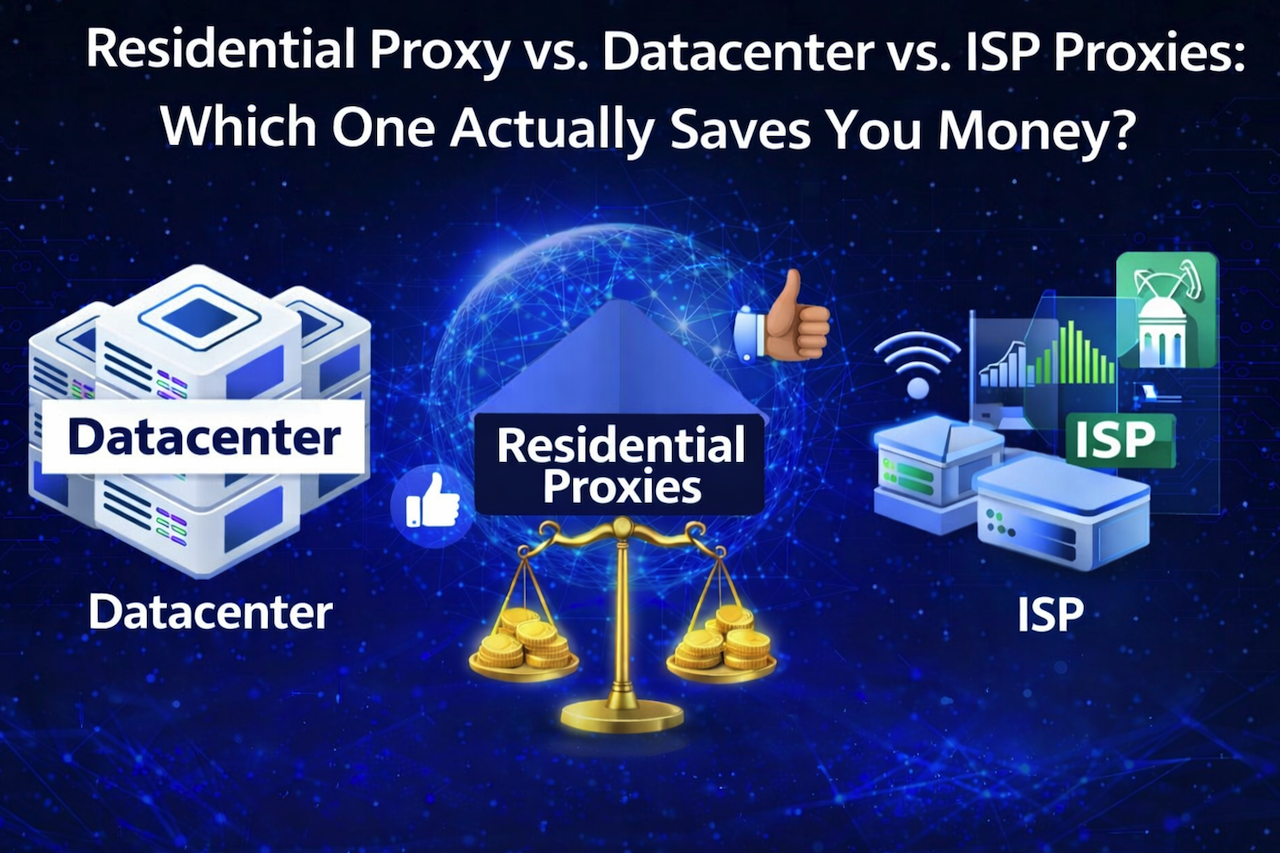
Non-technical users often struggle to distinguish between residential, datacenter, and ISP proxies. While they all serve a similar purpose, the way they operate differs significantly.
Not understanding the advantages and disadvantages of each option can cost businesses far more than necessary or leave them stuck with a poor solution they don’t realize is ineffective until it’s too late.
Note that choosing the lowest-cost option right away does not guarantee savings in the long run. What seems "cheap" at first can end up being far more expensive later. In this article, we’ll clear up some confusion about the three types of proxies and explain when to use each one to help you determine which option may be the most cost-effective for your business.
What Are Datacenter, Residential, and ISP Proxies — and How Are They Actually Different?
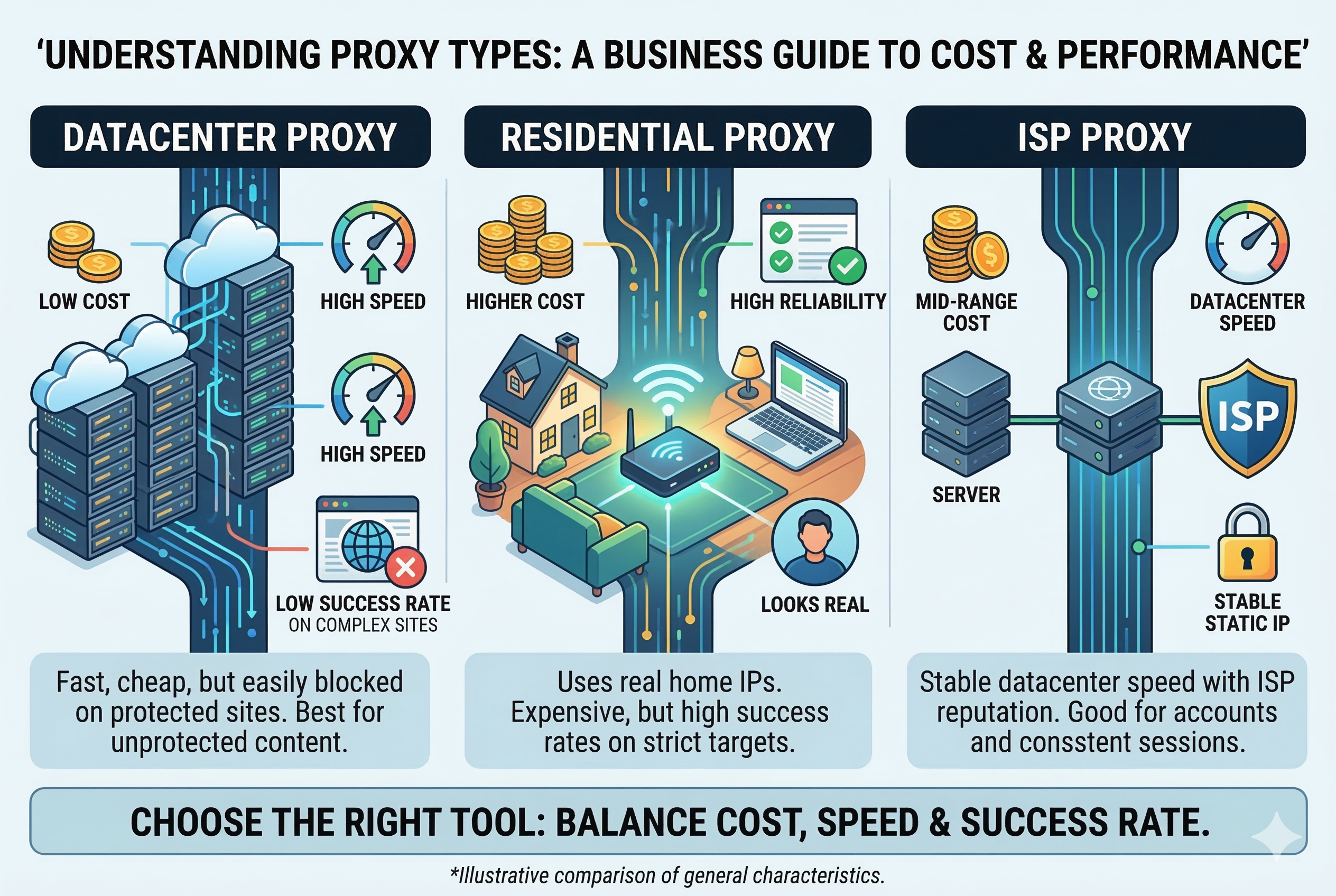
Image generated by Google Gemini.
At the simplest level, a proxy replaces your real IP address with another one so websites see that identity instead of yours.
The difference between proxy types comes down to how believable that identity is and how websites treat it over time.
Datacenter proxies use IPs generated by cloud servers. Residential proxies route traffic through IPs assigned by real internet service providers to household connections. ISP proxies also carry ISP registrations but behave very differently once you begin making repeated requests.
From a cost standpoint, what matters isn’t where the IP claims to be from, but how long it remains usable before blocks, CAPTCHAs, or bans begin piling up.
How Do Datacenter Proxies Work and When Are They the Most Cost-Effective Option?
Datacenter proxies are sourced from cloud hosting providers and server farms. They are easy to deploy, extremely fast, and widely available.
Pricing is where they look most attractive. Typical costs range from:
- $0.10–$0.50 per IP, or
- $0.50–$1 per GB for bandwidth-based plans
Speed is rarely an issue. On unprotected websites, success rates can exceed 95%. But once bot detection is involved, that number drops quickly. On modern protected sites, datacenter proxies often see success rates between 20–60%, depending on how aggressive the defenses are.
They save money when:
- The site doesn’t actively block automation
- You’re running proof-of-concept tests
- Occasional failures don’t break workflows
They stop being “cheap” the moment retries, IP replacements, or manual fixes become routine.
What Makes a Residential Proxy More Expensive — and Why It Can Be Worth the Cost?
A residential proxy uses IPs assigned by real ISPs to actual homes. To a website, this looks like a normal person browsing from their living room.
That realism is why residential proxy traffic costs more. You’re not paying for server infrastructure; you’re paying for legitimacy at scale.
Most providers charge by bandwidth, with market prices typically landing at:
- $2–$15 per GB, with most serious providers averaging $3–$8 per GB
The payoff is reliability. On sites with advanced bot protection, residential proxy success rates typically range from 85–95%. Fewer blocks mean fewer retries, less wasted traffic, and far less time spent managing systems.
In practice, residential proxies often reduce total operating costs even though the per-GB price is higher.
Where ISP Proxies Fit and Why They Behave Differently in Practice
ISP proxies occupy a middle position in both pricing and behavior.
They run on stable, datacenter-grade infrastructure, which makes them fast and predictable. Their IPs are registered with ISPs, so they don’t immediately trigger the same flags as pure datacenter traffic.
Cost-wise, they usually fall into:
- $2–$18 per IP, or
- Mid-range bandwidth pricing depending on the provider
Where they differ from rotating residential proxies is scale and movement. ISP proxies are typically static, maintaining the same identity for extended periods. That makes them excellent for:
- Account logins
- Session-based workflows
- Tasks where consistency matters more than volume
Success rates usually outperform datacenter proxies and can approach residential levels on medium-security sites, but they tend to degrade faster under heavy, repetitive scraping.
Why Looking Only at Proxy Prices Leads to Bad Decisions
Proxy cost is not just what you pay upfront.
The real expense shows up later in the form of:
- Failed requests consuming bandwidth
- CAPTCHA-solving services
- Developer time spent handling errors
- Burned IPs that need replacing
- Missed data due to blocked access
For example, spending $50 on datacenter proxies that fail half the time can easily cost more than spending $150 on residential proxy traffic that works consistently.
How Success Rates Directly Affect Your Monthly Spend
Success rate determines how many attempts it takes to get one usable result.
A 50% success rate means you’re effectively paying double for the same output. Every retry consumes bandwidth and processing time. Residential proxies reduce retries so aggressively that total traffic usage often drops, even though the price per GB is higher.
That’s why serious scraping operations focus on completion rates rather than advertised pricing.
Which Proxy Type Is Most Cost-Effective for Low-Security Sites?
For sites with minimal protection — public directories, static content, and government portals — datacenter proxies are usually the most cost-efficient option.
Success rates remain high, and paying for residential proxy traffic would be unnecessary overhead.
What Works Best for Medium-Security Websites?
For general e-commerce platforms and business directories, ISP proxies often strike the best balance.
They cost more than datacenter proxies but typically deliver 70–80% higher success rates, which reduces wasted traffic and manual intervention. Residential proxies still work but may not be cost-optimal unless access failures have real business consequences.
Why Residential Proxies Dominate High-Security Targets
Platforms such as social networks, travel aggregators, and major marketplaces aggressively monitor IP reputation and behavioral patterns.
In these environments, datacenter and static ISP proxies burn quickly. Residential proxy traffic remains the only option with consistently high success rates, often 85–95%, even under strict detection systems.
Avoiding account bans and repeated verification checks often saves far more money than the additional bandwidth cost.
Can Mixing Proxy Types Lower Your Overall Cost?
Yes and many teams already do this quietly.
A common setup uses:
- Datacenter proxies for low-risk content
- ISP proxies for logged-in sessions
- Residential proxies only where protection is strict
This hybrid approach can reduce residential bandwidth usage by 30–40% while maintaining high reliability. Some platforms, such as residentialproxy.io, offer flexible rotation and session controls that help teams assign the appropriate proxy type to each task.
Where Most Businesses Waste Money on Proxies
The biggest mistakes include:
- Using residential proxy traffic for everything
- Forcing datacenter proxies onto protected sites
- Ignoring traffic expiration and overage fees
- Trusting “unlimited” plans with hidden throttles
Most losses come from mismatched expectations rather than bad tools.
How to Spend Less Without Breaking Your Workflow
Smart cost control includes:
- Choosing non-expiring traffic
- Buying volume tiers instead of small plans
- Testing success rates before scaling
- Paying for premium locations only when needed
- Monitoring 403 and 429 errors as cost signals
What Proxy Pricing Trends Matter Going Into 2026?
Premium locations continue to rise in price, advanced targeting features are becoming paid add-ons, and provider consolidation is reducing the availability of ultra-low-cost options.
Efficiency and success rates will matter more than sticker price.
How Do You Actually Choose the Most Cost-Effective Proxy?
Match the proxy to the website’s defenses.
Datacenter proxies for low-risk sites. ISP proxies for stable sessions. Residential proxy traffic when access reliability matters.
The most cost-effective proxy is rarely the one with the lowest price. It’s the one that completes the job with the least waste.
Conclusion
Choosing the right proxy type depends on the security level of the websites you interact with and the reliability your workflow requires. Datacenter proxies remain the most economical choice for low-protection sites, while ISP proxies offer stability for session-based tasks. Residential proxies, although more expensive per gigabyte, often deliver the highest success rates on heavily protected platforms.
Ultimately, the most cost-effective solution is rarely the one with the lowest sticker price. It’s the one that minimizes retries, reduces wasted traffic, and consistently completes the job without interruptions. By understanding how each proxy type behaves under different conditions, businesses can build proxy strategies that balance performance, reliability, and long-term cost efficiency.
Featured Image generated by Google Gemini.
Share this post
Leave a comment
All comments are moderated. Spammy and bot submitted comments are deleted. Please submit the comments that are helpful to others, and we'll approve your comments. A comment that includes outbound link will only be approved if the content is relevant to the topic, and has some value to our readers.



Comments (0)
No comment