
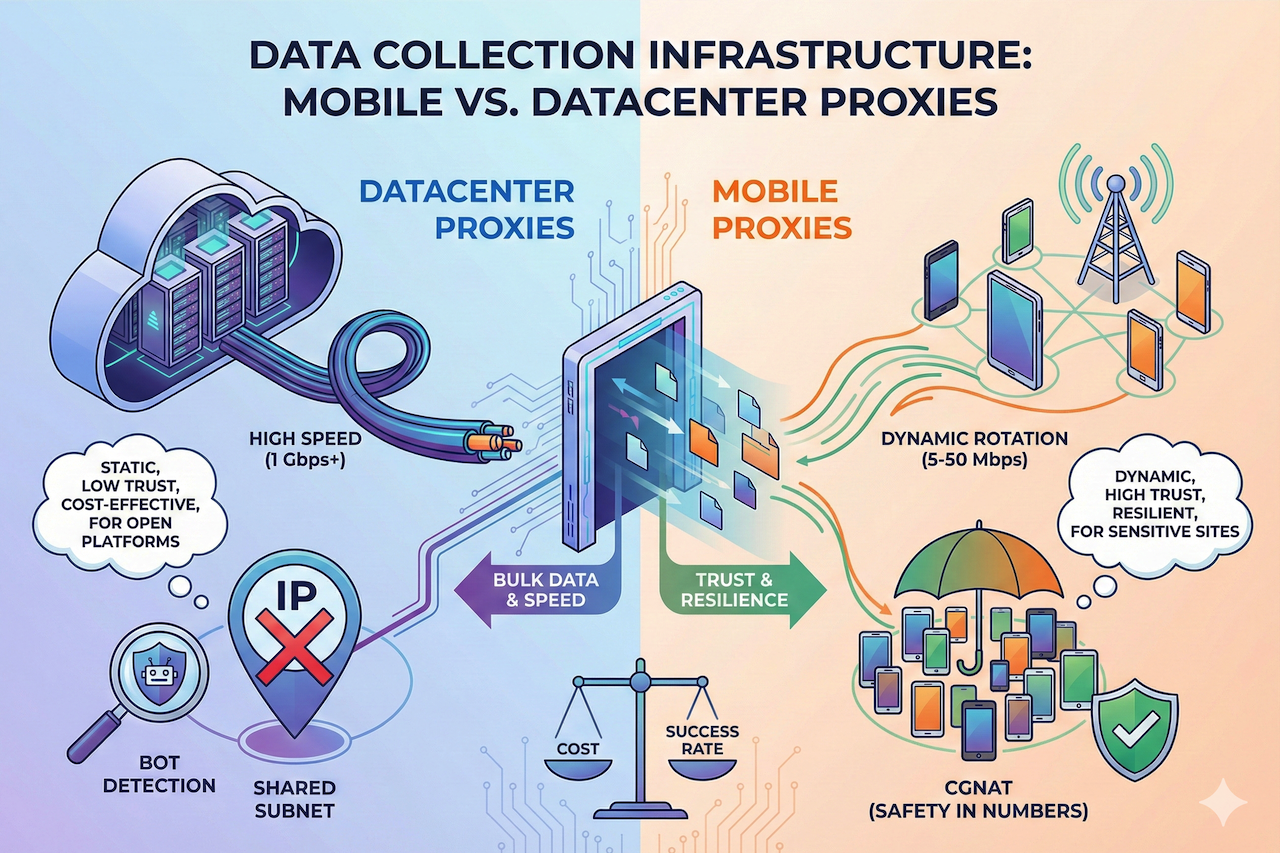
Why do certain data collection projects proceed without any problems, and others are interrupted all the time? The solution is typically in the infrastructure you employ. Mobile proxies and datacenter intermediaries function differently at the network level. Knowledge of these mechanical differences helps developers and SEO experts select the right tool to scale their operations.
The Mechanics of Datacenter IPs
These live in the cloud (cloud-based). They are products from secondary providers such as AWS, Google Cloud, or smaller hosting providers. These IPs are not connected to an Internet Service Provider (ISP) that serves residential customers.
Because of this origin, their Autonomous System Number (ASN) clearly labels them as "hosting" or "business" traffic.
Performance and Detectability
Cloud-based IPs are extremely fast. You normally have 1 Gbps or higher since they operate on commercial fiber lines. There is a trade-off to this speed, however.
Proxy detection systems can easily identify large subnets belonging to a single data center. If a single IP in a subnet is bot-like, the whole range may be affected.
How Mobile Proxies Operate
Mobile proxies route traffic through real devices connected to 3G, 4G, or 5 G networks. These IPs are directly provided by large carriers such as Verizon, T-Mobile, or Vodafone.
The Power of CGNAT
Carriers lack sufficient IPv4 addresses to serve all smartphone users. To solve this, they use CGNAT to assign a single public mobile IP address to hundreds or even thousands of users simultaneously.
This creates a unique situation for fraud prevention systems. A site cannot block this kind of address because it would block thousands of legitimate human users sharing the same IP address.
This common structure compels security algorithms to be less strict.
Note: Shared mobile networks rely on this "safety in numbers" principle. This makes the IP itself less of a target for bans, unlike static cloud IPs.
Comparison
When you analyze an IP reputation score, the source matters more than the behavior. Even a cloud-based IP with no history can receive a low score simply because it is part of a hosting ASN.
In contrast, ISP-assigned IP addresses on cellular connections inherit the carrier's trust.
Comparison of Performance Metrics
| Feature | Datacenter Proxies | Mobile Proxies |
|---|---|---|
| Source | Cloud Servers | Real 4G/5G Devices |
| Speed | High (>1 Gbps) | Moderate (5-50 Mbps) |
| Price | Low ($1-$2 per IP) | High ($40-$100/mo) |
| Trust Score | Low | High |
| Rotation | Usually Static | Dynamic / Rotating |
Scraper Technical Considerations
If you handle high-volume requests, you must consider how bot-detection algorithms analyze your traffic.
Cloud-based endpoints are suitable for:
- Lenient site market research
- Monitoring of brand protection
- High-speed file transfers
Mobile-powered IPs are required in:
- Checking advertisements in cellular bands
- Accurately checking search engine rankings (SERP)
- Using social media management tools
- Checking user experience in various geolocations
IP Geolocation and Accuracy
IP geolocation accuracy varies significantly between the two. The datacenter IPs are hard-coded in databases with their exact locations. Mobile IPs are dynamic. A device may switch between cell towers, causing a slight change in its apparent position within an area.
You can verify the information of any IP to determine whether its location information fits your target market.
Rotation and Session Management
Most cloud-based solutions offer a fixed set of IP addresses. You hold them until you cancel. Cellular options operate differently. They use rotating IP addresses that change either on a set timer or with every new request.
This rotation is natural. Smartphones keep losing and regaining connection to towers, acquiring new IP addresses. This behavior is best imitated so that you can fit in with the regular traffic.
To find the best mobile proxy, you usually need to verify that the IP rotation intervals are compatible with your software's timeouts. A proxy that spins every 2 minutes will interrupt your workflow if your script requires a 10-minute session.
Cost Analysis: Is the Premium Worth It?
Costs vary wildly.
- Datacenter: It can cost as low as $1.50 per IP per month.
- Mobile: Legitimate carrier networks are costly to operate. Prices range from $40 to $80 per month for a dedicated port, or users can pay per gigabyte (e.g., $15/GB).
When to Switch
Do not overspend on mobile infrastructure when you do not need it. Start with datacenter IPs. If you see a high error rate or a high CAPTCHA rate, that is your clue. The target site probably flagged your ASN.
At that stage, it is reasonable to switch to a residential or cellular network to enhance the success rates.
Final Summary
The decision between mobile and datacenter is left to the target. The former offers high trust scores and resilience with CGNAT in harsh environments. The latter offers raw speed and efficiency for large-scale work on open platforms.
Analyze your error logs. If your requests fail even with good code, your IP type is likely the bottleneck.
Featured Image generated by Google Gemini.
Share this post
Author

Leave a comment
All comments are moderated. Spammy and bot submitted comments are deleted. Please submit the comments that are helpful to others, and we'll approve your comments. A comment that includes outbound link will only be approved if the content is relevant to the topic, and has some value to our readers.



Comments (0)
No comment