
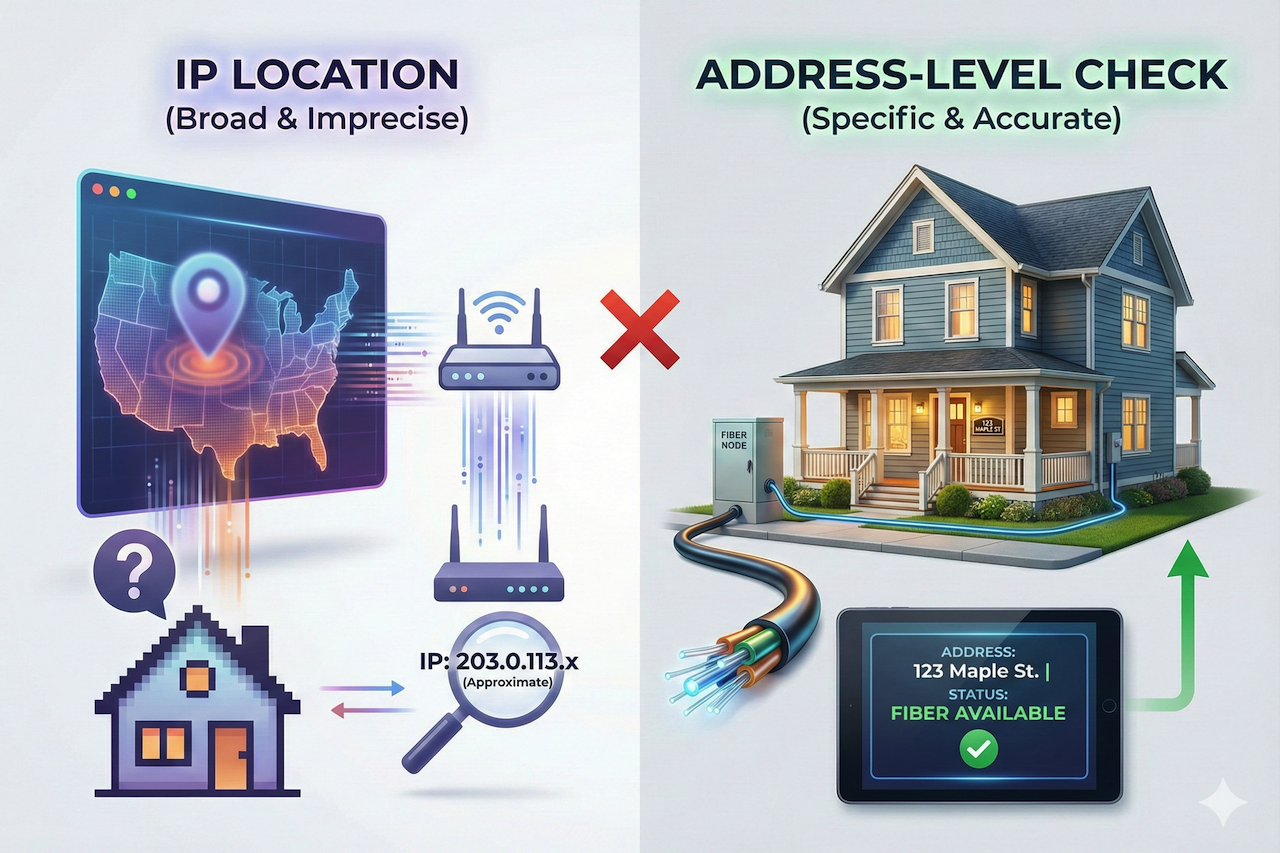
When users want to know whether fiber internet is available at their home, one of the first tools they often turn to is an IP address location lookup. IP geolocation can reveal helpful information about a network connection, including the general geographic area and the internet service provider (ISP) handling the traffic. While IP-based tools can provide helpful context, they are frequently misunderstood when it comes to fiber availability. An IP address can hint at network characteristics, but it cannot reliably confirm whether fiber infrastructure exists at a specific address. Understanding how IP geolocation works and its limitations is essential for correctly interpreting results.
What IP Address Location Actually Represents
An IP address is a logical identifier assigned to a device or network interface connected to the internet. IP geolocation databases map IP ranges to information such as country, region, city, ISP, and autonomous system number (ASN). These mappings are created using a combination of registry data, ISP disclosures, routing information, and observed network behavior.
In practice, an IP lookup can typically provide:
- Country and region associated with the IP range
- Approximate city or metropolitan area
- The ISP or organization that owns the IP block
- ASN data that indicates the broader network operator
- Whether the IP appears to be residential, mobile, or hosted
This data is beneficial for applications such as fraud detection, content localization, network troubleshooting, and understanding routing paths. It can also help identify which ISP is providing service to a user at a high level. However, IP geolocation reflects network ownership and routing, not physical service infrastructure.
How IP Location Relates to Internet Infrastructure
From a networking perspective, IP addresses are assigned and routed based on efficiency, scalability, and network design, not precise geography. ISPs often allocate IP blocks across large regions, sometimes spanning multiple cities or even states. A single ASN may serve customers using fiber, cable, DSL, fixed wireless, or mobile connections.
Additionally, many ISPs centralize routing through regional data centers. As a result, a residential user’s IP address may appear to be located where the ISP’s core network equipment resides, rather than where the customer physically lives. This is especially common in smaller cities or rural areas.
Because of this abstraction, IP location can indicate the type of ISP involved, but not the last-mile technology actually delivering service to the address.
Using IP Location as an Initial Signal for Fiber Checks
Despite these limitations, IP address location can still be useful for checking fiber availability. At a high level, IP data can help users understand:
- Which ISP is currently serving the connection
- Whether the network is likely residential or mobile
- Whether the ISP is known to deploy fiber in certain regions
This makes IP location a reasonable starting point. It can provide context and narrow down which providers may be relevant. However, it should not be treated as a definitive indicator of fiber access.
To move from general context to accurate availability, address-level verification is required. Address-based tools like Fiber At My Address are explicitly designed for this purpose. Instead of relying on IP assignments, they reference service availability data tied to physical locations, such as street addresses or building-level infrastructure. This approach aligns with how fiber networks are actually deployed and provisioned.
Why IP-Based Checks Fall Short for Fiber Availability
There are several technical reasons why IP address lookups cannot reliably determine fiber access at a specific address.
First, IP addresses are not bound to physical service points. An IP block may cover thousands of customers using different access technologies. Two users on the same IP range could be connected via entirely different last-mile infrastructure.
Second, modern network architectures introduce additional layers of abstraction. Carrier-grade NAT (CGNAT), commonly used by ISPs to conserve IPv4 addresses, causes multiple customers to share a limited pool of public IP addresses. Mobile networks further complicate this by dynamically assigning IPs across broad geographic areas.
Third, VPNs, proxies, and corporate gateways can significantly distort IP location results. In these cases, the IP address reflects the tunnel's exit point rather than the user’s actual location, rendering any availability assumptions meaningless.
Finally, ISPs frequently reallocate IP ranges as networks evolve. Fiber expansions, mergers, and infrastructure upgrades do not necessarily coincide with changes in IP assignments, which means IP data often lags behind physical deployment.
Why Fiber Availability Is Inherently Address-Specific
Fiber internet differs from other access technologies because it depends on physical infrastructure that must be installed close to the end user. Fiber lines are extended street by street, building by building, and sometimes unit by unit. The presence of fiber in one area does not guarantee availability next door.
Factors that influence fiber availability include whether fiber conduits have been installed on the street, whether a building has been wired internally, whether the ISP has activated service for that address, and whether the location falls within a provider’s current service footprint.
Even within the same apartment complex, some units may have fiber access while others do not. These nuances cannot be inferred solely from IP data, which is why address-level lookup tools are essential for accurate results.
Combining IP Geolocation With Address-Level Verification
The most reliable approach to checking fiber availability is to treat IP location as contextual information rather than a final answer. IP data can help identify the general network environment and the ISPs operating in a region. At the same time, address-level tools confirm whether fiber service is actually available at a specific location.
Address-based lookup platforms bridge this gap by focusing on infrastructure availability tied directly to physical addresses. This method reflects how ISPs provision service and how fiber networks are built, making it far more precise than IP-based inference.
Used together, IP geolocation and address-level checks provide a more complete and accurate picture of available internet options.
Best Practices for Checking Fiber Availability Accurately
A practical workflow for checking fiber availability typically involves starting with an IP lookup to determine the current ISP and general region, then performing an address-level fiber availability check, and finally confirming details directly with local providers. This layered approach minimizes the risk of false assumptions and helps users avoid drawing conclusions based solely on IP address data.
By understanding the role and limitations of IP geolocation, users can make better-informed decisions and avoid common misconceptions about fiber availability.
Featured Image generated by Google Gemini.
Share this post
Author

Read the latest articles from Jahid Hasan
Top 3 Money Saving Sites to Get Deals on Proxies

September 21, 2025
Proxies are no longer just tools for tech enthusiasts. They are now used by digital marketers, SEO professionals, gamers, e-commerce entrepreneurs, and even small businesses that need secure browsing and account management. The only challenge is that proxy subscriptions can become expensive if you are not careful [...]
Learn moreLeave a comment
All comments are moderated. Spammy and bot submitted comments are deleted. Please submit the comments that are helpful to others, and we'll approve your comments. A comment that includes outbound link will only be approved if the content is relevant to the topic, and has some value to our readers.
 DNS Lookup
 Search a Person
 Inspect suspicious links
 Data Breach Check






Comments (0)
No comment