
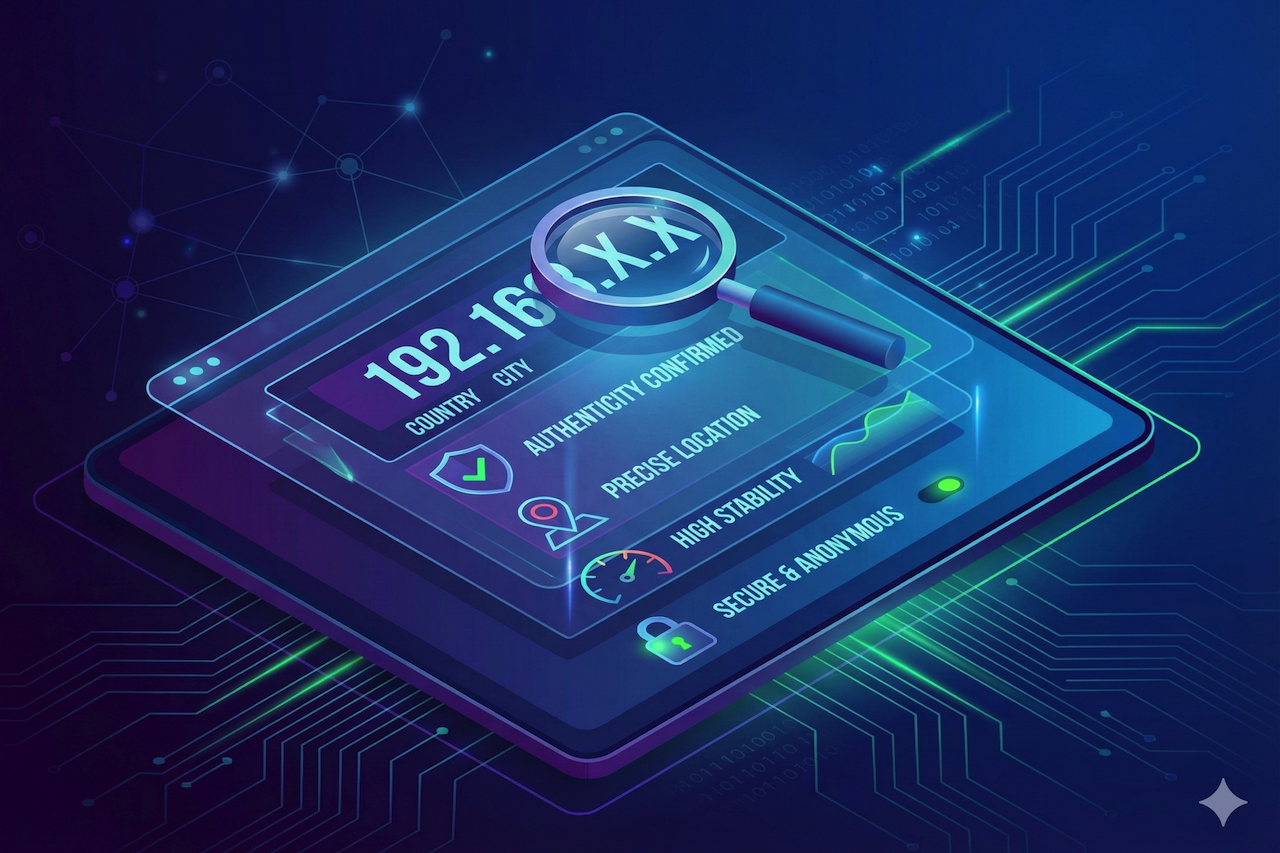
Every time you open IPLocation or a similar tool and enter that proxy IP for a query, the real question in your mind probably goes far beyond the country and city displayed on the screen. What you are genuinely searching for is a crucial confirmation: "Is the proxy I am using really reliable? Is it invisibly exposing me, slowing me down, or even betraying me?"
As a developer, cybersecurity expert, or person in charge of a data-driven business, you understand better than anyone: the quality of a proxy IP directly determines the success or failure of a task, the security of an account, and the value of the data. Every time you come here to make a query, there may be a pressing business pain point behind it.
Common Concern 1: Verifying Whether an IP Appears “Authentic”
One common reason for checking an IP is uncertainty about how it is classified. If an IP lookup returns an unfamiliar or clearly data-center-based ISP, it may indicate the use of a shared data center proxy. These IPs are frequently reused, widely known, and more easily detected by website risk systems.
As a result, activities such as web crawling, account access, or ad verification may face interruptions or increased blocking.
In contrast, residential proxies typically originate from consumer broadband connections and appear similar to ordinary household traffic when viewed through IP lookup tools. This distinction often plays a role in whether automated or large-scale activities blend in or stand out.
Common Concern 2: Ensuring Location Accuracy Beyond the Country Level
Another reason users verify proxy IPs is to confirm geographic accuracy. For tasks involving local search results, regional pricing, or location-specific content, a broad country-level match may not be sufficient.
If a proxy resolves to a different city or region than intended, the resulting data may be misleading or unusable. This is especially relevant for advertising verification, market research, and localized testing, where even small geographic discrepancies can affect outcomes.
Proxies that support more granular location targeting are often preferred for these use cases, as they allow closer alignment between the IP’s reported location and the intended audience or market.
Common Concern 3: Assessing Stability and Reputation
Users also check IP addresses when experiencing connection issues, slow response times, or access failures. These symptoms may indicate that an IP has been overused, flagged, or limited by certain websites.
IP lookup tools can provide basic signals, such as ASN type or hosting classification, which help users assess whether an IP belongs to a heavily shared environment or a cleaner pool. Combined with connection testing, this information can help determine whether instability is related to the proxy itself.
High-anonymity configurations and responsible IP sourcing are often factors that influence long-term stability and availability. In comparative evaluations, services such as Cherry Proxy are often assessed against these factors, with consistent reliability being a key indicator of long-term availability.
Common Concern 4: Supporting Informed Procurement Decisions
For teams responsible for selecting proxy infrastructure, IP verification is often part of a broader evaluation process. Beyond performance, considerations include compliance, sourcing transparency, scalability, and total cost over time.
Rather than focusing solely on price, many organizations assess whether an IP resource meets operational requirements consistently and with minimal risk. IP lookup tools play a role in this evaluation by offering an external view of how proxies appear to the wider internet.
Using IP Lookup Tools as a Validation Step
Regardless of provider or use case, IP lookup tools serve as a simple but valuable checkpoint. By reviewing ISP information, location data, and network classification, users can better understand how their proxies are presented externally.
This type of verification does not replace functional testing, but it complements it by highlighting potential issues before they impact production workflows.
In practice, regularly checking proxy IPs helps users align expectations with reality and make more informed decisions about their network setup, without relying solely on documentation or claims.
For example, teams evaluating services such as Cherry Proxy may use IP lookup tools to confirm how assigned IPs appear externally. Checking attributes like ISP classification, reported location, and network type helps validate whether the proxy aligns with the intended use case before it is deployed in production.
Conclusion
Proxy verification is rarely about curiosity alone. It reflects a need for confidence in how infrastructure behaves under real-world conditions. By combining IP lookup tools with functional testing, teams gain a clearer picture of authenticity, location accuracy, stability, and risk.
Rather than relying solely on specifications or provider documentation, external verification helps ensure that proxy resources align with operational requirements before they affect critical workflows.
Featured Image generated by Google Gemini.
Share this post
Leave a comment
All comments are moderated. Spammy and bot submitted comments are deleted. Please submit the comments that are helpful to others, and we'll approve your comments. A comment that includes outbound link will only be approved if the content is relevant to the topic, and has some value to our readers.






Comments (0)
No comment