

The Digital Trails That Can Make or Break a Car Accident Case
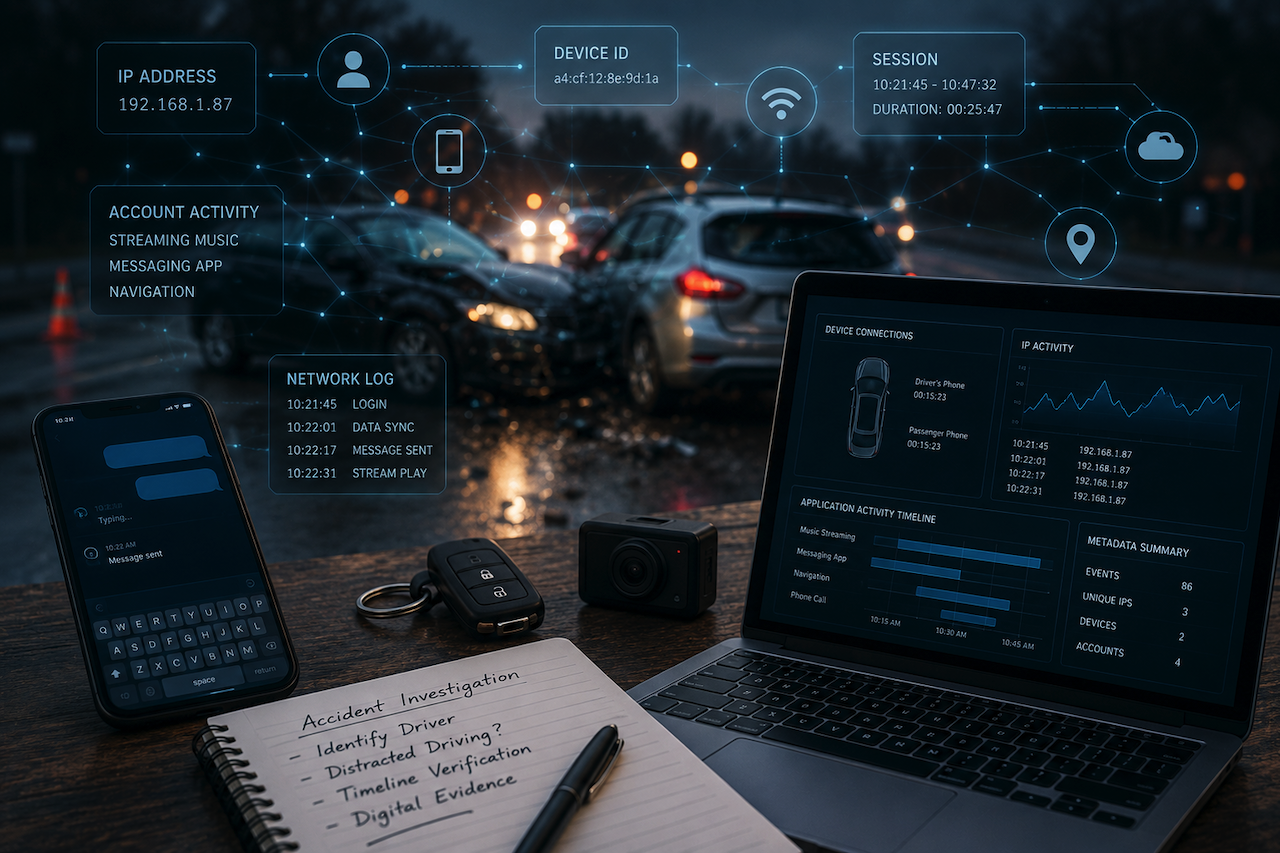
Most discussions of digital evidence in car accident investigations focus on the same handful of sources. GPS coordinates from the phone. Telematics from the car. Maybe footage from a dashcam or a nearby surveillance camera. These are the technologies that get attention because they answer the most obvious questions: where the vehicle was, how fast it was going, and what was happening immediately before the impact.
There is another layer of digital evidence that gets much less attention but turns up in more cases than people realize. It consists not of coordinates but of identifiers: IP addresses, device fingerprints, account session records, and network logs that establish not where something was, but what was active, when, and to which person. This layer rarely produces the dramatic single piece of evidence that resolves a case. It produces the corroborating detail that determines whether the more dramatic evidence holds up.
What this layer actually contains, and where it tends to matter, is one of the most consistently underestimated parts of the modern evidentiary record.
The Identifiers That Tend to Show Up
When someone is in a car accident, the phones, the vehicle, and the connected services around them all generate identifier-based records that may have nothing to do with location and everything to do with presence and identity.
A driver who was streaming music through the car's infotainment system has been authenticating against a streaming service account at intervals throughout the drive. The streaming service has logged the IP address used for authentication, the device identifier, the time of each session refresh, and the activity within the session: what was playing, when playback was paused, and when the next track was selected. None of this is location data. All of it tells a story about what the driver was doing and attending to in the minutes before the event.
A passenger whose phone connected to the car's Bluetooth has left an identifier trail in the vehicle's onboard systems. The MAC address of the phone, the time of the connection, the duration, and the data exchanged are recorded in the car's logs even after the trip is over, whether the passenger remembers being in the car or not.
A driver who used a messaging app shortly before the accident has produced records on the app's servers that include the IP address of the device at the time of each message, the timestamp, the recipient, the device identifier, and in many cases the activity state of the app, whether it was in the foreground, whether the user was actively typing, whether a draft was abandoned. The actual content of the messages may not be accessible without a specific legal process. Still, the metadata surrounding the messages is often produced more readily and carries its own evidentiary weight.
These records are not stored in one place. They are scattered across the carriers, the streaming services, the messaging platforms, the car manufacturer's cloud systems, the mobile operating system vendor, and the various applications that were running during the drive. Each holds a small piece of the picture. Taken together, they can produce a remarkably detailed reconstruction of who was doing what.
Where This Evidence Actually Matters
The cases where identifier evidence tends to be most important are not the cases where the basic facts are in dispute. They are the cases where one of three more specific questions is in play.
The first is identity. Who was actually driving? This question comes up more often than public discussion suggests, particularly in cases involving rideshare arrangements, family vehicles with multiple regular drivers, and incidents in which the registered driver was not the person at the wheel. GPS data tells you where the car was. It does not tell you whose hands were on the steering wheel. Identifier evidence, whose phone was paired to the vehicle, whose accounts were active in the infotainment system, whose IP address was logging into the car's connected services, can substantially narrow the answer.
The second is attention. Whether the driver was distracted. The question of whether a driver was looking at a phone in the moments before an accident is one of the most consequential factual questions in many cases, and the answer rarely comes from GPS data. It comes from the records of when the phone was actively used, which application was in the foreground, whether messages were being typed, and whether calls were active. These are identifier-and-activity records, not location records, and different systems with different retention policies produce them.
The third is fraud. Cases where someone claims to have been somewhere they were not, or to have sustained an injury that does not match their actual activity in the days surrounding the accident. Identifying evidence, such as what services someone was logging into, from what IP addresses, during what hours, can establish patterns of activity that either support or contradict a claimed timeline. Insurance carriers have invested heavily in this kind of analysis over the last several years, and the sophistication of the techniques has grown substantially.
For example, a car accident attorney handling a serious case may increasingly need to evaluate identifier evidence alongside more familiar categories of digital evidence. The questions are not always the dramatic ones that location data resolves. They are often the smaller details that determine whether the broader narrative actually holds together: whose phone was connected to the vehicle, which accounts were active, what network activity occurred, and when those interactions took place. These are questions that digital records can often answer when someone knows where to look.
Where Identifier Evidence Breaks Down
Identifier evidence has its own failure modes. IP addresses, in particular, are less stable than they appear. A phone moves between cellular and Wi-Fi networks throughout an ordinary day, and each transition produces a different IP address. NAT and carrier-grade NAT allow multiple devices to share a single externally visible address. VPNs, increasingly common, can mask or shift the visible IP entirely. Treating an IP log as if it answered a question more precise than the technology supports leads to the same kinds of errors that arise from over-reading GPS coordinates.
Device identifiers themselves have become more constrained as operating system vendors have tightened privacy controls. Modern iOS and Android both restrict the kinds of persistent identifiers that applications can access, and the cross-app tracking that was once routine has become more difficult. The result is identifier evidence that is sometimes thinner than it was five years ago, depending on the apps involved.
What has not changed is the underlying value of the evidence when it is available. The cases that handle it well tend to be those where someone understood the difference between an IP log and a GPS log, between a session record and a location ping, and between a device identifier and a coordinate. The distinctions are not difficult once they are recognized. They are routinely missed in cases where no one knows to look for them, and the missing layer is often the one that would have changed the outcome.
Conclusion
Digital evidence in modern car accident investigations extends far beyond GPS coordinates and surveillance footage. Identifier-based records such as IP logs, device connections, account sessions, and network activity increasingly help investigators reconstruct timelines, evaluate driver behavior, and verify competing claims. While this evidence has limitations and must be interpreted carefully, it has become an important part of how serious accident cases are analyzed.
As connected vehicles, mobile devices, and cloud-based services continue generating larger volumes of metadata, understanding how identifier evidence works is becoming increasingly important for investigators, insurers, legal professionals, and everyday drivers alike. In many cases, the details hidden within these digital trails can provide the context needed to support or challenge the broader narrative surrounding an accident.
Featured Image generated by ChatGPT.
Related Articles

June 23, 2026
Server IPs vs. Residential IPs: How Major Websites Detect That You're Using a VPN
How major websites use IP classification, behavioral signals, and risk scoring to detect VPN use — and when residential IPs can reduce detection.
Read More
April 28, 2026
Mask Your IP on Windows Without Wrecking Your Daily Workflow
People who live in IP tools usually know too much to trust slogans and too little time to babysit every session. That is why this section matters. In IP lookups, DNS tooling, and w...
Read More
March 20, 2026
IP Addresses: Key to Digital Identity
Each device connected to the internet is assigned a distinct numerical label. This label, commonly known as an IP address and automatically assigned by your network, serves as...
Read More
Comments
Comments are available to signed-in users and are moderated to keep the discussion useful and respectful. Spam, automated submissions, and low-value promotional comments are removed. Outbound links may be approved when they are relevant and genuinely helpful to readers, but they are displayed as plain text rather than clickable hyperlinks.
No comments have been published yet.
Please sign in to submit a comment.