
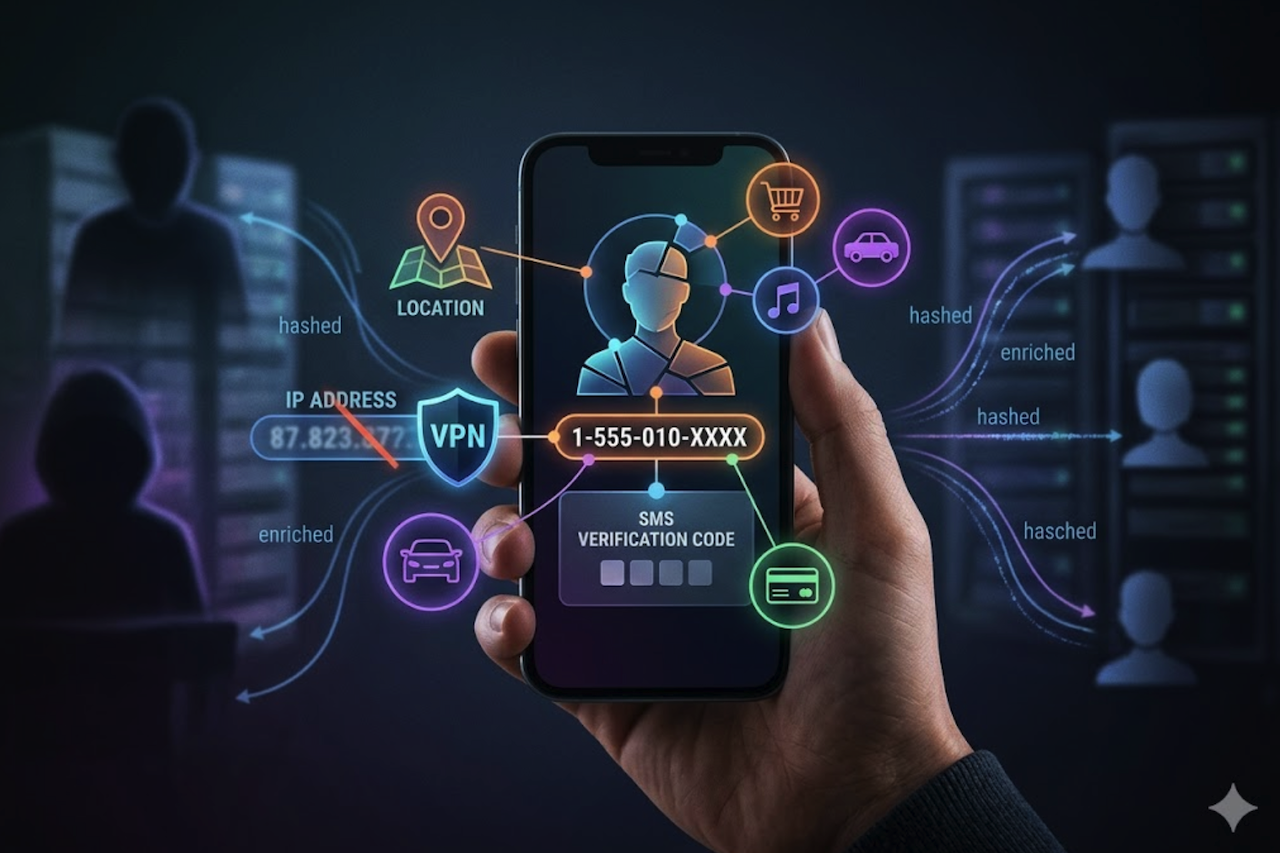
If you have ever looked up your own IP address, you already understand something most people don't: you are not as anonymous online as you assume. An IP address reveals your approximate location, your internet provider, and a surprising amount about your connection. That awareness is exactly why privacy-conscious users mask their IP with a VPN or proxy.
But here is the uncomfortable truth. Hiding your IP address is only half the battle. There is a second identifier that follows you across the internet, and it is far more permanent, far harder to change, and far more valuable to the companies tracking you. It is your phone number. While you were busy hiding your IP, you have probably been handing this one out freely dozens of times a year.
Why your phone number beats your IP as a tracking key
From a tracker's perspective, the ideal identifier is one that rarely changes. Measured against that standard, your IP address is actually a weak signal. It changes when you switch networks, reset your router, or connect through a VPN. A dynamic IP from your provider can rotate every few days on its own.
Your phone number is the opposite. People keep the same number for years, often for a decade or more. It survives new phones, new laptops, new homes, new email addresses, and every VPN you will ever use. That permanence makes it the perfect match key for linking your activity together. You can route your traffic through a server on the other side of the world, but the moment you type your real number into a sign-up form, you have handed over a stable identifier that no amount of IP masking can hide.
How the number-based tracking works
Once a company has your number, it rarely stays in one place. Here is the chain that most people never see:
- Hashed number matching: Ad platforms let advertisers upload lists of customer phone numbers in scrambled "hashed" form. The platform hashes its own users' numbers the same way and matches them. The result: you can be targeted on a platform you never gave your number to, simply because another company shared it.
- Data broker enrichment: Brokers buy and merge lists from loyalty programs, app sign-ups, warranty cards, and public records, all keyed to your number. The profile they build can include your age range, income bracket, neighborhood, interests, and recent purchases.
- Cross-service linking: Two apps that both hold your number can be connected behind the scenes, even if they never talk to each other directly. A broker holding both records stitches them into one timeline.
- Offline-to-online bridges: Gave your number at a store checkout for a discount? That in-store purchase can now be linked to your online profile through the same number.
None of this depends on your IP address. You could be behind the best VPN in the world, and this tracking would continue uninterrupted, because it is keyed to a number you typed in yourself.
The risks go beyond targeted ads.
Annoying ads are the least of it. The more places your real number lives, the larger your exposure to real harm:
- SIM-swap fraud: An attacker convinces your carrier to move your number to a SIM they control, then intercepts every verification code, including those protecting your email, bank, and crypto accounts.
- Tailored phishing: When scammers buy a profile attached to your number, their fake "verification" texts become alarmingly specific, referencing services you actually use.
- Account-takeover paths: Your number is often a password-recovery route. Every service that knows it is another door an attacker can try.
- Permanent profiling: Because you rarely change your number, the dossier built around it can follow you for years, even after you delete the apps that started it.
How to protect your number the way you protect your IP
You already take deliberate steps to control your IP address. Apply the same mindset to your phone number with a few simple habits.
- Treat your real number like a secret: Reserve your primary number for the small set of contacts and services that genuinely need to reach the real you: your bank, your doctor, close family, and your most important accounts. Everything else does not deserve it.
- Use a virtual number for sign-ups and verifications: This is the phone-number equivalent of using a VPN. For one-time verifications, free trials, marketing accounts, and any service you are only testing, consider using a disposable virtual number instead of your real SIM. Many virtual number providers, such as otpjet.com and similar services, allow users to receive verification codes without exposing their primary phone number. This helps keep your real number out of data-broker databases and reduces the amount of tracking tied to a single identifier.
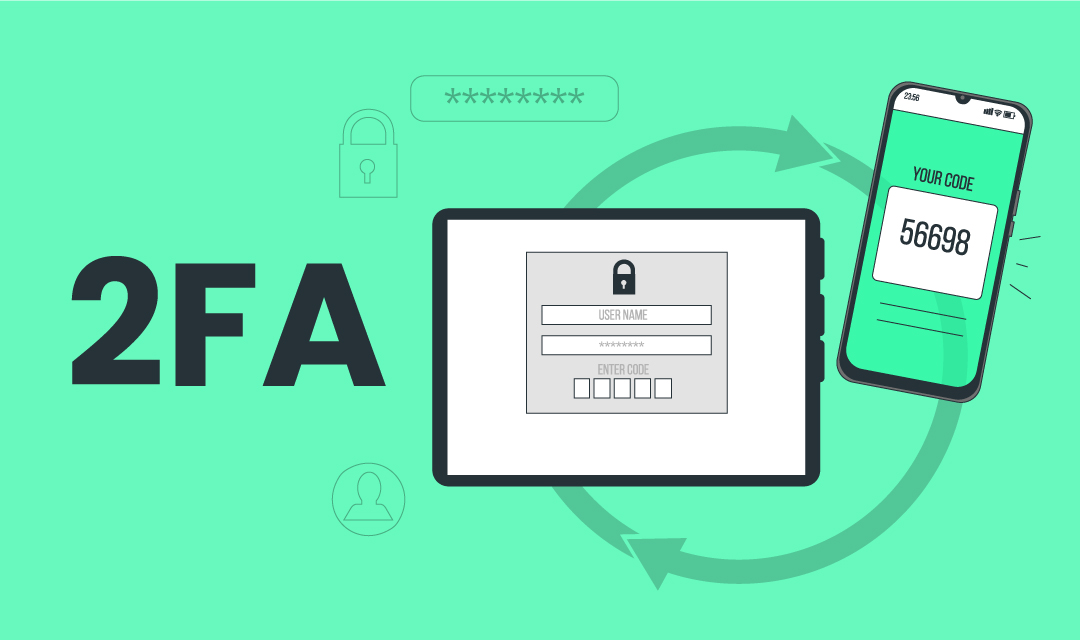
- Move critical accounts off SMS-based 2FA: Where possible, switch two-factor authentication from SMS codes to an authenticator app or hardware key. This closes the SIM-swap door on the accounts that matter most, such as your primary email and financial accounts.
- Compartmentalize your identifiers: The whole game of trackers is connecting your records. Break the chain by using different numbers and email addresses for different purposes, just as you might use different IPs for different sessions. If no single broker can stitch your accounts together, your profile stays fragmented and far less valuable.
The bottom line
Checking and masking your IP address is a smart habit, but it protects only one of the two identifiers that follow you online. Your phone number is the more permanent one, and for most people, it is wide open. Treat it with the same care you give your IP: keep your real number for the few services that truly need it, use a disposable virtual number for everything else, and you close the gap that no VPN can cover.
 FAQs
FAQs
No. A VPN only masks your IP address and encrypts your traffic. It does nothing about the phone number you type into sign-up forms. The two are completely separate identifiers, and you need to protect both.
Not at all. You pick a service and a country, receive a number instantly, and read the verification code in an online dashboard. The whole process typically takes only a minute or two.
Yes. Receiving verification codes through a virtual number uses the same underlying technology used by many legitimate businesses and communication providers. Always follow the terms of service of the platform you are using.
Costs vary by provider and destination country. Many services charge only a small fee per verification, making them an inexpensive way to keep your primary phone number separate from non-essential accounts.
Disclaimer
This article is provided for informational and educational purposes only and should not be considered legal, cybersecurity, privacy, financial, or professional advice. The information presented reflects general privacy and security concepts and may not apply to every situation, service, jurisdiction, or platform.
References to third-party products, services, websites, or technologies are provided solely as examples and do not constitute an endorsement, recommendation, or guarantee of performance. Readers should conduct their own research and review the terms, privacy policies, and security practices of any service they choose to use.
While reasonable efforts have been made to ensure accuracy at the time of publication, privacy practices, technologies, regulations, and online services may change over time. IP Location and its operators make no representations or warranties regarding the completeness, accuracy, reliability, or suitability of the information contained in this article.
IPLocation.net shall not be liable for any direct, indirect, incidental, consequential, or other damages arising from the use of, reliance upon, or inability to use the information, products, services, or websites discussed in this article.
Featured Image generated by Google Gemini.
Share this post
Leave a comment
All comments are moderated. Spammy and bot submitted comments are deleted. Please submit the comments that are helpful to others, and we'll approve your comments. A comment that includes outbound link will only be approved if the content is relevant to the topic, and has some value to our readers.


Comments (0)
No comment