

When you travel internationally, your digital identity shifts in ways that most people never think about. Your IP address, the numerical label that identifies your device on the internet, changes the moment you connect to a foreign network. This has implications for everything from the content you can access to the accuracy with which geolocation databases can map your position. With the rise of travel eSIMs, these dynamics are changing in subtle but significant ways that matter to anyone who works with IP data, manages network security, or wants to understand what happens to their online footprint when they cross a border.
A Quick Primer: How Your IP Changes When You Travel
Under normal circumstances, your public IP address is assigned by your Internet Service Provider (ISP) or mobile carrier. When you are at home, your IP address maps relatively cleanly to your city or region through geolocation databases maintained by providers such as MaxMind, IP2Location, and DB-IP. The accuracy is generally reliable at the city level, though pinpoint precision remains elusive.
When you travel abroad and connect to a local Wi-Fi network — at a hotel, airport, or café — your device is assigned a new IP address from that local network’s ISP. Geolocation databases typically resolve an IP address to the country and city where the network is located. Your online identity, from a network perspective, shifts to that new location almost instantly.
Mobile data complicates things further. If you use your home carrier’s international roaming service, your traffic may be routed through your carrier’s home infrastructure via a process known as Local Breakout (LBO) or Home-Routed traffic. In many cases, roaming traffic is tunneled back to the home network before reaching the public internet, meaning your IP address might still geolocate to your home country even though you are physically abroad. This creates a disconnect between your actual location and your apparent digital location, something that geolocation professionals encounter regularly when analyzing mobile traffic.
Enter the eSIM: A New Variable in IP Geolocation
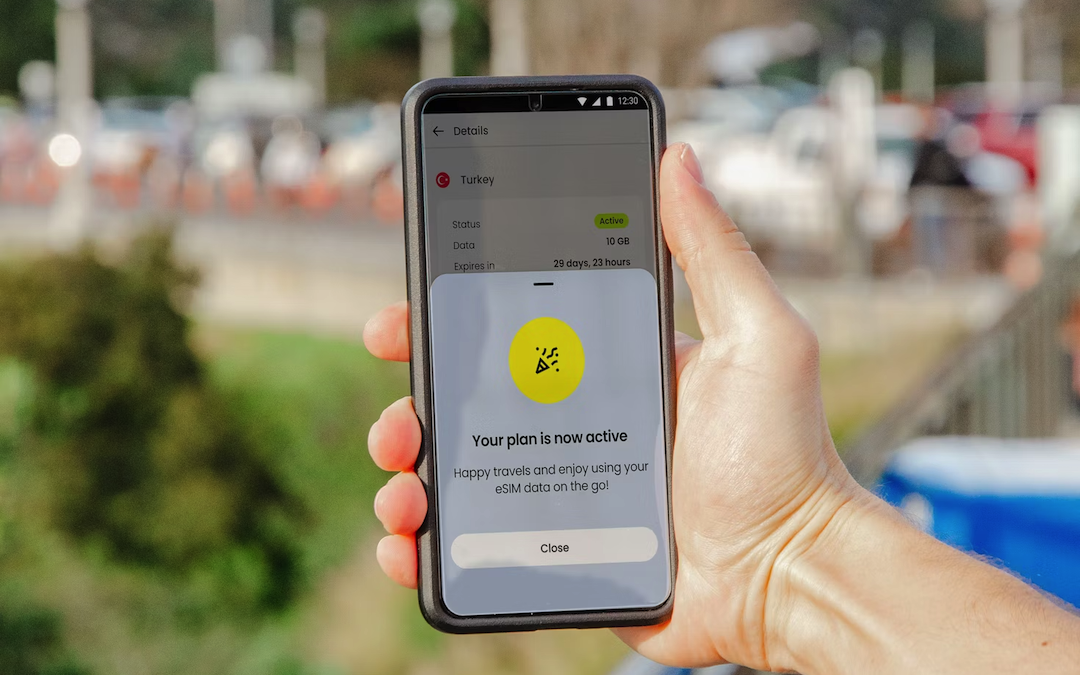
An eSIM (embedded SIM) is a digital SIM profile that can be downloaded and activated on compatible devices without a physical SIM card. Travel eSIM providers offer data plans for specific countries or regions, allowing travelers to connect to local mobile networks upon arrival. Unlike traditional roaming, where traffic is often tunneled back to the home carrier, travel eSIMs typically connect directly to a partner network in the destination country. This distinction has meaningful consequences for how your IP address behaves.
When a traveler activates a travel eSIM in, say, Japan, their device connects to a Japanese mobile network and is assigned a local IP address. Geolocation databases will resolve that IP to Japan, accurately reflecting the user’s physical location. This contrasts with traditional roaming, where the same traveler’s traffic might still appear to originate from their home country due to home-routed data tunneling.
For geolocation accuracy, this is broadly a positive development. When users connect through local networks via eSIMs, the correlation between their IP-derived location and their actual physical location improves. For services that rely on IP geolocation for content delivery, fraud detection, or regulatory compliance, this alignment is valuable.
The Dual-SIM Dimension: Two Identities, One Device
Most modern smartphones support dual-SIM configurations — either two physical SIM cards or, more commonly now, one physical SIM and one eSIM. This means a traveler can maintain their home carrier on the physical SIM (for receiving calls, SMS, and two-factor authentication codes) while using a travel eSIM for data connectivity.
From a networking perspective, this creates an interesting situation. The device has two active network identities simultaneously. Data traffic — web browsing, app usage, streaming — routes through the eSIM’s local network, acquiring a local IP address. Meanwhile, SMS and voice traffic continue through the home carrier. If a service uses both IP-based geolocation and phone-number-based verification, it may see conflicting location signals: the IP suggests the user is in Germany, while their phone number is registered in the United States or Australia.
This dual-identity scenario is already common among frequent travelers and digital nomads. Providers like BazTel, which offer eSIM connectivity across more than 160 countries, facilitate this kind of split-network usage by design. For fraud detection systems that flag mismatches between IP location and registered phone number region, this growing user behavior needs to be factored into risk models to avoid false positives.
IP Geolocation Accuracy: Where eSIMs Help and Where They Complicate
Travel eSIMs generally improve IP geolocation accuracy by assigning genuinely local IP addresses. However, there are scenarios where complexity arises. Some eSIM providers route traffic through intermediary servers or use cloud-based infrastructure that may not be located in the same country as the user. In these cases, the IP address might resolve to a data center location rather than the traveler’s actual city. For instance, a traveler in Rome could end up with an IP that geolocates to Frankfurt if their eSIM provider routes data through a European hub.
Additionally, regional eSIM plans, which provide a single data plan that works across multiple countries, may assign IP addresses from a centralized point of presence rather than from the user's specific country. A traveler moving through France, Spain, and Portugal on a European regional plan might use the same IP address throughout, geolocating consistently to a single country regardless of actual movement. This is efficient from a connectivity standpoint but introduces noise into geolocation data.
For professionals who work with IP geolocation data, understanding these routing patterns is becoming increasingly important as eSIM adoption grows globally.
Privacy Implications: What Travelers Should Know
From a privacy standpoint, travel eSIMs introduce both advantages and considerations. On the positive side, because eSIM data traffic passes through a local or regional network rather than being tunneled home, travelers avoid having their browsing data routed through potentially congested or monitored home-carrier infrastructure. The local IP address also means that location-specific content — search results, news, local services — aligns with where the traveler actually is, reducing the friction of being served irrelevant content for a country they are not in.
On the other hand, acquiring a local IP means that local surveillance and data retention laws apply to your traffic. A traveler using a local eSIM in a country with extensive data monitoring will have their traffic subject to that jurisdiction’s legal framework. In contrast, home-routed roaming traffic might fall under the home country’s regulatory protections. This is a nuance that security-conscious travelers and professionals handling sensitive data should consider when choosing how to connect abroad.
For those who prioritize privacy, pairing a travel eSIM with a reputable VPN service remains a sensible approach. The eSIM provides affordable local connectivity, while the VPN encrypts traffic and can mask the local IP if needed. This combination gives travelers control over both their connectivity costs and their digital privacy.
What This Means for Developers and Security Professionals
As eSIM adoption accelerates, driven by travelers seeking affordable alternatives to traditional roaming, the behavior of mobile IP addresses is becoming less predictable. For developers building location-aware applications, the assumption that a mobile IP consistently reflects the user’s home country is becoming unreliable. More users will increasingly appear with local IP addresses from countries they are visiting rather than where they live.
For cybersecurity teams managing fraud detection, the rise of dual-SIM/eSIM configurations means that legitimate users will increasingly trigger location mismatch alerts. A user logging into a banking app with an Australian phone number but a German IP address is not necessarily a threat; they may be a traveler using a travel eSIM. Adjusting risk-scoring models to account for this growing pattern will be essential to maintaining security without degrading user experience.
IP geolocation databases will also need to adapt. As eSIM providers establish routing agreements with networks in different countries, the IP ranges associated with mobile traffic will diversify. Database providers like MaxMind and IP2Location will benefit from incorporating eSIM provider network data into their mapping to maintain accuracy. The GSMA’s emerging standards on eSIM provisioning and network identification may eventually provide more structured data to help geolocation providers keep pace with these changes.
The Bigger Picture: eSIMs and the Evolution of Mobile Identity
The shift towards eSIMs reflects a broader trend in how mobile identity is decoupling from physical hardware. A single device can now seamlessly switch between network identities, connecting to different carriers across different countries without any physical intervention. For users, this is a convenience. For systems and databases that rely on stable relationships among devices, networks, and locations, this is a paradigm shift that requires ongoing adaptation.
Understanding how travel eSIMs affect IP assignment, geolocation accuracy, and digital privacy is no longer a niche concern. As the technology becomes mainstream and affordable, with providers now offering international connectivity across 160 or more countries, its impact on IP-based systems will only grow. Whether you are a developer, a network administrator, a security analyst, or simply a curious traveler, keeping pace with these changes will help you make better decisions about how you connect and how you interpret others' connections.
Share this post
Author

Leave a comment
All comments are moderated. Spammy and bot submitted comments are deleted. Please submit the comments that are helpful to others, and we'll approve your comments. A comment that includes outbound link will only be approved if the content is relevant to the topic, and has some value to our readers.




Comments (0)
No comment