
A couple of years ago, adding AI to your product meant wiring up a recommendation engine or a basic classifier. That was enough to sound innovative in a board meeting. Things look very different now.
Today, large language models have shifted users' expectations of software. People want to talk to their tools, ask questions in plain English, and get summaries instead of reading through fifty pages of documentation. The products that do this well are pulling ahead. The ones that haven't started yet are starting to feel dated.
I've spent time working with product and engineering teams trying to figure out how to make this transition without ending up with a half-baked chatbot duct-taped to their existing product. It's harder than it looks, but it's also very doable if you approach it with a clear head. McKinsey's 2025 AI survey found that 78% of organizations were using AI in at least one business function in 2024, up from 55% the year prior. That number tells you the window for treating this as optional is closing fast.
Here's what actually works.
Why LLMs Specifically?
It's a fair question. There are plenty of AI techniques out there. So why are LLMs the ones changing how products are built?
The short answer is that they work on unstructured data. Most of the information circulating within a company or between a product and its users is unstructured. Emails, support tickets, contracts, chat logs, internal wikis. Traditional ML models struggle with this. LLMs were built for it.
In practical terms, that unlocks things like:
- A support assistant that can actually read your documentation and answer customer questions without a human writing a thousand FAQ entries
- An internal search tool that understands what someone meant, not just what keywords they typed
- A document summarization feature that saves your team hours of reading every week
- Personalized content or recommendations generated at a scale no human team could keep up with
As discussions around AI and machine learning in modern network services highlight, the shift toward intelligent, adaptive systems is happening across every layer of the stack. LLMs are not the only part of this shift, but for product-facing use cases, they are often the most impactful starting point.
Start With the Problem, Not the Model
This sounds obvious, but it's where a lot of teams go wrong. They read about a new model release, get excited, and start prototyping before they've answered the most basic question: what is this actually supposed to do for the user?
Before touching any code, get specific. What problem are you solving? Who has it? How bad is it right now? What would success look like in three months? If your answer to the last question is vague, your project will be too.
Pick an honest metric. Not "improved user experience" but something you can actually measure, like reduction in average support resolution time, or the percentage of queries answered without human escalation. These numbers will keep your team honest throughout the build and tell you whether the thing you shipped actually worked.
Choosing a Model Without Overthinking It
There are a lot of options right now, and the choices change every few months. My honest advice is not to let this become a six-week research project. Here's a rough framework that works in practice.
If your data is not sensitive and you need to move fast, start with a hosted API. OpenAI, Anthropic, Google. Pick one, get something working, learn from real usage. You can always swap later. The switching cost is lower than most people think.
If your data is sensitive or your volume is high enough that token costs are a serious concern, you'll want to look at open-source models like LLaMA or Mistral that you can run on your own infrastructure. This adds complexity but gives you full control. For regulated industries, healthcare or finance, especially, this often isn't optional.
Fine-tuning is worth considering once you have a working system and a clear signal that the base model's behavior doesn't align well with your domain. Not before. Fine-tuning without good evaluation data is just expensive guessing.
Getting the Right People in the Room
Honestly, a lot of this comes down to whether your team has done it before. LLM integration involves decisions that span data engineering, infrastructure, UX, security, and product strategy. If you're missing experience in any of those areas, the gaps show up in production. Working with an AI software development company that has shipped LLM-powered products before can save you from a lot of the mistakes that are obvious in hindsight but costly when you're in the middle of them.
It's not about outsourcing the thinking. It's about not reinventing the wheel on problems that have already been solved.
Build a Proper Data Pipeline
This is the part most teams underestimate, and almost everyone underinvests in. The model is not the hard part. Getting the right information into the model's context at the right time is where most LLM projects actually succeed or fail.
Retrieval-Augmented Generation (RAG) is the pattern you'll almost certainly want to implement. The idea is straightforward. Instead of asking the LLM to answer based on its general training, you first retrieve the specific, relevant documents from your own data source, then pass them into the prompt along with the user's question. The model answers based on what you've given it.
Getting this working properly requires:
- Cleaning and structuring your source data so it's actually useful (this takes longer than expected)
- Chunking documents into pieces that fit meaningfully within a context window
- Converting those chunks into vector embeddings and storing them somewhere you can query quickly (Pinecone, Weaviate, and pgvector are all solid options)
- Building a retrieval layer that pulls the right chunks based on semantic similarity to the user's query
If the wrong chunks are being retrieved, even the best model will give you bad answers. Garbage in, garbage out. Spend the time here.
Prompt Engineering Is a Real Discipline
It took me a while to take this seriously. It sounds like a soft skill next to architectural work. But the difference between a well-crafted prompt and a lazy one is the difference between a feature that actually ships and one that goes back to the drawing board.
A prompt is not just a question you type. It's a system instruction that tells the model who it is, what it should and shouldn't do, how it should format its response, and what to do when it doesn't know the answer. Getting those details right requires iteration.
Treat your prompts like code. Version control them. Test them before shipping changes. Keep a log of what you changed and why. Teams that do this can iterate confidently. Teams that don't end up breaking things in production and not knowing what caused it.
Testing the Output
Your existing test suite isn't going to cut it. LLMs are probabilistic. The same input can produce different outputs on different runs. You can't write a unit test that checks for an exact string and call it a day.
What you actually need is an evaluation framework built around how good the outputs are, not just whether they match a fixed expected value. That means building a set of representative test cases, defining what good and bad answers look like, and running your system against them regularly.
In practice, a solid eval setup usually involves:
- A curated benchmark of real queries with expected answer characteristics, not exact answers
- Automated scoring using metrics like semantic similarity or LLM-as-judge approaches
- Regular human review of a sample of outputs, especially after any model or prompt changes
- Red-teaming sessions where your team deliberately tries to break the system before users do
This connects to a broader point about infrastructure. As this guide on future-proofing your IT infrastructure makes clear, building systems that hold up over time requires ongoing monitoring and evaluation loops, not just good initial engineering. LLM products are no different.
Don't Skip the Governance Conversation
I know governance sounds like something that belongs in a compliance meeting, not a product sprint. But in my experience, teams that ignore it early end up doing a rushed, painful retrofit later. Better to build it in from the start.
At a minimum, you need output filtering to catch harmful or wildly off-topic responses before they reach users. You need logging so you can actually debug what the model did when something goes wrong. You need to be transparent with users about when they're interacting with AI-generated content. And you need a fallback plan for when the model fails or returns an unhelpful response.
The stakes are real. According to the Menlo Ventures 2024 State of Generative AI in the Enterprise report, enterprise spending on generative AI hit $4.6 billion in 2024, roughly 8x what it was the year before. Regulators are paying attention. Having a documented approach to responsible AI use will matter more and more as adoption scales.
Conclusion
LLM integration is one of those things that looks simple from the outside and gets complicated fast once you're inside it. The model is usually the least of your problems. The hard parts are the data pipeline, the evaluation infrastructure, and making sure the thing actually behaves well with real users in real situations.
Start with a focused use case. Measure it properly. Iterate on the data layer and prompts before assuming the model is the problem. Build your evaluation before you ship, not after. And take governance seriously from the beginning rather than treating it as something to sort out later.
The teams getting the most out of LLMs right now are not necessarily the ones with the biggest budgets or the most advanced models. They're the ones who approached it with patience and built each layer properly. That's reproducible. You can do it too.
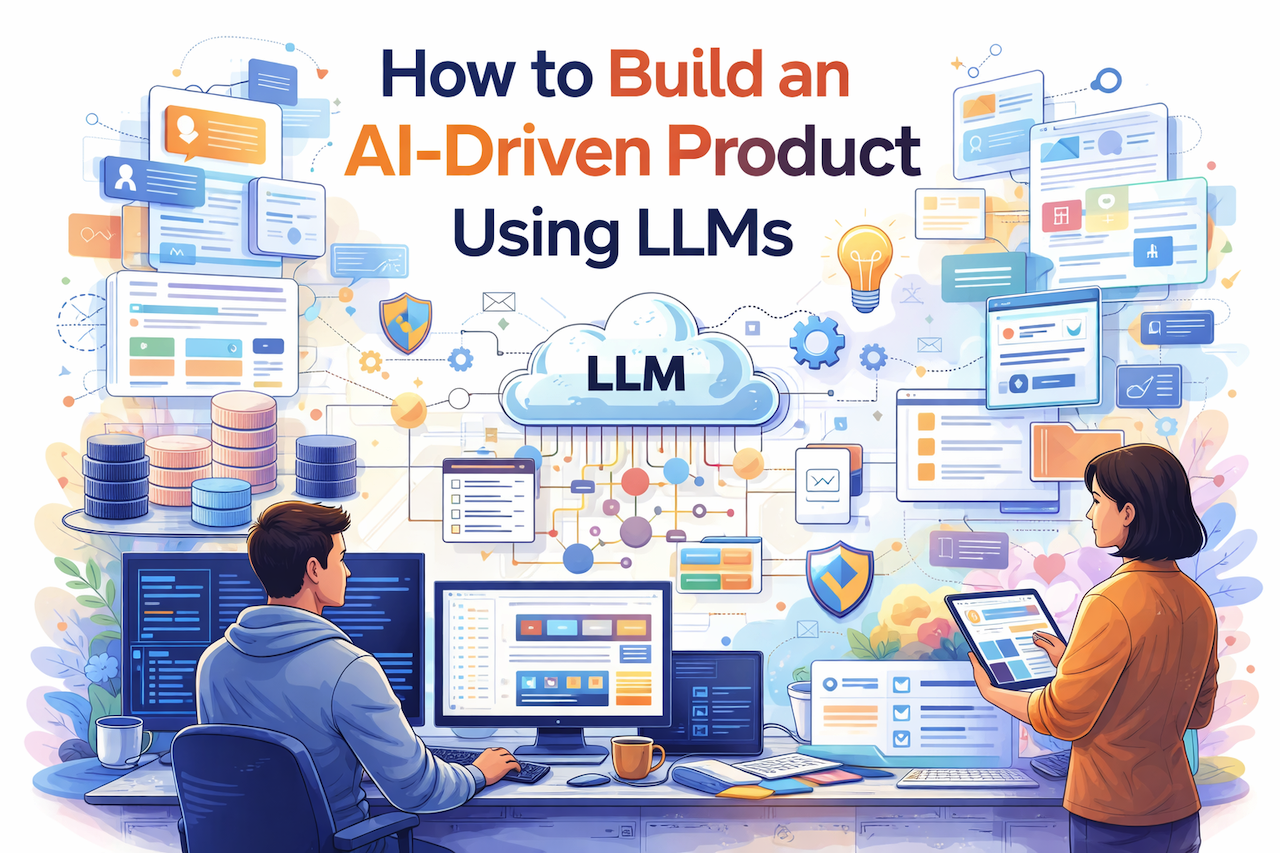
Featured Image generated by ChatGPT.
Share this post
Author

Leave a comment
All comments are moderated. Spammy and bot submitted comments are deleted. Please submit the comments that are helpful to others, and we'll approve your comments. A comment that includes outbound link will only be approved if the content is relevant to the topic, and has some value to our readers.
Comments (0)
No comment