

How Fresh Are "Fresh" SIM Owner Details? 5 Tests That Date Any SIM Database

Scope note: This guide applies to Pakistan. Its CNIC-based checks, official SIM Information System, operator procedures, and PECA references are specific to Pakistan. Readers elsewhere should use the same evaluation principles but follow their own regulator and mobile operator.
You can test whether a batch of “fresh” SIM owner details is credible in a few minutes because recency leaves evidence. Five practical checks can reveal whether the records behind that label are current, outdated, or impossible to verify, and none requires access to another person’s private information.
That matters because a database page rarely provides verifiable provenance. You may not be able to audit where its file came from, but you can check whether its operator labels, timestamps, and assumptions describe a Pakistan that no longer exists.
What a fresh SIM database is really promising
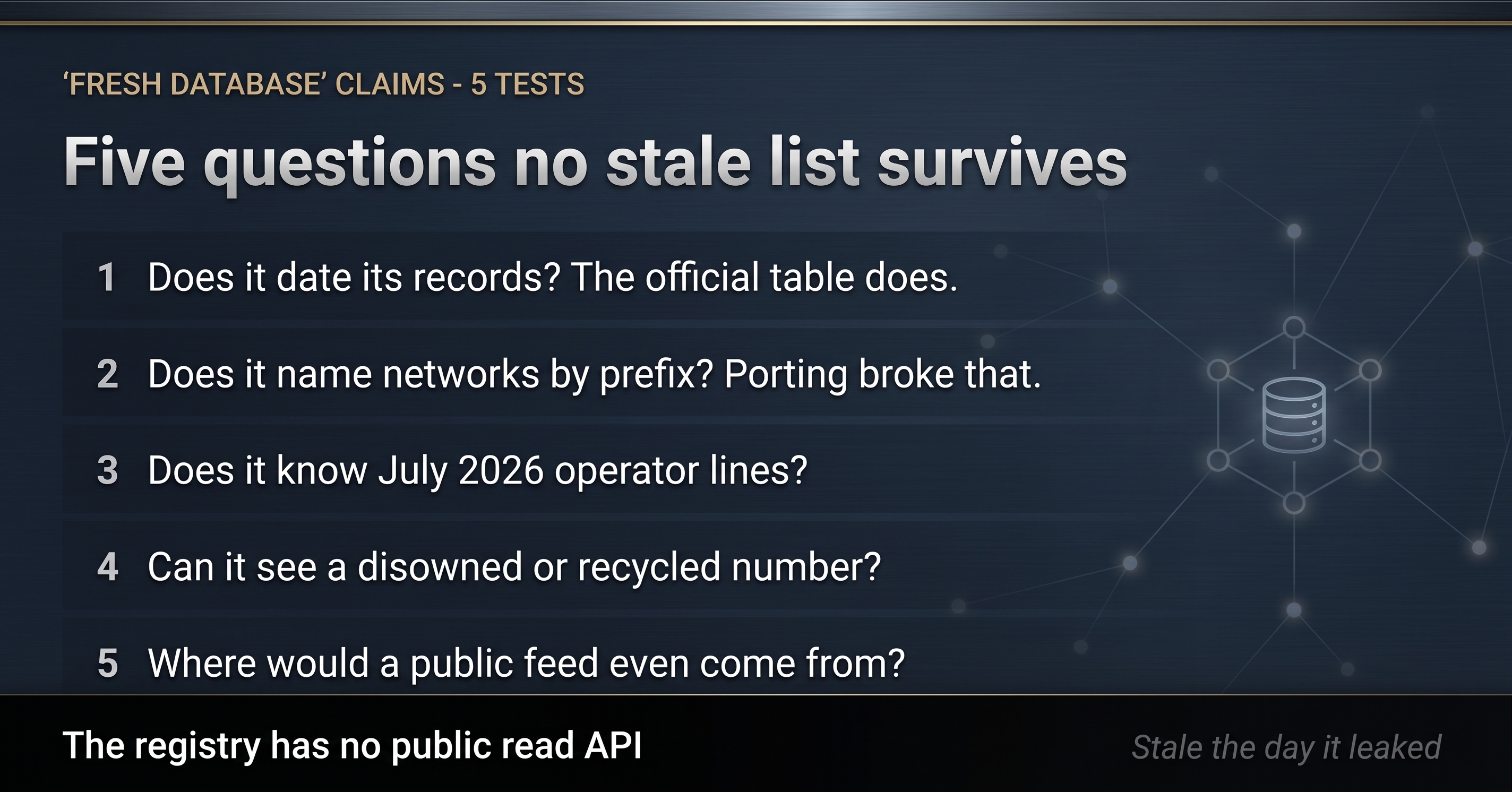
Five tests any fresh SIM database claim fails: no dated records, prefix-based networks, outdated operator labels, recycled numbers and unknown breach vintage
The phrase promises SIM owner details that are current today, yet many listings provide no collection date, update method, or lawful source. The practical question is simple: when was this copy made? The five tests below look for clues in the data itself, much as you would date an unlabeled map by the borders drawn on it.
Test 1: does the list read the network from the prefix?
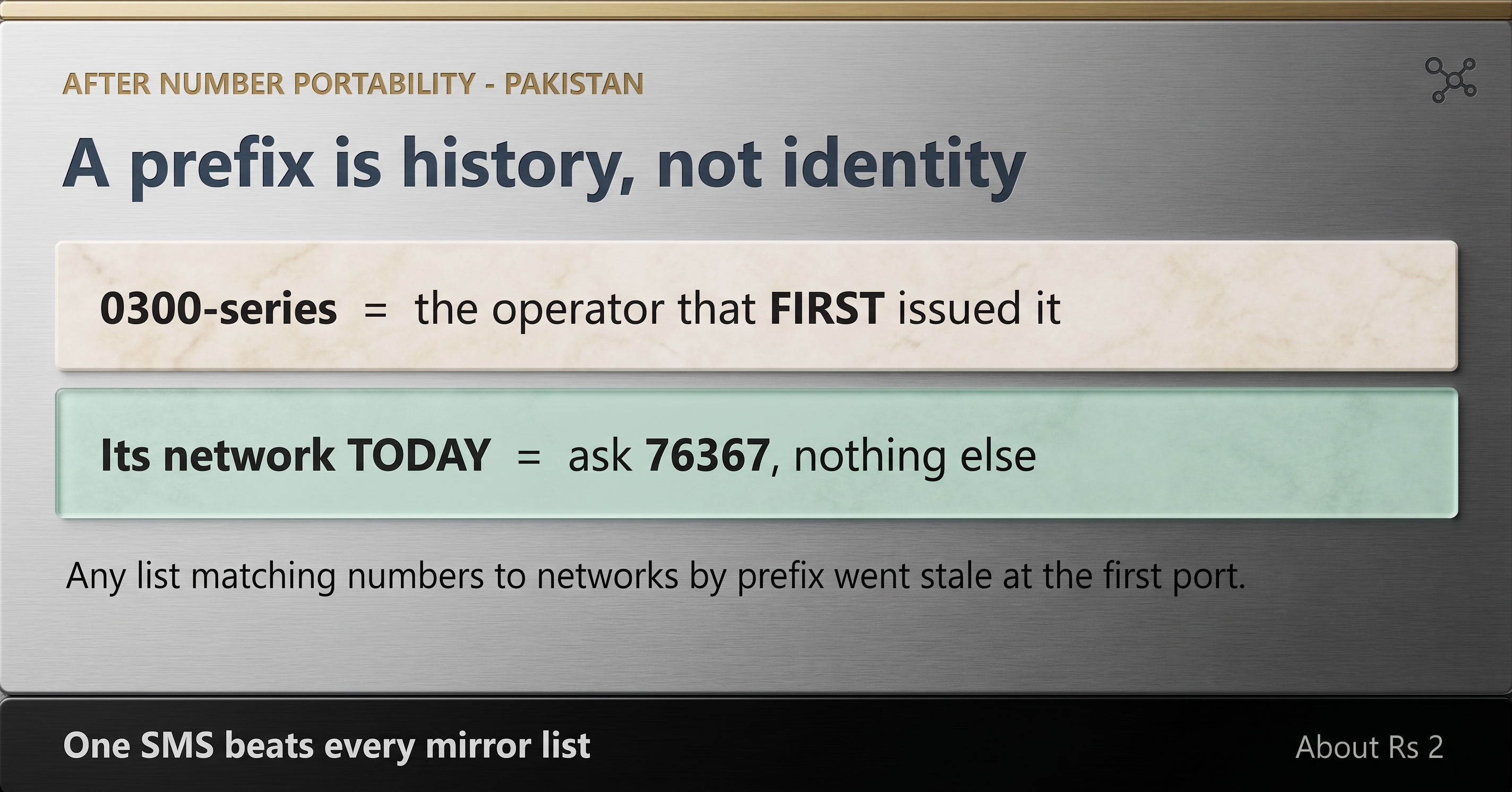
After number portability, a prefix may show the operator that first issued a number rather than the network serving it today. Confirm the current carrier through an authorized operator or regulator-supported method.
If it does, the copy predates number portability and admits it. For example, a Pakistani number can move between operators with every digit unchanged, so the opening digits record where a line began, not who serves it now. Any file whose network column is inferred from prefixes is running on logic that porting retired, and the SIM owner details beside that column are no younger.
To verify the serving network, use a current method recommended by PTA or the relevant mobile operator. If that result disagrees with a database assembled from number prefixes, the database has exposed an outdated assumption.
Test 2: does it rely on outdated operator labels?
Operator ownership, branding, and network labels can change while a copied database remains frozen. PTCL’s official acquisition documents, for example, describe the proposed acquisition of Telenor Pakistan and the approvals required to complete it. Treat any corporate-change date as something to verify from a current official source, and compare a database label with the operator that actually serves the number today. A static file has no reliable correction cycle.
Test 3: does anything on the page carry a date?
Often it does not, and that absence is useful evidence. A source that markets freshness should disclose when the data was collected, how it is updated, and what lawful source supports it. For the broader legal and privacy limits of checking a number, see our safe SIM owner details online check guide.
See the contrast for yourself. Enter your own CNIC at the official SIM Information System, and the result is a table of SIM counts by network. It provides counts for your identity rather than names or private records belonging to strangers. A transparent result explains its scope and comes directly from an authorized system.
Now open any page that claims to provide a fresh SIM database or current SIM owner details. No date on the file, no date on a row, no date anywhere on the screen. A product whose entire pitch is recency never commits to a timestamp, because a timestamp would invite the one comparison the official table survives: read it today, read it again next month, watch it move when something real changes. A frozen file printed with its true date would advertise its own age, so the date stays off, and the word fresh goes in the title instead.
Test 4: Could the number have changed hands since the copy?
Easily, and nothing inside the file will tell you when it happened. This test dates individual rows rather than the whole file. Leave a number unused for long enough, and the operator can withdraw it and issue it to a new subscriber later. Pakistan publishes no fixed timetable for that, so treat any page quoting an exact window with suspicion; the honest statement is simply that dormant numbers go back into the pool and are returned registered to somebody new, and the SIM owner's details move with them.
The registry absorbs that change on the day the new SIM is issued, because issuance happens at a counter, against a fingerprint. A circulating file has no counter and no fingerprints. Its row keeps the earlier subscriber's name for as long as copies exist, so the SIM owner details in a static list describe whoever held the number when the copy was made, and, for a recycled number, that is a person who may have released it years ago. Nothing in the file can even flag which rows have turned; every entry looks equally confident, and the confidence is part of the packaging.
Test 5: What vintage is the file itself?
The vintage of whatever incident produced it, because every fresh SIM database is a copy, and a copy stops updating the moment it is taken. So put a single question to the file: where would a new row come from? Operators publish no subscriber records. The official channels answer only the person a record belongs to, after checking who is asking. No feed exists for a reseller to subscribe to, and that stack of closed doors is the point: recency has no lawful supply route. A year tag in a filename is marketing, not provenance, and nothing inside a spreadsheet can certify when it was read. Whatever the banner says, the SIM owner details inside froze on the day the copy escaped, and every form of drift covered in tests 1 to 4 has been accumulating since.
The law also matters. Section 16 of Pakistan’s Prevention of Electronic Crimes Act, 2016 covers obtaining, selling, possessing, transmitting, or using another person’s identity information without authorization. It provides for imprisonment of up to three years, a fine of up to Rs 5 million, or both. Recency does not make unlawfully obtained identity data safe or lawful to possess.
Where current SIM owner details actually live
The registry stays current for a plain reason: every change is written the moment it happens, at a franchise counter, against a fingerprint. Issue a SIM, transfer one, disown one, and the record moves the same day. No download shares that property. Currently, in this subject, it can only mean reading from the live system just now, and the official channels do exactly that, each scoped to what you are entitled to see. It is also why a screenshot of an official reply proves little a month later; the checks are cheap precisely so they can be repeated.
- 668: Pakistan’s official cyber-crime prevention guidance recommends periodically checking the number of SIMs issued in your name by sending your CNIC number to 668. Confirm current formatting and charges with PTA or your operator before sending.
- SIM Information System: cnic.sims.pk portal lets you review network-level SIM counts associated with your own CNIC.
- Your mobile operator: For ownership corrections, disowning an unknown SIM, number-portability status, fees, or shortcode instructions, use the operator’s current official support channel. Procedures and charges can change.
The SIM owner details behind a number remain with the operator that registered it, which is why official self-service channels do not hand over a stranger’s name. If your official SIM count includes a network you do not recognize, contact that operator or PTA for the current verification, complaint, and deactivation procedure.
FAQ
Frequently asked questions
01How can I tell how old a SIM database's records really are?
Apply the five checks from this guide. A network column that follows number prefixes predates porting. No read-out date anywhere contrasts with the official portal, which stamps its counts table with the day it answered. And SIM owner details attached to long-dormant numbers may describe an earlier holder. Two failures or more mean the copy is old, whatever its listing claims.
02Do SIM owner details change when a number is ported or recycled?
Yes, both ways, which is why static lists rot. Porting moves a number to a different operator with its digits intact, so any stored network label can expire. Recycling hands a dormant number to a new subscriber, so the registered person changes completely. The live registry records each event as it happens; a downloaded file learns of neither, and its SIM owner details only drift further.
03Why do some lookup pages show outdated operator labels?
Because a copied file does not automatically learn about acquisitions, rebrands, ported numbers, or corrections. Treat an outdated operator label as evidence that the row needs verification through a current official source, not as proof of the subscriber's identity.
04Does any official check show a dated SIM record?
Use the official SIM Information System to review SIM counts associated with your own CNIC. Pakistan’s official cyber-crime prevention guidance also recommends sending your CNIC number to 668 periodically. Confirm current instructions and charges with PTA or your operator.
05Can a fresh SIM database at least get the network right?
Only if nothing has changed since the copy was made. Ported numbers can change operator without changing their digits, and operator brands or ownership can change as well. Confirm the serving network through a current operator or regulator-supported method rather than treating a stored database as authoritative.
The one-minute freshness verdict
Run the simplest checks first. Look for a collection date, update method, lawful source, current operator labels, and an explanation of how ported or recycled numbers are handled. A fresh SIM database that cannot answer those questions is not reliable enough for identity decisions. You do not need to submit personal information to evaluate its claims.
The trustworthy record is the one retrieved from an authorized source for a permitted purpose. Check your own SIM counts through cnic.sims.pk, follow current PTA or operator instructions, and never submit a CNIC or other sensitive information to a database seller. Freshness is not a label a copied file can prove; it depends on a current, authorized system.
Disclaimer
This article is for informational purposes only and does not provide access to private or confidential user data. SIM owner details such as full names, identification numbers, home addresses, or other sensitive information cannot be legally obtained through public websites or online tools. Any platform claiming to offer complete personal details should be avoided, as it may violate privacy laws or misuse user data.
Comments
Comments are available to signed-in users and are moderated to keep the discussion useful and respectful. Spam, automated submissions, and low-value promotional comments are removed. Outbound links may be approved when they are relevant and genuinely helpful to readers, but they are displayed as plain text rather than clickable hyperlinks.
No comments have been published yet.
Please sign in to submit a comment.