

How IP Address Data Is Used in Legal Investigations and Court Evidence
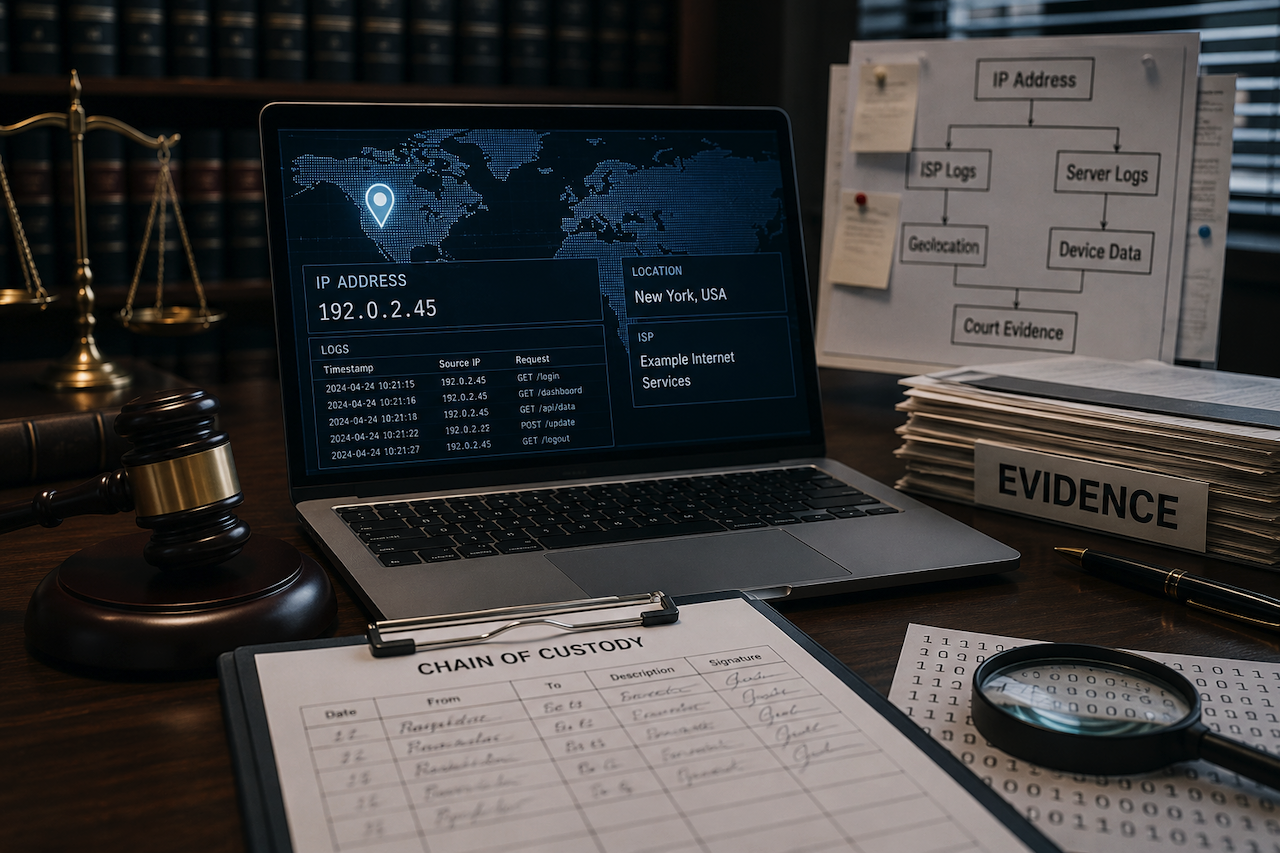
Every device connecting to the internet leaves a digital footprint. Internet Protocol (IP) addresses act as foundational markers, linking online activity to specific locations, networks, and devices. As cybercrimes and digital disputes increase, understanding how this technical data functions becomes critical for navigating the legal system.
Legal professionals, investigators, and forensic analysts regularly rely on digital logs to build legal arguments, investigate cyber incidents, and analyze online activity. By examining server requests and data packets, investigators can retrace a user’s digital steps with increasing precision. This guide explores how law enforcement collects IP data, the way forensic data analysis shapes modern trials, and the strict limitations of IP-based tracking in investigations.
The Role of IP Addresses in Online Identification
An IP address is a unique string of numbers assigned to every device communicating over a network. It serves a dual purpose: identifying the host device and providing network location information. When you visit a website, send an email, or stream a video, your device communicates using this specific numerical address.
Localization and IP tracking systems embedded in web platforms work by logging these server interactions. Platforms automatically record the user’s IP address, the exact timestamp of the visit, and the specific files requested from the server. This creates an objective audit trail of user activity. Investigators use this online identification data to prove that a specific internet connection accessed a platform at a given time.
Tech companies also use this data to route traffic efficiently. Content Delivery Networks (CDNs) analyze IP addresses to connect users to the closest physical server. While this localization improves website speed, it also generates permanent digital records that law enforcement can later request during an investigation.
How Law Enforcement Collects ISP Logs
Police and federal agents cannot access private internet records without proper legal authority. When an IP address surfaces in a cybersecurity investigation, law enforcement must identify the actual human user behind the screen. They achieve this by requesting ISP logs directly from Internet Service Providers such as Comcast, AT&T, or Cox.
To obtain this protected information, investigators use legal instruments such as administrative subpoenas or search warrants. A basic subpoena can compel an ISP to reveal the subscriber’s name, billing address, and account details associated with a specific IP address on a specific date. This initial step transforms an anonymous string of numbers into a concrete physical address for investigators to pursue.
If law enforcement needs deeper access, such as a history of websites visited or email contents, they must secure a judge-approved search warrant. Securing a warrant requires demonstrating probable cause. ISPs maintain these connection records for specific periods, meaning investigators must act quickly before the digital logs are legally purged from company servers.
Analyzing Geolocation Data and Forensic Evidence
Once law enforcement secures the ISP logs, digital experts step in to perform forensic data analysis. This specialized process involves cross-referencing timestamps from the ISP with the activity logs from the targeted platform or network. Exact time synchronization is crucial, as a discrepancy of just a few seconds can invalidate the findings.
Geolocation data helps investigators map the physical location of the router used during the incident. IP tracking relies on databases that map IP blocks to specific geographic regions. While an IP address rarely pinpoints an exact street address on its own without ISP subscriber records, it can quickly identify a user’s city, neighborhood, or zip code.
Analysts combine this geolocation data with other forms of digital evidence to build a comprehensive picture of a suspect’s movements. They may examine cell tower pings, device MAC addresses, or GPS coordinates embedded in uploaded photographs. Layering these different data points creates a web of evidence that is much harder to dispute in a courtroom setting.
Presenting Digital Evidence in Court
Gathering digital evidence is only the first phase of the legal process. Presenting it effectively before a judge or jury requires specialized technical and legal knowledge. Lawyers and legal teams regularly work with digital forensic experts to validate or challenge the accuracy of collected IP logs.
In both criminal and civil cases, prosecutors may use IP tracking to place a suspect at a digital “scene of the crime.” They present server logs and ISP records as objective evidence of user activity. The goal is to establish a direct connection between the online activity and a specific network or device.
Defense attorneys, however, heavily scrutinize the collection methods and the chain of custody. They examine whether search warrants violated constitutional privacy rights or whether digital evidence was mishandled during collection and storage. Reliable court evidence must be properly authenticated. Lawyers must demonstrate that the server data was not altered, spoofed, or misinterpreted during the investigation.
Identifying the Limitations of IP-Based Evidence
Despite its utility, an IP address identifies a network connection, not necessarily a specific individual. This technical reality creates significant limitations in legal investigations. Shared networks in coffee shops, libraries, hotels, or university dormitories mean dozens of unrelated people might share a single public IP address simultaneously.
Privacy tools further complicate online identification efforts. Virtual Private Networks (VPNs) and proxy servers intentionally mask a user’s true IP address by routing web traffic through encrypted external servers. If a suspect uses a VPN based in another country, tracing the original connection becomes a major jurisdictional and technical challenge.
Dynamic IPs also complicate investigative timelines. Most residential internet providers use dynamic IP addresses, which change frequently depending on network availability. An IP address assigned to one household on Tuesday may belong to a completely different user days later. Investigators must therefore match activity timestamps with extreme precision to identify the correct subscriber.
The Impact of Network Security on Legal Investigations
Because of these limitations, modern courts generally require more than an IP address alone to secure a criminal conviction. Hackers frequently spoof IP addresses or hijack vulnerable home Wi-Fi networks to conduct illegal activities. If a cybercriminal accesses an unsecured router to commit a crime, the victim’s IP address may incorrectly appear in server logs.
This reality highlights the importance of comprehensive cybersecurity investigation techniques. Investigators cannot stop at the IP address itself; they must search for corroborating evidence on physical devices. This may include local browser histories, downloaded files, hidden chat logs, or device metadata that ties a specific individual to the alleged activity.
A solitary IP address is rarely considered definitive proof in a courtroom. Instead, it functions as an investigative starting point that directs investigators toward a specific household, business, or network. From there, traditional detective work and deeper forensic analysis help build a legally sound case.
Conclusion
IP address data serves as a foundational element in modern legal investigations. From basic online identification to complex forensic data analysis, ISP logs provide a critical roadmap for law enforcement navigating the digital landscape. However, the limitations of shared networks, dynamic routing, and VPN usage mean that an IP address alone cannot always definitively identify an individual user.
Understanding the nuances of IP tracking, geolocation data, and legal privacy rights is essential for anyone involved in cybersecurity investigations or digital evidence cases. Digital evidence requires careful handling, precise timestamping, and rigorous authentication to withstand courtroom scrutiny. As online investigations become increasingly common, the role of IP-based evidence will continue shaping how courts analyze and interpret digital activity.
Disclaimer
This article is provided for informational and educational purposes only and should not be considered legal advice, cybersecurity advice, or professional investigative guidance. Laws regarding digital evidence, IP tracking, online privacy, subpoenas, and data collection vary by jurisdiction and may change over time. Readers should consult qualified legal or cybersecurity professionals regarding specific situations or legal matters.
Any references or links to third-party websites, services, or legal resources are provided solely for informational convenience. iplocation.net does not endorse, verify, or guarantee the accuracy, reliability, legality, or completeness of third-party content and is not liable for any loss, damage, legal issue, or consequence arising from the use of external websites, tools, or information referenced in this article.
Featured Image generated by ChatGPT.
Related Articles
February 3, 2026
Can Your IP Address Identify You During Legal Cases?
Yes, an IP address can be used in court. However, it often doesn’t identify a specific person on its own. Courts typically treat it as a starting point rather than proof.
Read More
August 25, 2025
Why is IP Address Data Important for Cybersecurity?
An IP address is a unique number assigned to every device connected to the internet, and every single online action, like sending an email or visiting a website, involves it. We ca...
Read More
June 13, 2025
What Is a Random IP Address Generator and How Does It Work?
Every device connected to the internet relies on a unique IP address to function. As networks scale and testing demands increase, tools that simulate, validate, or generate IP addr...
Read More
Comments
Comments are available to signed-in users and are moderated to keep the discussion useful and respectful. Spam, automated submissions, and low-value promotional comments are removed. Outbound links may be approved when they are relevant and genuinely helpful to readers, but they are displayed as plain text rather than clickable hyperlinks.
No comments have been published yet.
Please sign in to submit a comment.