

What is a VPN?
A Virtual Private Network (VPN) is a network technology that extends a private network (such as a LAN) over a public network, such as the Internet. A VPN allows a computer (or a network) to connect securely, as if it were physically wired together. Corporations use VPN to allow remote workers to connect securely to their private network. A VPN is also used to interconnect remote offices with a head office as if they are physically connected.
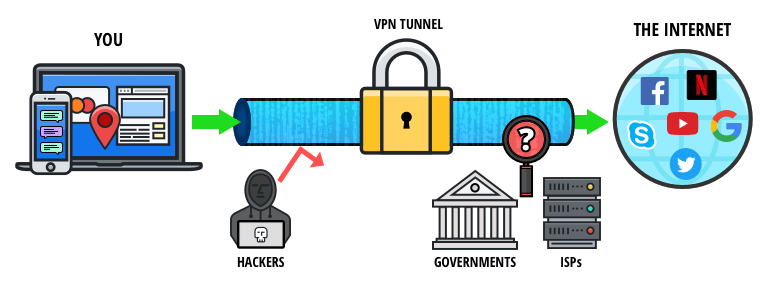
With the proliferation of the Internet, users are exposed to threats from the invasion of privacy and eavesdropping on Internet activities. To protect users' identities and privacy, a personal VPN service has been launched. A personal VPN service is identical to connecting to a corporate network, except users connect to servers provided by the VPN provider and obtain a new IP address from the country of their choice. We recommend our readers to explore personal VPN services offered by Express VPN.
Advantages
- The primary reason for implementing VPN technology is to create a secure connection to the other endpoint. Creating a WAN connectivity is very costly, and may not be practical for individual users making client-to-server connections. The information exchanged between the two VPN endpoints is encrypted; therefore, no eavesdropping can occur when it is transmitted over a public network.
- A VPN can also be used to hide your privacy by disguising the true IP address of the user's computer. Online gamers may use a VPN to hide IP address of their computers, and business owners may use a VPN to change IP address to protect their identity from their competitors.
Disadvantages
- Since all virtual private network traffic is encrypted, there will be a 10-15% increase in payload transmitted over VPN. This additional overhead causes (1) computing devices to use more processing power to encrypt the data, (2) send more data over the network, and finally (3) takes longer to transmit data as there will be 10-15% additional data. With advancements in computing and network technologies, the additional processing power required for encryption/decryption and the additional data transmission have a negligible impact on overall network usage.
- Not all VPN appliances interoperate well, so a VPN device from one vendor may not work well with a device from another vendor. A network engineer implementing the VPN technology must verify compatibility between the two endpoints. Similarly, a client-to-server connection may experience slowness (or degraded QoS) if the VPN is not properly configured.
VPN Protocols
A virtual private network is created by establishing a virtual tunnel between two endpoints via a virtual tunneling protocol or by data encryption. Some of the most popular VPN protocols include IPsec, SSL/TLS, PPTP, and L2TP.
- PPTP - Point-to-Point Tunneling Protocol is the oldest VPN protocol developed by a consortium founded by Microsoft, which is supported by the vast majority of operating systems. The encryption based on a 128-bit key has been cracked, and it is no longer considered very secure.
- L2TP/IPsec - Layer 2 Tunnel Protocol with IPsec encryption-based VPN provides more secure service with more features than PPTP. L2TP uses UDP port 500, so advanced configuration may be required to open a NAT firewall.
- Open VPN - OpenVPN is the open source technology developed on OpenSSL, which provides a very secure connection and strong encryption. It has become the default VPN connection type, and is widely supported by 3rd-party software, including iOS and Android.
Authentication
A VPN connection, whether it's a client to server or network to network, tunnel endpoints must be authenticated before establishing a secure connection. A user-initiated VPN connection either uses a password or two-factor authentication, whereas network-to-network tunnels often use digital certificates (private/public key combination).
Disclaimer
We receive compensation when a purchase is made from the referred link on this webpage. Our recommendation is based on our research and the positive feedback we received from the users who've used the services.
Related Articles
June 25, 2019
Why Smart Homes Need a VPN?
A smart home is a home connected through a network commonly referred to as the Internet of Things (IoT). This allows people to easily manage their appliances, thermostats, lighting...
Read More
May 18, 2019
How does a VPN Work?
A VPN, or a Virtual Private Network, is essentially an extension of a private network across the public space of the Internet between two endpoints. These two endpoints are two mac...
Read More
Comments
Comments are available to signed-in users and are moderated to keep the discussion useful and respectful. Spam, automated submissions, and low-value promotional comments are removed. Outbound links may be approved when they are relevant and genuinely helpful to readers, but they are displayed as plain text rather than clickable hyperlinks.
No comments have been published yet.
Please sign in to submit a comment.