

From Compliance to Risk Intelligence: Modernizing Enterprise Security Programs

Passing an audit does not always mean an organization understands its greatest risk.
A clear view of changes to business exposure is not necessarily the same as compliance, which demonstrates the existence of controls. Businesses are growing through the use of cloud, APIs, AI, and integrated services, and the gap is difficult to ignore. Risk conditions can change in days. Governance reviews often move much more slowly.
Modern security programs need more than compliance status. They need risk intelligence that connects operational signals to business impact, residual risk, and investment decisions.
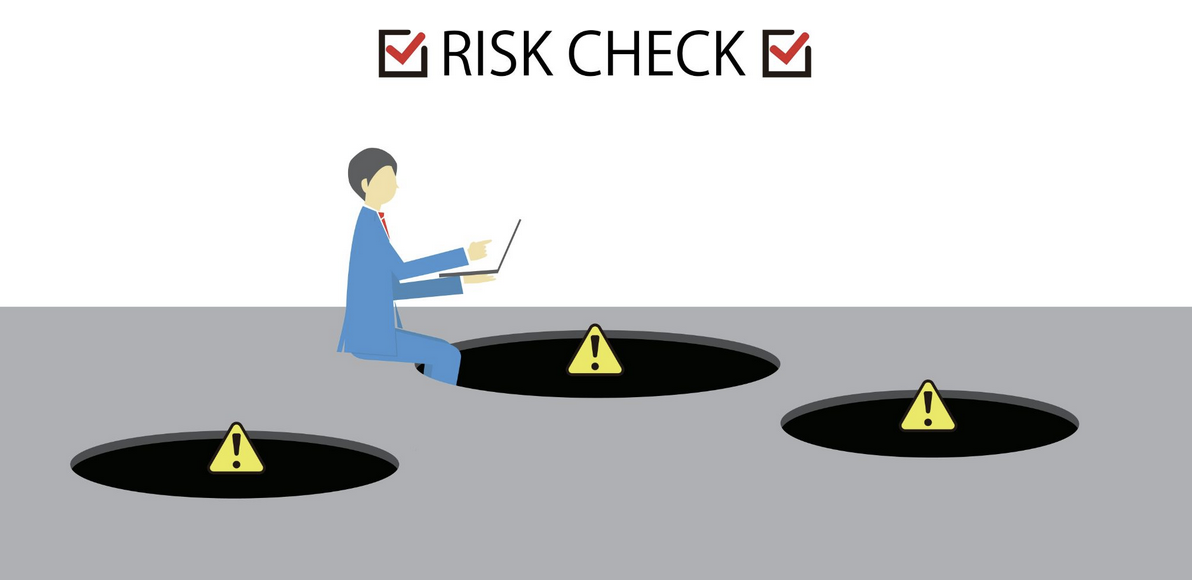
Image by Shutterstock.
Why Compliance Alone Cannot Define Enterprise Risk
Frameworks like ISO 27001, SOC 2, and NIST Cybersecurity Framework (CSF) 2.0 provide a solid governance foundation. They help teams organize controls, clarify accountability, and effectively demonstrate their security maturity.
The challenge emerges when compliance activities become the primary measure of security performance. Audit readiness does not necessarily reveal which technology risks carry the highest potential business impact. It does not include whether surging operational conditions have increased their exposure since the last assessment.
For security leaders and executives, it usually comes down to four key questions:
- What tech risks could actually take down our critical business services?
- Which exposures go beyond our risk tolerance?
- Where should we focus our remediation budget and resources?
- What operational signs tell us our exposure is growing?
Answering these requires moving from checking compliance boxes toward building continuous risk intelligence.
Building a Risk Register That Supports Business Decisions
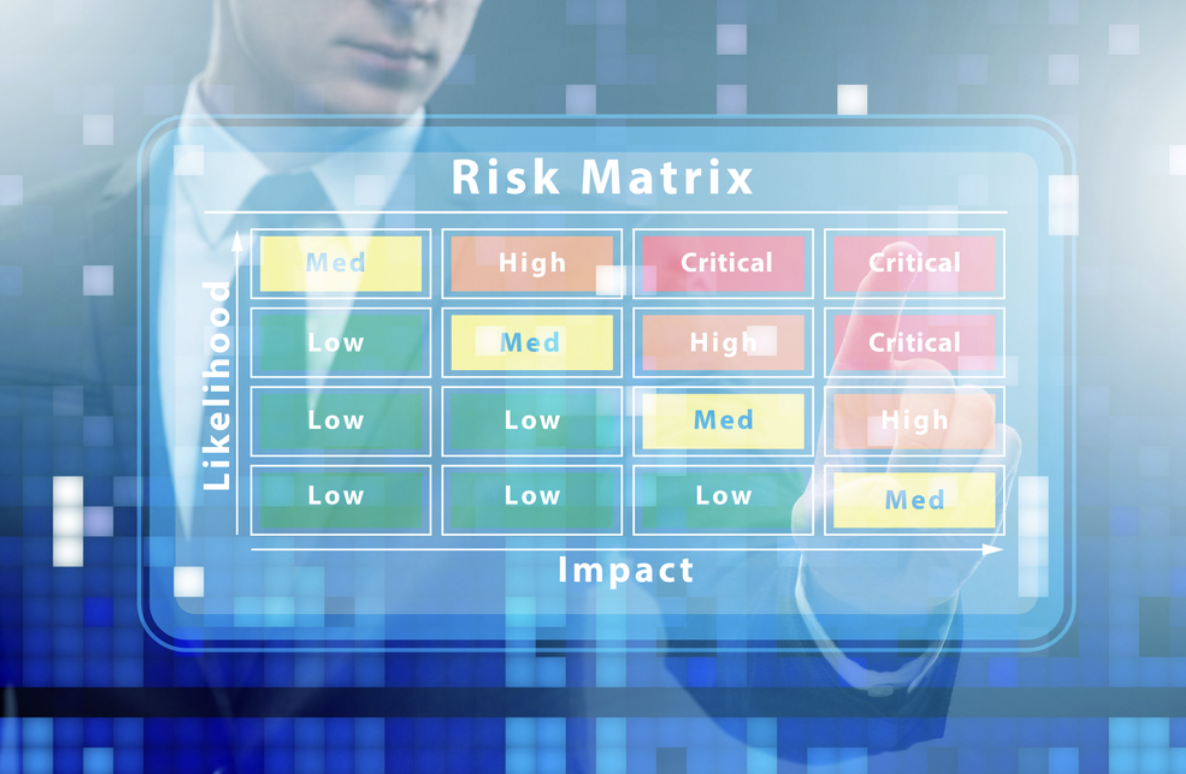
Image by Shutterstock.
In mature security programs, the risk register can be used not just for recording findings. It becomes a decision-making support mechanism that links risk consumption, assessment tasks, mitigation measures, monitoring, warning, and executive reporting.
Executives can only make decisions based on the quality of risk documentation.
Technical findings alone rarely provide sufficient context. For example, "lack of MFA" describes a control gap but does not explain business exposure. A stronger risk statement links technical conditions to operational consequences.
Consider inconsistent privileged access controls across cloud environments. The technical issue may appear limited at first glance. The business risks may include data breaches, service outages, FCC compliance, and reputational risks. That framing helps identify priorities by connecting technical issues to organizational outcomes.
| Component | Business Purpose |
|---|---|
| Risk Statement | Connects technical exposure to business impact |
| Business Impact | Supports prioritization decisions |
| Likelihood | Helps estimate how probable the risk scenario is |
| Existing Controls | Identifies mitigation already in place |
| Residual Risk | Shows remaining exposure |
| Risk Owner | Establishes accountability |
| Remediation Plan and Status | Tracks response progress |
Security controls also influence residual risk calculations. Strong authentication and data protection measures help reduce exposure. Organizations should understand how encryption algorithms support data security and risk reduction.
Why Governance Must Come Before GRC Platforms
Technology frequently receives attention before governance fundamentals receive sufficient investment.
Many risk programs are launched with disconnected information in spreadsheets, inconsistent terminology, and unclear ownership and responsibilities. If that’s the case, implementing an advanced governance, risk, and compliance (GRC) solution may overlook fundamental process gaps. The technology can become more complex than the process it is intended to support.
With a risk taxonomy, centralized intake workflows and review cadences, and impact criteria and likelihood definitions, consistency across the organization is created. Once those foundations are in place, risk data becomes easier to compare, monitor, and communicate.
From a governance perspective, risk management should support business objectives rather than operate as an isolated technical exercise. NIST SP 800-39 reinforces this concept by positioning risk management as an organization-wide process aligned with mission and business priorities.
Moving Beyond Qualitative Risk Ratings
High, Medium, and Low ratings remain common across enterprise security programs. They provide a simple method for categorizing findings and supporting operational triage.
As environments scale, those ratings often become subjective.
Different teams may interpret the same risk differently. Two high-rated risks may require very different levels of investment. Executive stakeholders frequently struggle to compare competing priorities when ratings lack financial or operational context.
Qualitative ratings remain useful for triage, but they become less effective when organizations rely on them as the primary basis for investment and prioritization decisions. Organizations seeking stronger prioritization frequently explore quantitative approaches that provide greater insight into probable business exposure.
Making Risk Quantification Practical

Image by Shutterstock.
Quantitative risk management often begins with the FAIR methodology. FAIR breaks cybersecurity risk into measurable components such as threat frequency, vulnerability, and probable loss magnitude. Instead of focusing exclusively on technical severity, the model helps translate security risk into business-relevant terms.
Implementation challenges are common. Many technology organizations lack mature historical loss data, standardized asset inventories, or highly consistent telemetry. Engineering environments also change continuously, making precision difficult to maintain over time.
With that, quantification should improve decision quality rather than pursue mathematical precision for its own sake.
Monte Carlo simulations extend that conversation. Instead of giving a single risk estimate, they create a range of possible outcomes to account for uncertainty and assumptions. Security leaders gain a better understanding of potential loss scenarios, making investment discussions more effective and resource allocation more sound. Research into automated cyber risk quantification using the FAIR model demonstrates how these approaches can support more data-driven risk analysis.
A starting point often includes:
- Critical cloud infrastructure
- Identity and privileged access governance
- Customer-facing production platforms
- AI and data governance initiatives
- Third-party dependencies
- Operational resilience scenarios
Even directional estimates can improve prioritization where qualitative ratings provide limited business context.
From Static Reviews to AI-Assisted Risk Intelligence
Risk conditions rarely wait for quarterly reviews. Common signals can appear at any point in the operational lifecycle, including:
- Cloud misconfigurations
- Identity governance violations
- Delays in vulnerability remediation
- Security incidents
- Endpoint telemetry findings
- CI/CD pipeline failures
- AI governance alerts
Continuous diagnostics and monitoring help organizations detect changing exposure before formal assessment cycles. As telemetry becomes part of governance, risk management shifts from periodic review toward continuous visibility.
Many organizations still track intake, assessment, remediation, and reporting across disparate systems. AI can be used to analyze findings, standardize risk statements, correlate telemetry, add asset criticality and threat intelligence, map frameworks, and recommend prioritization actions.
Repeated privileged access violations may justify higher residual risk ratings for identity governance. Recurring cloud exposure findings may trigger reassessment workflows before the next manual review.
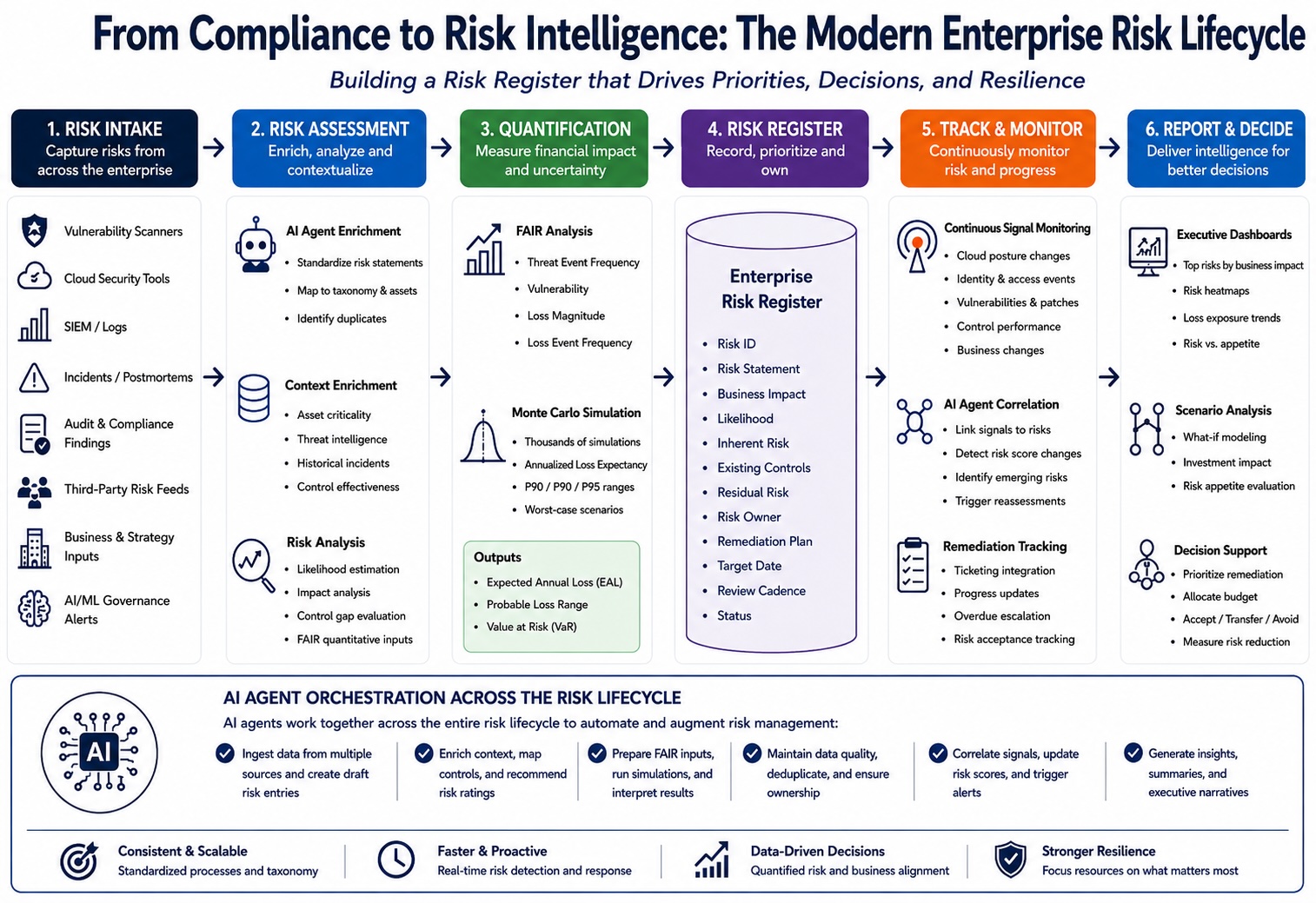
These capabilities create a more connected risk lifecycle of governance, quantification, monitoring, and response, with each continuously informing the others.
Turning Risk Intelligence Into Executive Action
Over time, the risk register becomes an adaptive intelligence layer that responds to changing operational conditions within the enterprise. It's no longer about passing an audit or holding enterprise security maturity certificates. That relies on organizations' ability to translate operational signals into risk intelligence or intelligence relevant to their business. It helps with investment decisions, resilience planning, and discussions of risk tolerance.
This transition is not an enterprise-wide quantification that needs much investment in technology. It begins with stronger governance, clearer risk ownership, better visibility, and a disciplined connection between security activities and business outcomes. Organizations that build those capabilities can move beyond periodic compliance snapshots and manage risk with greater confidence.
Featured Image generated by ChatGPT.
Related Articles
January 24, 2026
The Growing Importance of IP Intelligence for Security, Compliance, and Personalization
IP intelligence used to be one of those “backend” things most teams only thought about when something broke. A bad login spike. A sudden wave of bots. A market expansion that trigg...
Read More
December 16, 2024
Understanding the Role of Application Security Services in Risk Management
In an era where enterprises rely on applications to drive daily operations, each app presents both an opportunity and a potential risk. According to a recent Salesforce survey, the...
Read More
November 20, 2024
How AI-Powered GRC Tools Are Making Cyber Security Compliance a Breeze
Cyber security compliance can feel like a never-ending maze. With countless rules, standards, and audits, many businesses struggle to keep up and stay secure.
Read More
Comments
Comments are available to signed-in users and are moderated to keep the discussion useful and respectful. Spam, automated submissions, and low-value promotional comments are removed. Outbound links may be approved when they are relevant and genuinely helpful to readers, but they are displayed as plain text rather than clickable hyperlinks.
No comments have been published yet.
Please sign in to submit a comment.