

Are Your Encrypted Tunnels Safe from Tomorrow’s Computers?
The Emerging Threat to Encryption
In today’s digital economy, encrypted tunnels form the backbone of secure communication, data transfers, and privacy preservation across networks. These tunnels rely on cryptographic protocols that, until recently, have been considered robust against cyber threats. However, as quantum computing technology rapidly advances, the very encryption standards safeguarding our data face unprecedented challenges. Organizations must urgently assess whether their encrypted tunnels will withstand the computational power of tomorrow’s quantum machines.
Quantum computers operate fundamentally differently from classical computers. While classical systems process bits in binary states of 0 or 1, quantum computers utilize qubits, which can exist in multiple states simultaneously due to quantum superposition. This unique property enables quantum machines to solve certain mathematical problems exponentially faster, particularly those that underpin current encryption algorithms such as RSA and ECC (Elliptic Curve Cryptography). Unlike classical computers, which perform calculations sequentially or with limited parallelism, quantum computers exploit phenomena such as entanglement and interference to explore vast solution spaces simultaneously.
This quantum advantage poses a direct threat to many existing cryptographic mechanisms. Encryption algorithms that rely on the difficulty of factoring large numbers or solving the discrete logarithm problem are foundational to securing encrypted tunnels, VPNs, and TLS connections. However, quantum algorithms, most notably Shor’s algorithm, can efficiently solve these mathematical problems, rendering these encryption methods vulnerable once sufficiently powerful quantum computers become available.
Organizations providing managed IT services and overseeing secure network infrastructure must recognize this emerging threat and prepare accordingly. The stakes are high: adversaries could intercept encrypted data today and decrypt it retroactively once quantum computing resources become accessible, compromising confidentiality and privacy.
The Imminent Risk to Current Encryption Standards
Most encrypted tunnels today use public-key cryptographic schemes based on the computational difficulty of problems such as integer factorization and the discrete logarithm problem. These problems are currently infeasible for classical computers to solve within a reasonable timeframe, thereby ensuring secure key exchanges and encrypted communication. However, this security assumption breaks down in the face of quantum computing.
Shor’s algorithm, developed in 1994, provides a polynomial-time quantum solution to factoring large integers and computing discrete logarithms. This means that quantum computers running Shor’s algorithm could break widely used asymmetric encryption schemes like RSA and ECC. For instance, RSA-2048, a common encryption standard, is considered secure against classical attacks but vulnerable to quantum attacks.
According to the National Institute of Standards and Technology (NIST), quantum computers capable of breaking RSA-2048 encryption may emerge within the next decade, though exact timelines remain uncertain. This forecast emphasizes the urgency for organizations to adopt proactive strategies.
One critical aspect to understand is “harvest now, decrypt later” attacks. Malicious actors can capture encrypted traffic today and store it, anticipating future quantum decryption capabilities. This makes even currently encrypted data vulnerable to future compromise, particularly for sensitive information requiring long-term confidentiality.
Organizations using secure communication platforms, such as Hardin Technology, should consider evaluating quantum-resistant protocols as part of their long-term security planning.
Understanding Post-Quantum Cryptography
Post-quantum cryptography (PQC) is an emerging field dedicated to developing cryptographic algorithms resistant to quantum attacks. Unlike classical algorithms vulnerable to Shor’s algorithm, PQC schemes are based on mathematical problems believed to be hard even for quantum computers. These include lattice-based, hash-based, code-based, multivariate polynomial, and isogeny-based cryptography.
Lattice-based cryptography, for example, relies on the hardness of problems such as the Shortest Vector Problem (SVP) and Learning With Errors (LWE), which currently have no known efficient quantum algorithms to solve them. Hash-based signatures use cryptographic hash functions to create secure digital signatures, offering another promising avenue.
The National Institute of Standards and Technology (NIST) has been leading a global effort to standardize PQC algorithms. In July 2022, NIST announced the first four quantum-resistant cryptographic algorithms selected for standardization, marking a significant milestone in the transition toward quantum-safe encryption.
Businesses and cybersecurity professionals must familiarize themselves with these developments and begin integrating PQC into their security frameworks, especially in critical areas like VPNs, TLS, and encrypted tunnels.
Steps to Secure Encrypted Tunnels Against Quantum Threats
Transitioning to quantum-safe encryption requires a comprehensive and strategic approach. Organizations should consider the following steps:
- Inventory and Risk Assessment: Conduct a thorough audit of all encrypted tunnels and communication channels. Identify which systems handle the most sensitive data or have the longest confidentiality requirements. Assess the potential impact of a quantum decryption breach on these systems.
- Algorithm Selection: Adopt post-quantum algorithms standardized or recommended by authoritative bodies such as NIST. Evaluate their performance, interoperability with existing infrastructure, and suitability for specific applications.
- Hybrid Cryptography: Implement hybrid encryption schemes that combine classical algorithms with quantum-resistant ones. This approach allows for backward compatibility and gradual transition while maintaining strong security.
- Infrastructure Readiness: Ensure existing systems, applications, and network environments are prepared to support quantum-safe protocols and evolving encryption standards.
- Training and Awareness: Educate IT teams, developers, and stakeholders about quantum computing risks and mitigation strategies. Cultivating organizational readiness ensures smooth adoption and reduces operational risks.
A 2023 Gartner survey found that 45% of enterprises plan to adopt quantum-resistant encryption within the next five years, reflecting growing awareness and urgency in the business community. This trend highlights the increasing prioritization of quantum security in corporate strategies.
The Importance of Early Action
The window for proactive adaptation is narrowing. Quantum computing research and development are accelerating, fueled by significant investments from governments and private companies worldwide. While fully functional quantum computers capable of breaking current encryption standards are not yet available, the rapid pace of progress demands immediate attention.
Organizations that delay transitioning to quantum-resistant encryption risk exposure to future breaches, regulatory penalties, and reputational damage. Data with long-term confidentiality needs, such as financial records, healthcare information, and government communications, are particularly vulnerable.
Understanding the nuances of quantum security can help organizations streamline the transition to quantum-resistant encryption. Conducting risk assessments, developing implementation roadmaps, and maintaining ongoing monitoring are important steps in helping encrypted tunnels remain secure as the threat landscape evolves.
Moreover, adopting quantum-safe encryption is not merely a technical upgrade; it is a strategic imperative. It safeguards the integrity and confidentiality of digital communications, reinforces customer trust, and demonstrates a commitment to forward-looking security practices.
Conclusion: Don’t Wait Until It’s Too Late
The advent of quantum computing will undoubtedly reshape the cybersecurity landscape. Encrypted tunnels, which underpin secure digital communication, must evolve to meet this new challenge—waiting until quantum computers can break current encryption could leave sensitive data irrevocably exposed.
By understanding the risks and beginning the transition to quantum-resistant encryption today, businesses can protect sensitive data and maintain operational integrity well into the future. The path forward requires ongoing vigilance, strategic planning, and continued adaptation to emerging security challenges.
Ensuring that your encrypted tunnels are safe from tomorrow’s computers is not just a technical necessity; it is a fundamental component of any enterprise’s commitment to security and trust in the digital age. The time to act is now.
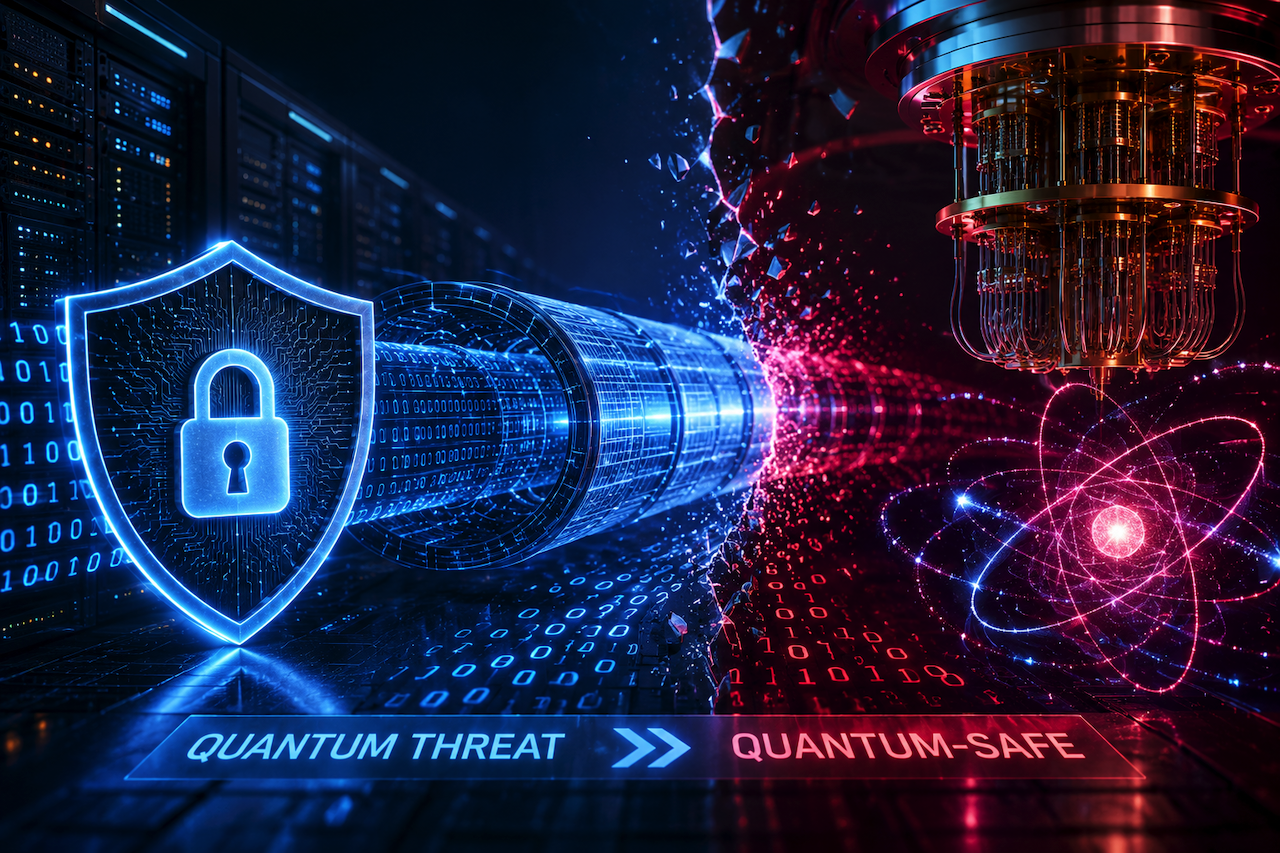
Featured Image generated by ChatGPT.
Related Articles

April 28, 2025
The Front Lines of Cyber Defense: Keeping Employee Devices Safe
You've likely overlooked the most vulnerable point in your organization's cybersecurity: unmanaged personal devices accessing company resources. While 82% of IT leaders have implem...
Read More
March 5, 2025
Top 6 Security Tools to Keep Your Android Device Safe
In a world where cyber threats are growing more sophisticated, keeping your Android device secure is more crucial than ever. With hackers targeting personal data, banking details,...
Read More
June 26, 2024
How Quantum Computing is Redefining Cybersecurity Challenges
The advent of quantum computing marks a significant milestone in technology, promising unprecedented computational power that could solve complex problems in seconds, which would t...
Read More
Comments
Comments are available to signed-in users and are moderated to keep the discussion useful and respectful. Spam, automated submissions, and low-value promotional comments are removed. Outbound links may be approved when they are relevant and genuinely helpful to readers, but they are displayed as plain text rather than clickable hyperlinks.
No comments have been published yet.
Please sign in to submit a comment.