

IP Address, Cybersecurity, Proxies
Why Mobile Proxies Challenge Modern Fraud Prevention

Mobile networks have always been associated with real users. When a request comes from a mobile carrier, it often appears more trustworthy than traffic coming from a data center or suspicious hosting environment. However, this assumption is becoming increasingly unreliable.
Mobile proxies allow automated traffic to operate through legitimate carrier networks, making malicious activity harder to identify. For fraud teams, this creates a new challenge: how to distinguish genuine mobile users from automated abuse when both appear to come from the same type of network infrastructure.
Why Mobile Carrier IPs Can Distort Risk Signals
The challenge with mobile proxies manifests as a fundamental contradiction in server logs. A request arrives from a reputable mobile carrier (e.g., 4G, 5G, or LTE) with a clean ASN and a plausible geographic footprint. Yet, the underlying session behavior screams automation.
This "split personality" is what makes mobile proxies so effective for bad actors. By routing traffic through a network of real mobile devices, attackers can mask their scripts as ordinary handsets. To most standard security filters, these requests appear as just another smartphone on a cellular network rather than a suspicious cloud instance or a known botnet node.
How Mobile Proxies Hide Automated Abuse
Mobile proxies create a unique challenge for fraud prevention because they separate the visible network identity from the actual behavior behind the request. Instead of connecting directly from a data center or suspicious hosting environment, automated tools can route traffic through mobile carrier networks. The target application receives a request that appears to come from a regular mobile subscriber, while the automation infrastructure generating that activity remains hidden. This creates a gap between what the network layer shows and what is actually happening.
The problem becomes more complicated because mobile networks are naturally designed around shared and dynamic infrastructure. Many mobile operators use Carrier-Grade Network Address Translation (CGNAT), which allows multiple subscribers to share the same public IPv4 address. While this architecture is essential for modern mobile connectivity, it also introduces challenges for fraud detection.
First, shared IP reputation can reduce the reliability of traditional blocking strategies. A single mobile IP may represent thousands of legitimate users, meaning aggressive blocking can easily result in false positives.
Second, mobile networks are highly dynamic. Users frequently receive different IP addresses as they reconnect or move between network locations. Attackers can take advantage of this natural volatility by rotating traffic sources and making automated activity appear distributed.
Third, mobile proxies can create geographic and network-level deception. Automated traffic can appear to originate from specific carriers or regions, making it more difficult for location-based fraud rules to distinguish legitimate users from coordinated abuse.
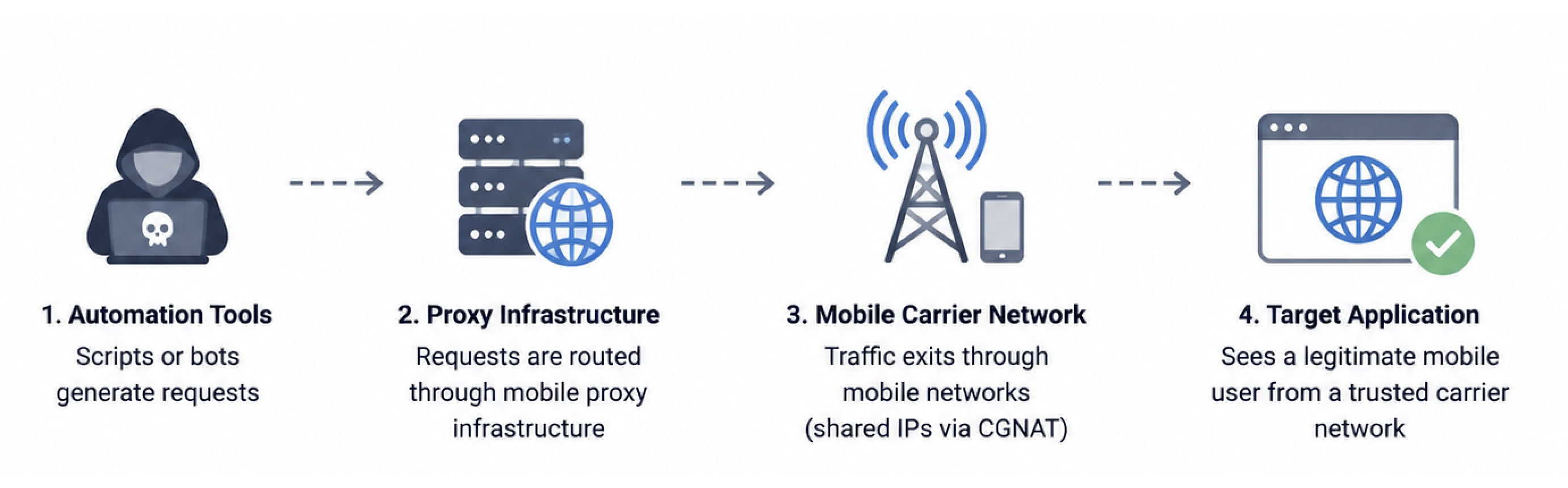
However, changing the network identity does not change the underlying intent. While mobile proxies can hide where automated traffic comes from, they do not remove the behavioral patterns, device relationships, or account signals that reveal coordinated activity.
This is why modern fraud prevention cannot rely on IP reputation alone. Organizations need to combine network intelligence with device identity, behavioral analysis, and business context to accurately evaluate risk.
Common Abuse Scenarios Behind Mobile Proxies
Mobile proxies are not inherently malicious. Many businesses use mobile network environments for legitimate purposes such as testing, localization, or advertising verification. However, the same characteristics that make mobile proxies valuable for these use cases also make them attractive to attackers.
By routing automated activity through mobile networks, fraudsters can make large-scale abuse appear like normal user traffic. Common abuse scenarios include:
1. Fake Account Creation and Account Abuse
Mobile proxies are frequently used in large-scale account abuse campaigns. Attackers can distribute registration requests across different mobile IP addresses, making it harder for traditional IP-based controls to identify repeated attempts.
These activities are often linked to fake accounts created for promotional abuse, referral manipulation, or gaining unauthorized access to platform benefits. While the source IPs may appear different, underlying patterns such as similar device environments, registration behaviors, or account activity can reveal coordinated campaigns.
2. Credential Attacks and Account Takeover Attempts
Credential stuffing and automated login attempts are another common risk area.
Attackers may use mobile proxy networks to rotate traffic sources and avoid simple rate limits based on IP address. This allows login attempts to appear distributed across many users rather than originating from a single suspicious location.
However, changes in IP addresses do not necessarily change the behavior behind the activity. Repeated login patterns, unusual request timing, and abnormal account interactions can still provide strong indicators of automated attacks.
3. Scraping, Inventory Monitoring, and Promotion Abuse
Mobile proxies can also be used to support automated scraping and commercial abuse.
For e-commerce platforms, attackers may collect pricing information, monitor inventory availability, or target limited products. In other cases, automated traffic may attempt to exploit coupons, referral programs, or promotional campaigns by creating artificial demand.
Although these activities may not always involve direct account compromise, they can create operational challenges by affecting inventory accuracy, increasing infrastructure costs, and reducing the quality of customer experiences.
Mobile Proxies Are a Risk Signal, Not a Verdict
Mobile proxies create a unique challenge because the network identity itself is not necessarily suspicious. A request may originate from a legitimate carrier network, use a valid mobile ASN, and appear geographically consistent with real users. This means mobile proxy detection should not focus on identifying and blocking every proxy connection. Mobile networks are widely used for legitimate activities, including application testing, localization checks, and advertising verification. The real challenge is determining whether the activity behind the connection represents a genuine user or an automated workflow attempting to hide behind mobile infrastructure.
A mobile carrier IP should therefore be treated as a risk signal rather than a final decision point. The strongest detection strategies combine network intelligence with additional signals such as device identity, behavioral patterns, account relationships, and business context. The goal is not to eliminate mobile traffic. It is to identify when normal-looking mobile activity no longer matches expected user behavior.
How Mobile Proxies Differ From Other Proxy Networks
Not all proxy networks create the same challenges for fraud prevention. While different proxy types can be used for legitimate purposes, they expose different levels of visibility and risk signals for security teams.
| Proxy Type | How It Works | Common Characteristics | Fraud Detection Challenges |
|---|---|---|---|
| Mobile Proxies | Routes traffic through real mobile carrier networks using 4G, 5G, or LTE connections. | Uses carrier IPs, mobile ASNs, dynamic IP allocation, and shared network infrastructure. | Difficult to distinguish from genuine mobile users because traffic inherits trusted carrier signals. |
| Residential Proxies | Routes requests through consumer ISP connections and residential IP addresses. | Appears similar to home users and is often associated with specific regions or households. | Can bypass location-based rules and make automated activity appear like normal consumer traffic. |
| Datacenter Proxies | Uses IP addresses from cloud providers, hosting companies, or dedicated servers. | Stable infrastructure, easier ASN identification, and high-volume traffic capability. | Easier to classify, but legitimate cloud users may also appear from these networks. |
| VPN Traffic | Encrypts and routes user traffic through VPN servers. | Often used for privacy, remote work, travel, or accessing regional content. | VPN usage alone does not indicate abuse and requires additional behavioral context. |
The key difference with mobile proxies is that they operate within infrastructure already associated with legitimate users. A request coming from a mobile carrier network may look trustworthy at the network level, even when the underlying activity is automated.
For this reason, proxy classification should be treated as one piece of evidence rather than a final decision. Effective fraud prevention requires combining network intelligence with device identity, behavioral analysis, and business context.
Why IP Rotation Does Not Eliminate Fraud Signals
One of the biggest misconceptions about mobile proxies is that changing IP addresses can completely hide automated activity.
In reality, rotation only changes one part of the request profile. It does not remove the relationships and patterns that exist across an attack campaign.
Even when attackers distribute activity across hundreds or thousands of mobile IP addresses, they may still reveal common characteristics, including:
- Similar device environments
- Repeated browser or application behaviors
- Identical registration flows
- Similar login patterns
- Shared payment information
- The same targeted products, promotions, or accounts
This means security teams should analyze activity across sessions rather than evaluating each request independently.
A rotating mobile IP may make an individual request appear normal, but coordinated behavior across multiple sessions can reveal the larger campaign behind it.
How Can Security Teams Detect Fraud Beyond Source Blocking?
As automated threats like credential stuffing, promotional abuse, and inventory scalping become more refined, security teams must evolve. The core realization is that an IP label is merely context, not a verdict.
A robust defense strategy must be built on a multi-dimensional signal matrix:
1. Device Integrity and Fingerprinting
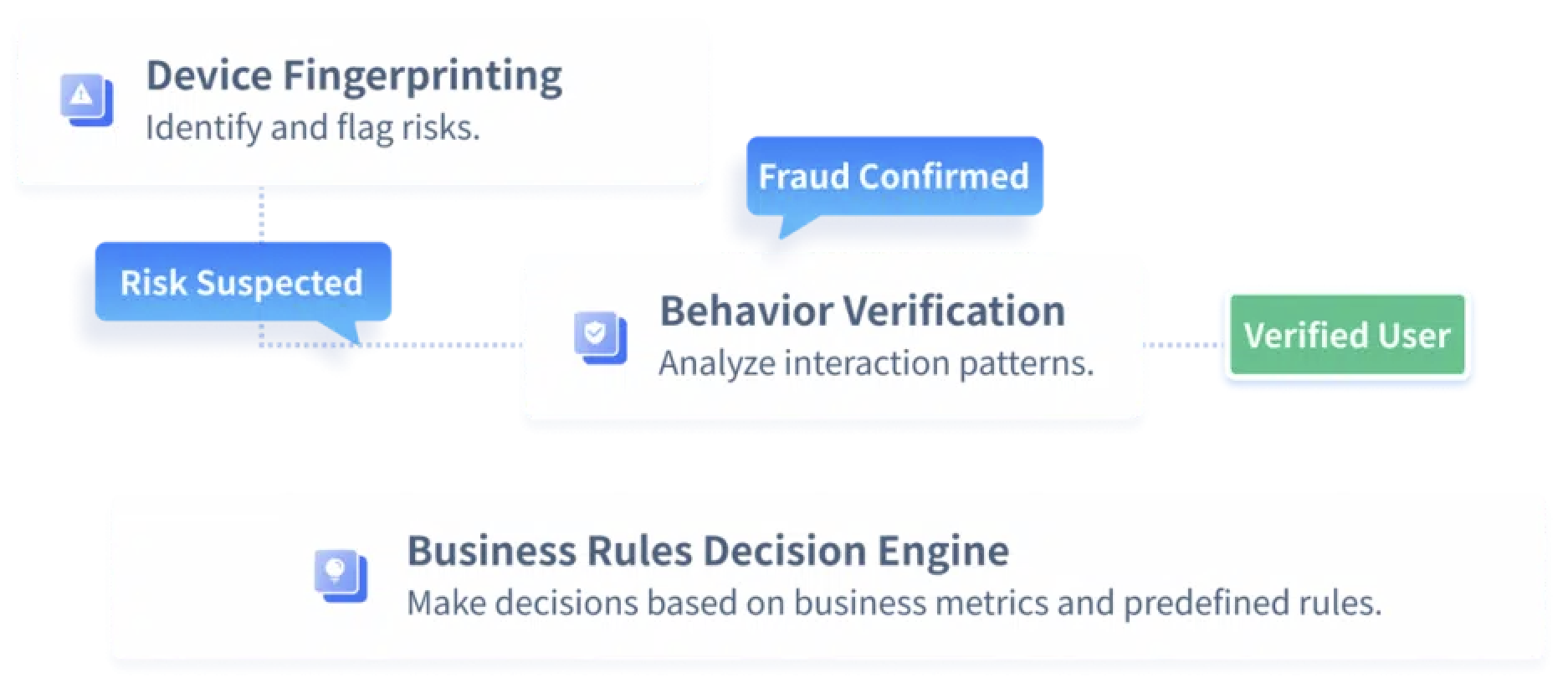
When the network layer becomes unreliable, the device layer provides critical clarity. Advanced device fingerprinting can detect the subtle discrepancies of emulators, inconsistent browser environments, and hardware spoofing. A genuine mobile user maintains a logical continuity across their session, whereas proxy-driven bots often reveal themselves through fragmented or unstable device identities.
2. Behavioral Intelligence
Even the most sophisticated proxy cannot perfectly replicate the nuances of human interaction. Beyond simple request rates, teams can examine navigation depth, form completion speed, cursor movement, and interaction patterns during adaptive challenges such as GeeTest Adaptive CAPTCHA. Behavioral analysis helps distinguish the mechanical precision of automated scripts from the natural variation of human activity.
3. Challenge Intelligence
Verification challenges provide another important layer of behavioral evidence. A successful security decision should not only consider whether a user passes a challenge, but also how that interaction occurs. Repeated failures, unusual retry patterns, abnormal completion speed, or inconsistent behavior across sessions can indicate automated activity even when the request originates from a trusted mobile network.
Adaptive verification approaches allow organizations to increase friction only when risk signals appear, instead of applying the same challenge level to every user. This helps security teams maintain protection against automated abuse while reducing unnecessary disruption for legitimate mobile users.
4. Business Context Correlation
Attackers are ultimately motivated by business value, whether they are targeting discount codes, limited-edition SKUs, or high-value accounts. By correlating signals across the business logic layer, security teams can uncover activity patterns that share common traits, such as the same payment method, referral code, or account targets, even when requests come from hundreds of different mobile IP addresses.
Conclusion: Moving Beyond IP-Based Fraud Prevention
Mobile proxies demonstrate a broader change in the fraud landscape. Attackers no longer need to rely on obviously suspicious infrastructure. They can operate through legitimate networks and make automated activity appear similar to normal users. For organizations, the solution is not stronger IP blocking. It is a more complete understanding of user identity, behavior, and intent.
By combining device intelligence, behavioral analysis, adaptive verification, and business context, security teams can detect sophisticated automation while reducing unnecessary friction for real customers.
Comments
Comments are available to signed-in users and are moderated to keep the discussion useful and respectful. Spam, automated submissions, and low-value promotional comments are removed. Outbound links may be approved when they are relevant and genuinely helpful to readers, but they are displayed as plain text rather than clickable hyperlinks.
No comments have been published yet.
Please sign in to submit a comment.