

IP Address, Virtual Private Network, Geolocation
The Hidden Infrastructure Behind a Compliant Global Remote Workforce
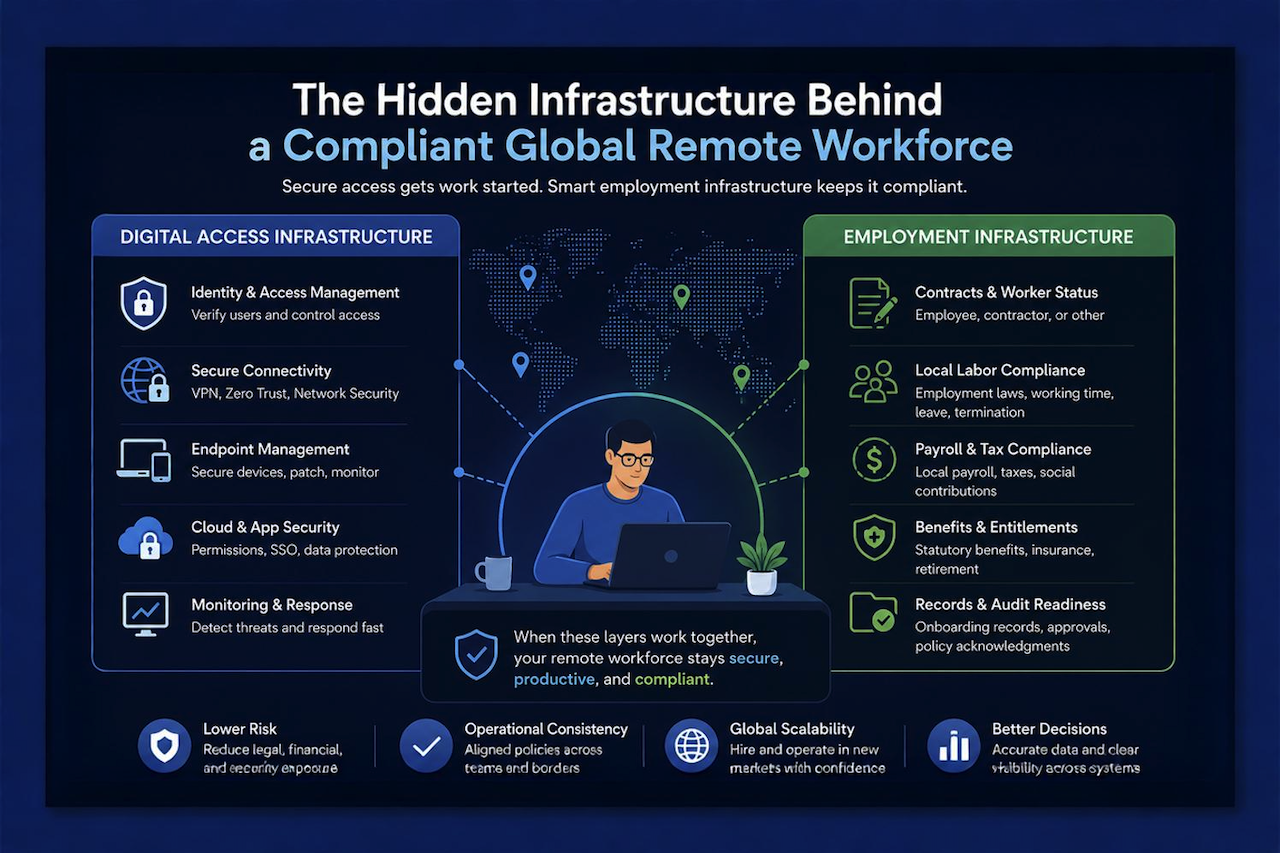
Remote work is usually planned through the tools people can see. Companies think about VPNs, endpoint protection, cloud apps, device policies, password managers, and collaboration platforms because those systems are part of the daily working experience.
There’s another layer underneath that setup, though, and it’s easier to miss. A global remote workforce also needs employment infrastructure: contracts, payroll, benefits, worker classification, local labor rules, onboarding records, and clear approval paths across HR, legal, finance, IT, and security.
A secure login doesn’t automatically mean the working arrangement is compliant. Someone’s location can affect how they should be hired, paid, managed, protected, and documented long before they open their first company laptop.
Remote work infrastructure has two layers
The technical side of remote work usually gets the most attention because it feels urgent. If an employee is logging in from another city or country, the company needs to know whether the device is trusted, whether the network is secure, and whether access is limited to the right systems.
That work matters. A clear VPN guide, strong endpoint policies, and sensible cloud permissions can reduce avoidable exposure. But they don’t answer the employment questions that appear when a worker is based in a different country.
The employment layer asks a different set of questions. Is the person an employee or a contractor? Which country’s employment rules apply? Who runs payroll? What benefits are required locally? What records should be kept if the company needs to justify the arrangement later?
These two layers often get built by different teams. IT handles access, HR handles onboarding, finance handles payroll, and legal reviews the contract. The risk arises when those decisions don’t align.
Access should wait for employment clarity
A common problem is speed. The hiring manager finds a strong candidate, IT can provision access quickly, and the company wants the person productive as soon as possible.
That can work for a domestic employee where the operating model is already clear. It becomes riskier when the person is based in a country where the company has never hired before.
Before a new remote worker receives cloud accounts, VPN permissions, device access, and internal tools, the company should know how that person is being engaged. If the business has no local entity in the worker’s country, it may need to open one, use a contractor arrangement where that is legally appropriate, or use an EOR model to support local employment.
That decision affects the contract, payroll setup, benefits, tax handling, onboarding documents, and compliance records. It also gives IT and security a cleaner context for what access the person should have, how long they should have it, and who is responsible for reviewing changes later.
Location signals need context
IP location data can be useful for remote workforce oversight, but it shouldn’t be treated as perfect evidence on its own. Workers travel, VPNs can mask locations, and some IP records can point to the wrong city or country.
Still, repeated location patterns are worth reviewing. If someone is officially approved to work in one country but frequently logs in from another, that may raise questions about tax exposure, labor rules, immigration permissions, security policies, or access to regulated data.
IP geolocation can provide a useful signal, but it should always be verified against HR records, approved work locations, travel policies, device records, and the worker’s contract before any conclusions are made.
A good process doesn’t overreact to one unusual login. It looks for patterns, asks better questions, and routes the issue to the right team before it becomes a compliance problem.
Zero trust should include worker status
Many security teams already use a zero trust mindset for remote access. They verify identity, device posture, location, role, and behavior before allowing someone access to company systems.
That model becomes stronger when the employment context is part of the policy. A full-time employee, a temporary contractor, and a consultant may all need access to the same project, but they shouldn’t always receive the same permissions or oversight.
For example, a contractor might need limited access to a development environment for six weeks. A full-time finance employee may need access to payroll data from an approved country. A manager temporarily traveling abroad may need a different exception process from someone permanently relocating.
Endpoint security also fits into this picture. Remote devices are not just hardware assets because they connect employment status, location, access rights, and data protection duties. Effective endpoint management helps organizations maintain visibility, enforce security policies, and protect sensitive data across distributed workforces.
The point is practical. Security policies work better when they understand who the worker is, where they are allowed to work, what role they perform, and what employment arrangement governs the relationship.
Payroll and contracts are part of the stack
Payroll and contracts can feel like back-office admin. For global remote teams, they’re part of the operating stack.
A remote worker’s contract should match the actual working arrangement. It should reflect the role, location, employment model, confidentiality duties, intellectual property terms, working time expectations, benefits, and data access responsibilities.
Payroll needs the same alignment. A person who is treated as an employee in day-to-day management but paid as a contractor may raise classification issues. A worker who has moved countries without a payroll review may create tax or benefits questions. A role approved in one location may require additional review if access logs show regular work from elsewhere.
This is also where masked location behavior can complicate reviews. VPNs and proxies have legitimate uses, but they can make it harder to determine where work is actually taking place. Understanding how masked IP behavior works can help organizations distinguish legitimate privacy tools from activity that may warrant additional review or conflict with internal policies.
Onboarding should create evidence
Good global onboarding should do more than give someone a laptop and a list of tools. It should create a clear record of why the person was hired in a certain way, where they are approved to work, what systems they can access, and who approved each part of the setup.
The most useful onboarding checks usually cover:
- Approved work location
- Employment model
- Contract type
- Payroll setup
- Benefits requirements
- Device and access needs
- Data permissions
- Review owner
That list looks simple, but it prevents a lot of messy follow-up later. If a worker relocates, changes role, switches from contractor to employee, or starts accessing more sensitive systems, the company has a baseline to review against.
Without that baseline, teams end up rebuilding the story from Slack messages, email threads, spreadsheets, and access logs. That is slow, inconsistent, and painful during an audit or incident review.
Build the process before the team spreads
Global remote hiring can help companies access better talent and expand into new markets. It also spreads responsibility across teams that don’t always work from the same playbook.
IT sees devices, networks, and permissions. HR sees contracts, policies, and worker records. Finance sees payroll and tax exposure. Legal sees local employment rules and classification risk. Security sees access patterns and data risk.
A simple pre-hire review can connect those views before the person starts. For any worker based in a new country, the company should confirm the employment route, payroll setup, approved work location, local legal requirements, data access needs, and security controls before sending the final offer or granting access.
That may add a little friction. It is still easier than cleaning up misclassified workers, mismatched contracts, incorrect payroll, unmanaged access, and scattered compliance records after the fact.
Remote work happens through screens and cloud tools, but compliant remote work depends on the structure underneath. The companies that handle it well treat employment infrastructure and security infrastructure as one connected system, not two separate projects that meet only after something goes
Conclusion
Building a successful global remote workforce requires more than secure devices and reliable cloud access. Companies also need a strong employment framework that aligns contracts, payroll, worker classification, approved work locations, and compliance responsibilities with their security practices.
When HR, legal, finance, IT, and security work from the same foundation, organizations can reduce compliance risks, simplify onboarding, and respond more effectively as employees change roles, travel, or relocate. Treating employment infrastructure and security infrastructure as connected parts of the same system creates a more resilient and sustainable approach to managing distributed teams.
Comments
Comments are available to signed-in users and are moderated to keep the discussion useful and respectful. Spam, automated submissions, and low-value promotional comments are removed. Outbound links may be approved when they are relevant and genuinely helpful to readers, but they are displayed as plain text rather than clickable hyperlinks.
No comments have been published yet.
Please sign in to submit a comment.