

Education, Technology, Information Technology
Same Credential, 10x Price Difference: Inside the AI Master's Market
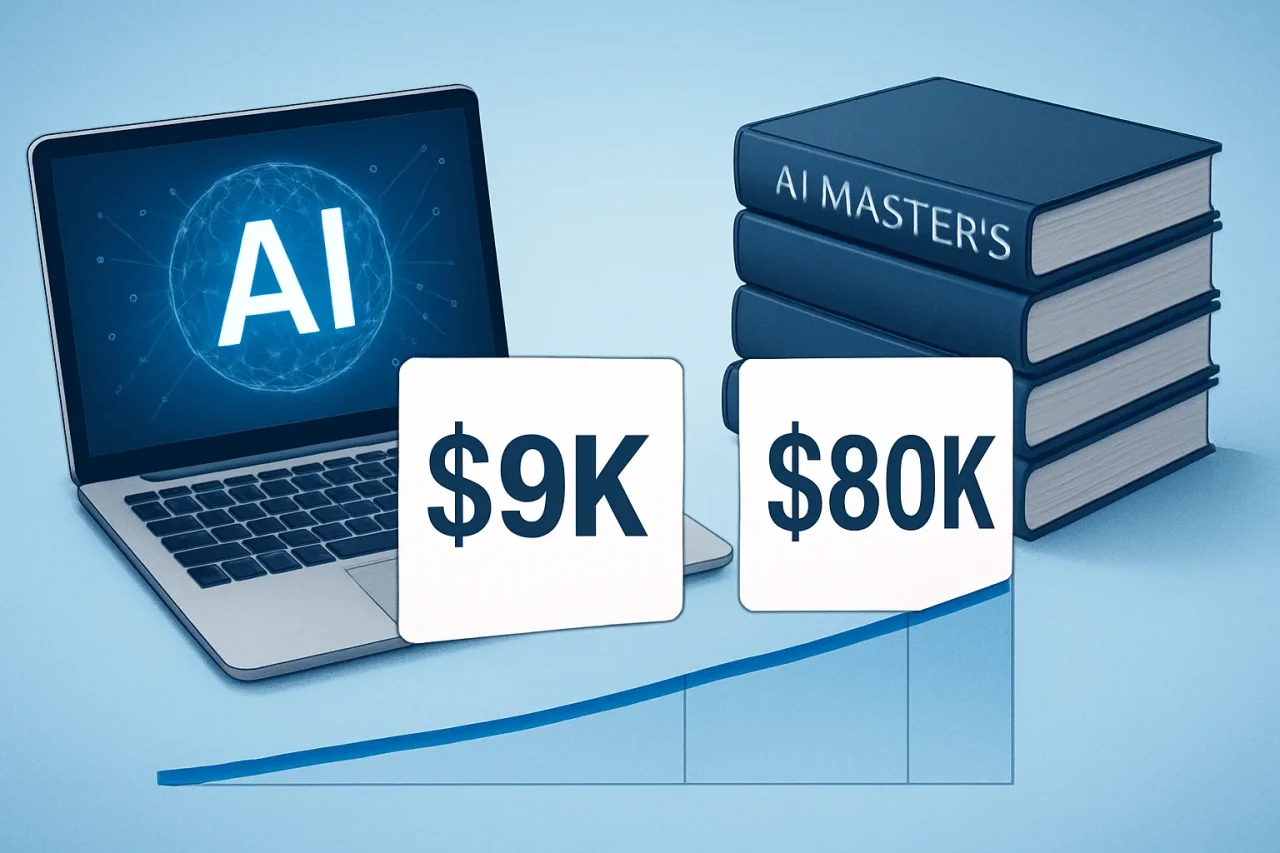
The number of US universities offering a master’s degree in artificial intelligence grew from 116 in 2022 to 310 in 2026. That is close to tripling in four years, making it one of the country’s fastest-growing graduate credentials.
But the more useful story is what these programs cost.
Georgia Tech’s online AI master’s costs $8,950. A private, campus-based program can run well over $80,000. Both are sold as advanced degrees in the same field, yet one can cost nearly ten times as much.
That does not necessarily mean the expensive programs are a ripoff. It means universities are using the same degree label to sell very different products. For an IT professional considering one, the important question is not simply whether an AI master’s is worth it. It is, specifically, what you are paying for.
Why universities started with the master’s
One detail in the data stood out (at least to me): about half of the US schools offering AI degrees offer only a master’s. They do not have an undergraduate AI major.
The reason is mostly practical. Creating a new undergraduate major can involve years of curriculum planning, four-year course maps, committee reviews, and sometimes state approval. A university can launch a master’s much faster, often by combining graduate courses its faculty already teach into a new program.
Graduate programs also give schools more freedom over pricing. They can market directly to working professionals, many of whom are paying with employer tuition benefits or their own money.
So when demand for AI skills took off, the master’s was the easiest program for universities to get into the market quickly. That helps explain the wide range in quality from the highly-ranked best AI masters programs vs the huge list of 310 programs with mixed quality levels.
Two very different markets
A growing share of the market consists of large online programs designed to enroll thousands of students.
Tuition for online AI master's programs varies considerably. Some programs cost around $10,000 in total, while others are priced even lower. There are now approximately 30 online AI master's programs in the United States with total tuition below $20,000.
The other side of the market looks more like traditional graduate education. These programs enroll smaller campus cohorts and typically cost between $40,000 and $100,000 or more. Many are based at universities with well-known brands and established recruiting relationships.
The higher price can buy things that are difficult to reproduce online: a close-knit cohort, direct access to professors, an alumni network, internship pipelines, and on-campus recruiting. For international students, the ability to study in the US can be a major part of the value.
What the higher price usually does not buy is course material that is several times better. A lecture on transformer architecture does not become nine times more useful because the program costs $90,000 instead of $10,000.
That is why the low-cost programs are so disruptive. A $45,000 AI master’s from a university with limited name recognition now has to compete with a $10,000 program from a top computer science department. That is a difficult position to defend, and it will probably become even harder over the next few years.
Who benefits from an AI master’s?
The degree makes the most sense when it solves a specific career problem.
One common problem is credential screening. Large companies, government contractors, and defense-adjacent employers still use degrees as hiring filters. The same is true of many internal promotion systems, where “relevant master’s degree” appears as a formal requirement or preferred qualification.
For someone moving from networking, cybersecurity, or infrastructure into an AI-related role at that kind of organization, the degree can help get through an initial screen that a portfolio alone may not.
There is also a reasonable case for paying for structure. Almost everything taught in an AI curriculum can be found online for free. That does not mean most people will work through it consistently.
A degree gives you a sequence, deadlines, assignments, feedback, and consequences for falling behind. Paying $10,000 for that structure can be sensible if you know you are unlikely to finish a self-directed curriculum. I say that as someone who has bookmarked roughly 400 tutorials I will probably never open.
The degree can also help people moving into AI from a less traditional background. Someone coming from sysadmin, network engineering, or general IT work may not have formal training in computer science, statistics, or machine learning. A well-designed master’s can provide that foundation in a more coherent way than a collection of unrelated courses.
The larger online programs are often more accessible to these applicants than highly selective campus programs. But the degree still needs to be paired with actual work. Completing courses is not the same as proving that you can build, evaluate, or deploy an AI system.
Where the degree falls short
An AI master’s will not create a strong portfolio for you.
Companies doing serious AI work tend to care about demonstrated ability. They want to see projects, research, open-source contributions, production systems, or other evidence that you can apply what you learned.
That matters in the current hiring market. New computer science graduates are facing roughly 6% unemployment, and adding another credential to a weak portfolio does not fix the underlying problem. It simply makes the same candidate more expensive.
For someone targeting a startup or research lab, the degree should be judged partly by the work it helps produce. Does the program include meaningful projects? Can you work with researchers? Will you leave with anything stronger than a transcript?
Without those opportunities, a two-year program may delay the work that would have made you employable in the first place.
Employer reimbursement changes the math
Many employers offer between $5,000 and $10,000 per year in tuition reimbursement.
For a program costing around $90,000, employer tuition reimbursement may cover only a small portion of the total expense. For lower-cost programs priced around $10,000, the same benefit may cover most or even all of the tuition.
Whether or not that was the explicit pricing strategy, the effect is significant. For a large portion of the target market, these programs are not merely inexpensive. They can be nearly free.
That makes the decision very different. A $10,000 degree completed part-time with employer reimbursement carries far less financial risk than leaving work for a $90,000 campus program.
Where the market goes from here
I expect enrollment to keep moving toward the two ends of the market.
Elite campus programs will continue to attract small cohorts because of their brands, networks, recruiting pipelines, and appeal to international students. Large online programs will keep expanding because their economics allow them to serve thousands of working professionals at a much lower price.
Programs priced between $40,000 and $50,000 may face increasing competition from lower-cost online alternatives. Prospective students should compare factors such as curriculum, faculty access, career services, networking opportunities, and overall cost when evaluating different AI master's programs.
Graduate computer science enrollment is already softening, partly because of declines in international enrollment. That will make domestic working professionals even more important to universities. Expect much more advertising for AI master’s programs, especially from schools trying to justify a price that no longer looks competitive.
The degree title itself tells you very little. Before enrolling, separate the program into its actual components: the education, the credential, the structure, the network, and the recruiting access.
Then decide which of those you need. Several are now available for around $10,000. The expensive part is usually the network and access, not the AI coursework.
Conclusion
AI master's programs now span a wide range of tuition costs, delivery formats, and learning experiences. While lower-cost online programs have expanded access to graduate education, higher-priced programs may offer additional benefits such as networking opportunities, campus resources, and career support.
Prospective students should evaluate each program based on its curriculum, learning format, career outcomes, total cost, and personal goals rather than the degree title alone. Comparing these factors can help determine whether a particular program aligns with an individual's educational and professional objectives.
Comments
Comments are available to signed-in users and are moderated to keep the discussion useful and respectful. Spam, automated submissions, and low-value promotional comments are removed. Outbound links may be approved when they are relevant and genuinely helpful to readers, but they are displayed as plain text rather than clickable hyperlinks.
No comments have been published yet.
Please sign in to submit a comment.