

Role of App Analytics in Business Growth
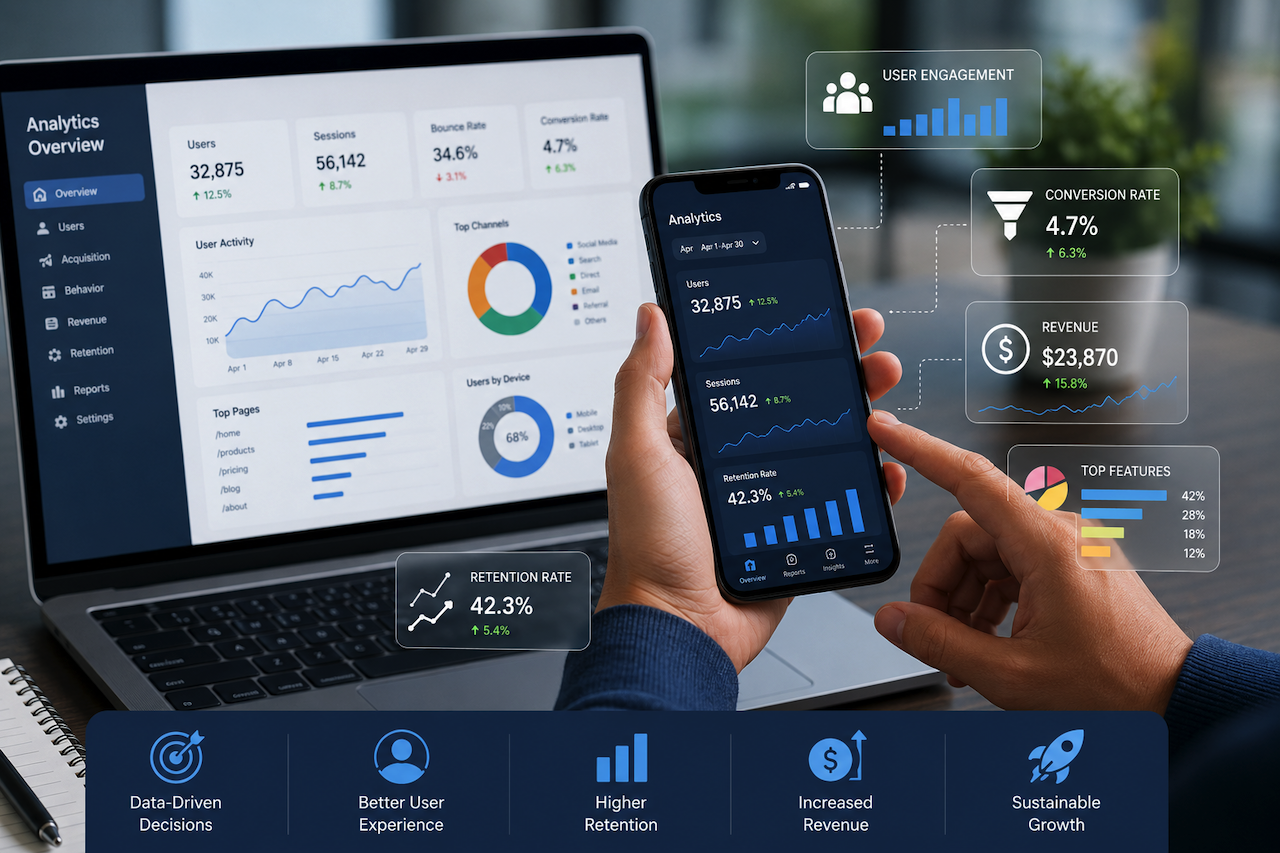
Today's mobile app-driven world has transformed the role of mobile applications from simple customer engagement tools into important business resources. They can help companies connect with customers, improve efficiency, boost sales, and strengthen brand loyalty. However, building an application is only part of the process. Understanding how people interact with an app and what they expect from it has become equally important for long-term success.
Companies can benefit from understanding how audiences interact with an app, which features attract the most attention, how people engage with content, and how well the application performs. This information helps organizations make informed decisions that improve user experiences and support sustainable growth. From startups launching their first app to established businesses expanding their digital presence, data-driven strategies can help companies remain competitive.
For businesses investing in mobile applications, monitoring behavioral patterns and technical metrics can be an important part of the development lifecycle from the beginning. Tracking meaningful information helps companies improve their applications over time and ensure they align with customer expectations and business goals.
Understanding User Insights and Performance Data
User insights involve gathering and reviewing activity information from a mobile application to better understand how people discover, use, and interact with it.
This information may include acquisition sources, session duration, feature usage, retention rates, conversion activity, in-app purchases, and customer demographics. These findings can help businesses identify what is working effectively and which areas may need improvement.
Instead of relying on assumptions, organizations can use real behavioral information to make strategic decisions. A data-driven approach reduces risk and increases the likelihood of achieving business goals.
As companies continue investing in digital transformation, measurable insights have become an important part of successful mobile strategies.
Why Data-Driven Decision Making Matters
Growth relies on accurate and timely decision-making in business. Earlier, many companies made decisions based on instinct or only on what their customers had to say. Experience is valuable, but measurable information provides deeper visibility into customer behavior.
Behavioral insights help organizations move away from guesswork and toward actionable strategies based on real activity patterns. For instance, if there is a consistent drop-off at a certain checkout step, teams can identify the issue and rework the process to increase conversions.
Likewise, highly engaging features can be expanded with additional resources, while less effective ones can be redesigned or removed. This helps companies make better use of development budgets while improving overall satisfaction.
Organizations that adopt data-based decision-making often improve retention, operational efficiency, and financial performance.
Improving User Experience Through User Insights
One of the most important factors influencing app success is user experience. No matter how well-designed the application is, difficulties with navigation or completing tasks can quickly frustrate people.
Activity data can help companies track customer journeys and identify barriers to engagement. User flow information can reveal how much time people spend in the app, where drop-offs occur, and which features receive the most interaction.
This information can help businesses make informed improvements that increase usability and satisfaction. Behavioral trends can also support small adjustments that improve customer experiences and encourage ongoing engagement.
For example, if people frequently abandon the app during sign-up, simplifying the registration process may help reduce abandonment rates. Likewise, identifying navigation difficulties can lead to design improvements that make the application easier to use.
Understanding Customer Behavior
One of the biggest benefits of reviewing behavioral information is gaining a clearer understanding of customer preferences, interests, and engagement patterns within an application.
Organizations can track conversion rates, identify the most popular features, and understand how much time people spend in different sections of the app and what actions contribute to conversions.
These findings enable organizations to build more personalized experiences. Companies can tailor messaging based on customer interests and behavior instead of relying on generic content or promotions.
Personalization has become an important tool for improving customer satisfaction. When customers receive relevant recommendations and experiences, they are more likely to stay connected to the brand and remain engaged.
Understanding behavioral patterns also helps companies anticipate customer needs and proactively address potential issues.
Enhancing Customer Retention
Acquiring new customers is important, but retaining existing customers is often more cost-effective and profitable. High retention rates usually indicate that people are satisfied with the application and continue using it over time.
Behavioral information can help businesses understand what influences retention. By monitoring activity over time, organizations can identify patterns associated with long-term engagement.
Behavioral trends can also reveal periods of inactivity and help companies develop re-engagement strategies. Features such as push notifications, custom offers, feature updates, and loyalty programs can then be tailored for audiences who appear to be disengaging.
Retention analysis can also help determine what effective onboarding looks like. Once companies identify which onboarding actions contribute to long-term usage, they can improve the experience for future users.
Strong customer retention can significantly improve customer lifetime value while lowering acquisition costs.
Optimizing Marketing Campaigns
Marketing effectiveness is a critical factor in business growth. Without proper measurement, organizations may invest heavily in strategies that fail to produce meaningful results.
User acquisition and campaign performance information can help companies understand how audiences discover their applications, whether through social media, search engines, paid advertising, email marketing, or referrals.
Understanding acquisition sources can help organizations allocate marketing budgets more effectively. Resources can then focus on channels that attract higher-quality users while reducing investment in underperforming campaigns.
Campaign metrics can also help track conversion rates, customer acquisition costs, and return on investment.
In mobile app development, audience behavior and campaign performance data can help teams better understand customer interests, improve user acquisition strategies, and refine marketing efforts over time.
Increasing Revenue Through Performance Insights
One of the main goals of most businesses is to increase revenue, and measurable insights can play an important role in achieving that objective.
Purchase trends can be analyzed to identify opportunities for growth and operational improvements. Performance metrics can help businesses determine which products, services, or features generate the most value and which areas require optimization.
For subscription-based applications, behavioral information can reveal factors that influence upgrades, renewals, and cancellations. This knowledge can help businesses refine pricing strategies and improve the customer experience.
User and sales information can also support e-commerce applications by identifying buying patterns, abandoned carts, and product performance trends. These findings can help improve product recommendations and streamline checkout experiences.
Continually evaluating revenue-generating activities can help organizations support sustainable long-term growth.
Measuring Application Performance
Technical performance plays an important role in customer satisfaction and business success. Slow speeds, crashes, and errors can quickly drive users away.
Technical metrics can provide visibility into response times, crash reports, network stability, and device compatibility.
Organizations can identify technical issues earlier and resolve them before they affect larger groups of users. Continuous monitoring helps maintain reliability and improve the overall experience.
Performance monitoring can also support quality assurance by identifying recurring technical issues that require attention. Businesses can then make updates and improvements based on actual usage patterns.
In mobile app development, maintaining reliable performance monitoring throughout the application lifecycle can help organizations identify technical problems early and maintain a stable user experience.
Supporting Product Development Decisions
Understanding market needs and customer expectations is critical to successful product development. In mobile app development, behavioral information and operational metrics can help guide feature improvements and development priorities.
Organizations can use real usage patterns instead of relying solely on feedback surveys. These findings help identify which features provide the most value and which receive minimal engagement.
Development teams can then prioritize future updates more effectively, improving high-value features while redesigning or removing underperforming elements.
Using behavioral and operational information helps developers reduce guesswork and make more informed development decisions.
As markets continue to evolve, measurable insights can support innovation and help organizations remain competitive.
Strengthening Customer Engagement
Customer engagement remains one of the most important factors influencing application success. Highly engaged audiences are more likely to remain loyal, make purchases, and recommend the brand to others.
Organizations can monitor engagement by reviewing metrics such as session length, active users, feature interactions, and content consumption patterns.
Understanding what encourages people to return can help organizations create experiences that support long-term engagement. Personalized notifications, interactive experiences, rewards programs, and relevant content can all contribute to stronger retention.
Another advantage of reviewing behavioral information is the ability to identify signs of disengagement early, allowing organizations to take corrective action before users stop using the application altogether.
Strong engagement can help build long-term customer loyalty and sustainable growth.
The Importance of Real-Time Analytics
In today's fast-paced digital environment, delayed access to information can limit business opportunities. Real-time operational and behavioral information provides immediate visibility into application activity and customer behavior.
Real-time monitoring enables businesses to track live activity, evaluate campaign outcomes, identify technical issues, and respond quickly to emerging trends.
For example, if a new feature experiences unexpected issues, real-time monitoring can help teams identify and resolve problems quickly. Likewise, if early marketing campaigns produce positive results, businesses can scale those efforts more efficiently.
Immediate access to operational information supports agile decision-making and helps organizations remain responsive to changing market conditions.
Competitive Advantage Through User Insights
The mobile application market continues to become more competitive. Businesses that better understand audience behavior and expectations can gain a significant advantage.
Organizations can benefit from behavioral and operational findings by observing activity patterns, identifying emerging trends, and improving customer experiences.
This understanding helps companies deliver stronger products and services while maintaining customer satisfaction.
Behavioral trends can also reveal opportunities for new features, products, and business models. Companies that consistently review usage patterns are often better prepared to adapt to changing market conditions and support long-term expansion.
Building Long-Term Business Growth
Business growth does not happen automatically. It requires continuous improvement and strategic adaptation to changing customer needs.
Behavioral and operational insights play an important role throughout this process by helping organizations make informed decisions and improve results. Whether improving customer experiences, strengthening retention, refining marketing strategies, or supporting revenue growth, these findings can significantly influence overall business performance.
Organizations that rely on measurable information often foster a culture of continuous learning and improvement. Decisions based on reliable findings rather than assumptions can help teams work more effectively and make stronger strategic choices.
This data-driven approach, applied consistently over time, can strengthen customer relationships, improve profitability, and support continued growth.
In the rapidly evolving mobile technology landscape, organizations that effectively use behavioral and operational information are often better positioned to identify opportunities, address challenges, and remain competitive.
Conclusion
Analytics has become increasingly important for business growth in today's digital landscape. Understanding customer behavior is essential for delivering strong user experiences and improving application performance. Organizations can use measurable findings to improve retention, refine marketing strategies, support product development, and identify new opportunities for growth.
From launching new applications to improving existing platforms, business decisions are often more effective when guided by reliable behavioral and operational information. Companies that use these findings to better understand customer activity can support stronger long-term growth.
Featured Image generated by ChatGPT.
Related Articles

September 11, 2025
Top Mobile App Development Companies for Innovative Digital Solutions
In our world, mobile applications are at the heart of customer engagement and business growth. Choosing the right mobile app development company can define your project’s success...
Read More
January 21, 2025
Role of APIs in Mobile App Development
Wondering how mobile apps communicate and share data with external devices? Thinking about how they seamlessly manage to exchange information with software systems and applications...
Read More
October 17, 2024
How to Choose and Implement the Best Mobile App Analytics Tools
The competitive mobile app market requires precise analytics. Mobile app analytics tools are critical for monitoring user engagement, pinpointing issues, and enhancing performance....
Read More
Comments
Comments are available to signed-in users and are moderated to keep the discussion useful and respectful. Spam, automated submissions, and low-value promotional comments are removed. Outbound links may be approved when they are relevant and genuinely helpful to readers, but they are displayed as plain text rather than clickable hyperlinks.
No comments have been published yet.
Please sign in to submit a comment.