

IP Address, Network, Cloud Services
IP Transit Set to Grow at 4.8% CAGR as Cloud Traffic Surges Worldwide
The internet does not work by magic; it works by a paid connection network that enables traffic from one network to get through to all other networks around the world. This connection system is known as IP transit, which, at this point in time, is experiencing its own silent boom. The reason is that more enterprises are moving to the cloud, new data centers are being built, and 5G network connections are being established in Asia and beyond.
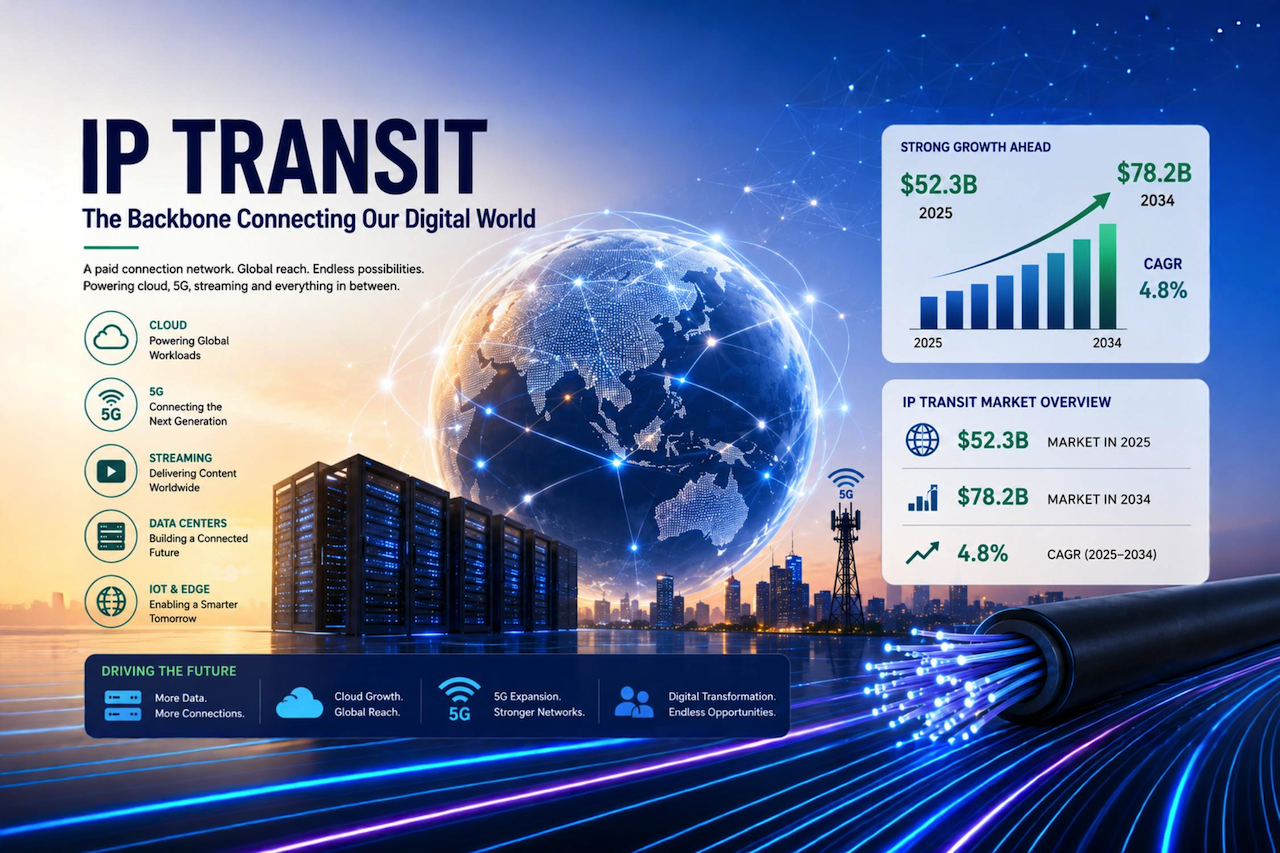
The global IP transit, as indicated in a recent market research report published by Marketintelo, is worth $52.3 billion in 2025 and is expected to rise to $78.2 billion by 2034 at a CAGR of 4.8%. It may not be the most impressive statistic out there for the technology industry, but it says something rather fundamental about how all those binge-watching sessions, migrations to the cloud, and IoT deployments have to happen.
What exactly is IP Transit?
The term IP transit refers to the service that allows ISPs, enterprises, data centers, and content platforms to transport their traffic through the world by making payments to an upstream provider for connectivity. Unlike "peering," in which there is no cost associated with transporting traffic, IP transit involves charges. Transit is a paid relationship, and for most organizations that can't strike direct peering deals with every network they need to reach, it's the backbone that makes global connectivity possible.
Recent Developments Shaping the Industry
A few trends have defined the last year or so of activity in this space:
- Cloud migrations have not stopped: Large corporations continue migrating their critical workloads into AWS, Microsoft Azure, Google Cloud, and regional cloud providers. Multi-cloud environments are now widespread enough to drive significant demand for IP transit connectivity between cloud platforms. IP transit applications supporting cloud services account for approximately 42% of application revenue.
- 5G rollouts increase backhaul demand: Telecom operators deploying 5G networks require greater transit capacity to carry data from distributed base stations to core networks. This trend is particularly evident in the Asia-Pacific region, where 5G deployment continues at a rapid pace.
- Streaming and short-form video keep pushing capacity limits: Content delivery—including platforms such as Netflix, YouTube, short-form video, and live-streaming services—accounts for nearly one-third of IP transit application demand. Providers continue investing in peering and caching infrastructure to accommodate growing traffic volumes.
- Consolidation continues among carriers: Smaller transit providers are increasingly challenged by the capital investment required to maintain and expand global network infrastructure, resulting in greater market concentration among larger providers such as AT&T, Lumen Technologies, Verizon Business, NTT Communications, and Tata Communications.
- Software-defined wide-area networking improves connectivity management: SD-WAN enables organizations to use multiple internet connections more efficiently, contributing to lower transit pricing in many developed markets while creating new service opportunities for network providers.
Market Overview: What Markets Show High Potential
The Asia Pacific region leads in terms of the number of regional markets, accounting for around 38% of the worldwide IP transit revenues due to the fast growth of the digital economy, the building up of hyperscale data centers, and the increasing adoption of clouds in China, India, and Southeast Asia. The second largest market is North America with a concentration of cloud players and content providers; Europe’s share depends on GDPR compliance and development of the carrier networks within the region.
By service type, dedicated internet access, which guarantees exclusive bandwidth and strict service-level agreements, remains the larger segment, favored by enterprises running mission-critical systems. Budget-friendly shared internet access remains suitable for smaller and medium-sized companies that do not require performance assurance.
Regarding the bandwidth, connections faster than 1 Gbps experience most growth due to demand from hyperscale data centers and content distribution networks that commonly buy transit links with speeds of 10, 100, and even 400 Gbps.
Key Factors That Will Drive Growth
- The expansion of hyperscale data centers: The rapid growth of hyperscale data centers is increasing demand for high-capacity interconnection to support redundancy, failover, and reliable network performance.
- Enterprise multi-homing: Organizations increasingly connect to multiple IP transit providers to improve network resilience, optimize routing, and reduce the risk of service interruptions.
- IoT and edge computing: The growth of connected devices and edge computing is driving demand for reliable connectivity across industries such as manufacturing, healthcare, and smart cities.
- E-commerce and SaaS expansion: Web hosting providers, cloud applications, and online business platforms continue to generate steady demand for IP transit services as digital services expand.
- Digital transformation in emerging markets: As broadband availability increases in underserved regions, more businesses and consumers are coming online, contributing to continued growth in IP transit demand.
Headwinds Worth Watching
Growth in this market isn't without friction. Per-Mbps pricing has been in gradual decline for years as competition intensifies and submarine cable capacity expands, meaning providers often have to grow traffic volumes just to keep revenue flat. Alternative connectivity options, including satellite internet and private backbone networks built by hyperscale cloud companies themselves, pose a longer-term competitive threat to traditional transit providers. And ongoing telecom industry consolidation could eventually concentrate pricing power among a smaller number of dominant carriers.
The Bigger Picture
IP transit rarely makes headlines the way AI chips or cloud outages do, but it's the plumbing underneath nearly everything digital. As long as adoption of cloud continues to grow, streaming continues to surge, and 5G deployment continues to accelerate, the conduits that connect our global network will continue to expand as well. Mid-single digits may not seem all that impressive as a compound annual growth rate, but over the course of the next several years on a $50 billion-plus base, that adds up to a lot of money.
Conclusion
IP transit remains a foundational component of the global internet, enabling connectivity between networks, cloud platforms, enterprises, and digital services. As cloud adoption, 5G deployment, edge computing, and data center expansion continue, demand for reliable, high-capacity transit services is expected to grow. Although pricing pressure, evolving network architectures, and industry consolidation present ongoing challenges, IP transit is likely to remain essential to supporting the performance, scalability, and resilience of the modern internet.
Comments
Comments are available to signed-in users and are moderated to keep the discussion useful and respectful. Spam, automated submissions, and low-value promotional comments are removed. Outbound links may be approved when they are relevant and genuinely helpful to readers, but they are displayed as plain text rather than clickable hyperlinks.
No comments have been published yet.
Please sign in to submit a comment.