

Search Engine Optimization, Artificial Intelligence, Web Development
From Chatbots to Autonomous Workflows: What the Rise of Agentic AI Means for SEO and Web Teams
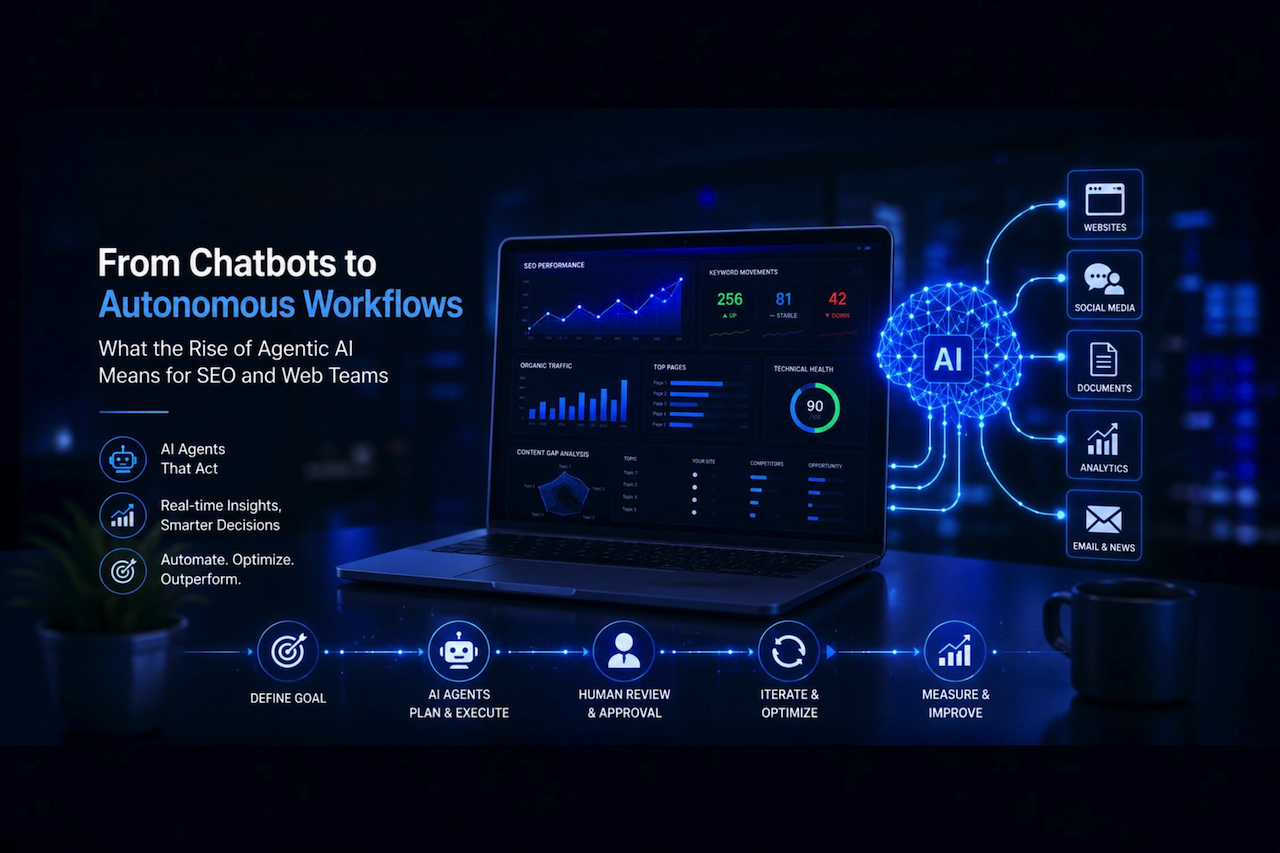
The concept of “AI on the website” was synonymous with a chatbot answering frequently asked questions via a pre-programmed decision tree for almost a decade. However, times are changing quickly, and statistics show that. The number of monthly active users of Google's AI Mode has already reached over a billion, more than four out of ten marketing and development companies have at least one AI agent launched, and the AI agent platform market is expected to increase from $7.8 billion in 2025 to $68.4 billion by 2034, with an average annual growth rate of over 27%.
This technology is not an improved chatbot. It is software that can design a complex procedure, select relevant applications for the process, retrieve real-time information from multiple applications, and execute the procedure with minimal human intervention. Such software is known as agentic AI, and it is revolutionizing the ways search results are produced, content is briefed and analyzed, and technical issues are solved by a website.
From Scripted Bots to Autonomous Agents
Traditional chatbots understand the user's intent, map it to an existing response, and hand off the interaction to a human whenever the interaction deviates from their programming. However, an AI agent is quite different as it keeps the context throughout the process, chooses what API to call, retries in case of failure, and works with other specialized agents to complete a task.
That distinction is showing up directly in SEO workflows. In a Q1 2026 survey of 250 marketing and development agencies by Digital Applied, 64% reported running content brief and outline generation agents in production, and 51% reported running SEO audit agents — the second most common agentic workflow after content briefs. Notably, audit agents delivered the highest return of any workflow type measured, at a median of 11.4x the manual baseline, because they replace hours of senior SEO time that would otherwise bill at $200 or more per hour. Brief-generation agents, by contrast, returned a more modest 2.9x, since a human strategist typically edits the output anyway — the agent is saving 20 minutes per brief, not several hours.
Recent Developments Driving the Shift
Several converging developments made this leap possible in a short window.
Reasoning and Tool Use Continue to Advance
Reasoning and tool use in large language models matured quickly. Models can now chain logical steps, call external functions, and produce structured output reliably enough for production use. By 2028, Gartner forecasts AI agents will be embedded into 33 to 40 percent of business application software, compared to less than one percent in 2024, and that a significant portion of day-to-day decisions will be made autonomously without human review.
Enterprise Adoption Is Outpacing Production Deployment
Rapid adoption in enterprises continues, but deployment lags behind pilot programs. McKinsey's 2025 research found that 62% of organizations are already experimenting with AI agents, and 23% are scaling an agentic system in at least one business function. PwC separately found that while 79% of senior executives say agents are being adopted somewhere in their company, only 17% have deployed them broadly. The gap between piloting and running agents in production remains one of the defining challenges of this technology.
Infrastructure and Orchestration Platforms Continue to Expand
The combination of agent memory, tool availability, and collaboration between multiple agents has increased demand for orchestration and infrastructure tooling. Middleware such as orchestration platforms, agent runtime environments, and observability dashboards has become an important part of supporting production AI agent deployments.
Search Is Becoming More Agent-Oriented
The way AI systems research and answer queries continues to evolve. Search Engine Land's analysis found that ChatGPT's browsing agent relies heavily on the Bing Search API, frequently accesses simplified "reading mode" versions of webpages, and often encounters issues caused by redirects, HTTP errors, or slow-loading pages. These findings suggest that webpages optimized for human visitors may still pose challenges for AI systems tasked with retrieving and interpreting their content.
Market outlook and growth factors
The size of the AI agent platforms industry is estimated differently by different analysis firms; for example, Dataintelo estimates it at $7.8 billion in 2025 and $68.4 billion by 2034 (27.4% CAGR). The direction, regardless of the exact multiple, is consistent: sustained, high double-digit annual growth through the next decade.
There is a variety of issues that contribute to that curve based on the report::
- Enterprise Automation Pressure: Many enterprise technology leaders are planning to deploy AI agent platforms across multiple business functions to help address rising labor costs and improve operational efficiency.
- Cloud and API-First Infrastructure: As more enterprise systems become cloud-native and expose APIs, AI agents can access data and perform tasks across connected systems with fewer custom integrations.
- Regional Momentum: North America currently accounts for the largest share of the AI agent platform market, while the Asia-Pacific region is experiencing the fastest growth, driven by increasing enterprise adoption across industries such as manufacturing, financial services, and e-commerce.
- Sales and Marketing Applications: Sales and marketing are significant application areas for AI agent platforms, supporting workflows such as SEO, content creation, campaign optimization, and customer engagement.
What This Means for SEO and Web Teams
Search Behavior Is Shifting Toward AI-Generated Answers
Search behavior has already shifted from links to answers, and the data shows it. Google's AI Overviews now appear in an estimated 89% of brand search results, according to a 2026 GoodFirms survey of SEO practitioners, and a separate industry analysis puts overall Google searches ending without a click at roughly 58.5%. Yet organic search traffic hasn't collapsed the way some early predictions suggested. Graphite's tracking found organic traffic down only about 2.5% between February 2024 and November 2025, suggesting a redistribution of visibility rather than a wholesale replacement of search. The practical implication is that ranking position alone is no longer a complete measure of performance; being the source an AI system chooses to cite is becoming a parallel, and in some categories, more important, success metric.
Content Operations Are Becoming Increasingly Hybrid
Content operations are becoming hybrid by default, and the adoption data shows where. Content brief generation is currently the most widely deployed agentic SEO workflow at 64% adoption among surveyed agencies, but audit and technical recommendation agents are generating the strongest measurable ROI. That trend indicates that the most immediate value for web teams comes not from content generation, but from labor-intensive diagnostic tasks such as crawling audits, link audits, schema validation, and competitive gap analysis.
Trust and Accuracy Remain Critical
Time savings are real, but attention to trust and accuracy still matters. First Page Sage's 2026 research measured an average time savings of 66.8% for tasks completed with AI agents compared to manual workflows. However, the same study found that 54% of users trusted manually verified results more than agent-generated ones for equivalent tasks, highlighting the continued importance of editorial review.
Managing AI Agent Risks
Different failure mechanisms require different safeguards. According to Gartner, more than 40% of agentic AI initiatives may be abandoned by 2027 due to rising costs and uncertain returns on investment. For web teams, common risks include hallucinated citations, compounding errors across multi-step publishing workflows, and technical barriers that prevent AI agents from successfully accessing website content.
Technical Readiness Is Becoming a Competitive Advantage
Technical readiness is becoming its own discipline. With many AI agents relying on simplified, JavaScript-free versions of webpages and a large percentage of visits ending immediately because of technical issues, traditional technical SEO practices such as clean HTTP status codes, minimal redirect chains, fast load times, and accessible HTML content are becoming increasingly important for AI discoverability. Independent tracking has also shown that AI systems can begin citing new content within days of publication when pages are easily accessible and crawlable.
Key Insights
From chatbots to agentic AI: This transition is supported by the adoption numbers, not marketing buzzwords; 60%+ of survey respondents have an agentic SEO workflow running in production, agents are delivering ROI multiples in the double digits wherever they are in use, and the investment into the platforms is on track for tens of billions of dollars to be spent by the early 2030s. However, the numbers are just as evident: most organizations still operate in pilot mode, there is more trust in manually verified results than in autonomous output, and many agentic initiatives are doomed to be terminated over the next two years.
For SEO professionals and web teams, the near-term opportunity is narrower and more practical than "adopt AI everywhere": deploy agents first on well-defined, repetitive diagnostic work where the ROI case is already proven, keep human judgment firmly in the loop for anything published under the brand's name, and treat technical accessibility for AI agents, not just human visitors, as a standing part of the site health checklist. Teams that make that distinction early will be far better positioned as autonomous systems become a permanent fixture of how search, content, and websites operate.
Comments
Comments are available to signed-in users and are moderated to keep the discussion useful and respectful. Spam, automated submissions, and low-value promotional comments are removed. Outbound links may be approved when they are relevant and genuinely helpful to readers, but they are displayed as plain text rather than clickable hyperlinks.
No comments have been published yet.
Please sign in to submit a comment.