

Business, Software, Manufacturing
Best CRM Software for Manufacturing Companies
Manufacturing sales is unlike most other B2B environments. Sales cycles stretch across months, sometimes years. Quotes involve complex product configurations and custom pricing. Distributors, dealers, and direct accounts all sit in the same pipeline. Multiple plants, territories, and business units complicate account management. And through it all, the CRM is expected to keep up.
Generic CRM platforms built for straightforward deal pipelines and simple contact management routinely fall short in manufacturing. The right platform must handle the specific operational realities of the industry: long multi-stakeholder sales cycles, complex product configuration and pricing, ERP integration, and the ability to manage relationships across dealer and distributor networks, not just direct accounts. This guide covers the strongest options available.
What to Look for in a Manufacturing CRM
Before evaluating specific tools, it helps to know which capabilities separate a manufacturing-fit CRM from a generic one:
- ERP integration: Manufacturing businesses run on ERP systems. A CRM that cannot connect cleanly to the ERP creates data silos between sales and operations, forcing manual reconciliation of orders, pricing, and inventory.
- Configure, price, quote (CPQ): Complex product configurations and custom pricing structures are the norm in manufacturing. Native or tightly integrated CPQ capability saves significant time and reduces quoting errors.
- Long sales cycle management: Multi-stage pipelines with multiple stakeholders across engineering, procurement, and finance require more than a simple deal card.
- Distributor and channel management: Many manufacturers sell through intermediaries. The CRM needs to support indirect channel relationships, not just direct accounts.
- Account hierarchies: Parent-child account structures are essential when managing corporate clients across multiple sites, subsidiaries, or purchasing entities.
Best CRM Software for Manufacturing Companies
1. Creatio
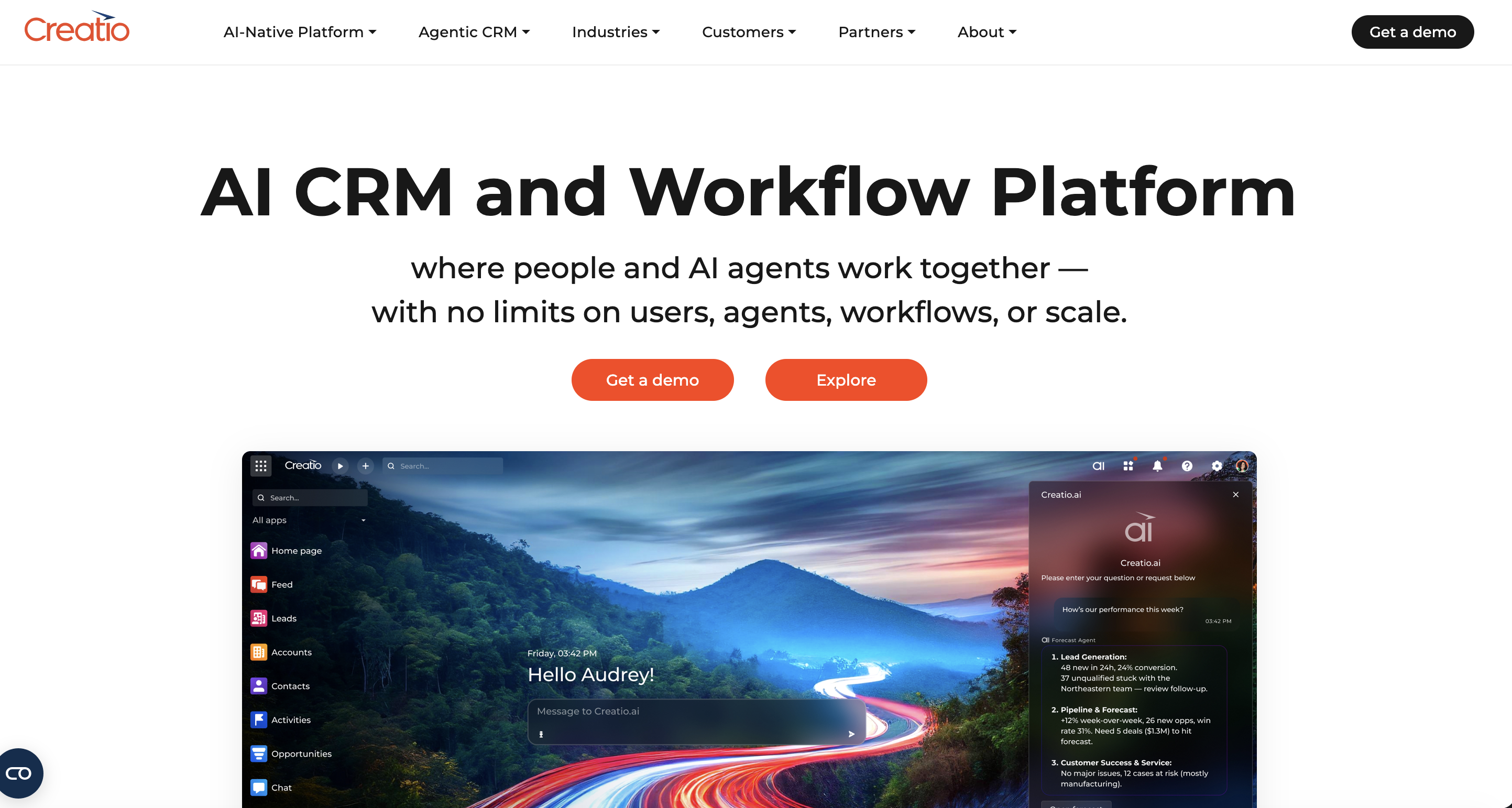
Creatio is a no-code CRM and process automation platform with built-in AI agents at its core. Sales and operations teams can configure pipelines, automate multi-step approval workflows, and deploy AI agents that handle lead and opportunity scoring, sales forecasting, and predictive maintenance insights, all without developer involvement. Where most CRMs treat automation as an add-on, Creatio makes it central to how the platform works. The agents learn from each interaction, surfacing next best actions and flagging bottlenecks before they affect production or customer delivery.
It supports full account hierarchy management, long sales cycle tracking, and integrates with major ERP systems. The no-code customization layer means the CRM adapts to the manufacturer's processes, rather than forcing the business to adapt to the software. For teams evaluating the best CRM for manufacturing, Creatio offers a combination of operational depth and customization flexibility that few competitors match, making it the strongest overall choice for mid-market to enterprise manufacturers.
Best for: Mid-market to enterprise manufacturers with complex sales workflows, multi-step approval processes, or distributor networks who need strong CRM and process automation in one platform.
2. Salesforce Manufacturing Cloud
Salesforce Manufacturing Cloud is the enterprise standard for large manufacturing organizations with complex, multi-channel sales operations. Built on top of the Salesforce platform, it adds manufacturing-specific features including run-rate agreement management, sales agreement tracking, and account-based forecasting.
It is the most feature-complete option for global manufacturers with the resources to implement and maintain it. For smaller or mid-market manufacturers, the cost and implementation complexity frequently outweigh the benefits, and many teams find themselves using a fraction of the functionality they are paying for.
Best for: Large enterprise manufacturers with existing Salesforce infrastructure and dedicated CRM admin resources.
3. Microsoft Dynamics 365 Sales
Microsoft Dynamics 365 Sales is a strong option for manufacturers already operating within the Microsoft ecosystem, particularly those using Azure, Teams, or Dynamics 365 for ERP and finance. The native integration between the CRM and other Microsoft products reduces the complexity of connecting sales data to operational data significantly.
Its manufacturing-relevant strengths include territory management, account hierarchy support, and the ability to embed it within broader Dynamics 365 business applications. The learning curve is steep, but for Microsoft-first organizations, the ecosystem coherence is a genuine long-term advantage.
Best for: Manufacturers running Microsoft infrastructure who want to keep their technology stack unified under a single vendor.
4. SAP Sales Cloud
SAP Sales Cloud is the natural choice for manufacturers running SAP ERP. The tight integration between CRM and ERP data eliminates the manual syncing that plagues mixed-vendor stacks. Pricing, inventory levels, order history, and customer records are all visible within the CRM without additional middleware.
Outside of the SAP ecosystem, it is harder to justify. The implementation is complex, and the interface is less intuitive than competing tools. But for organizations already invested in SAP, it removes more friction than any alternative.
Best for: SAP ERP users who want native CRM-to-ERP integration without third-party connectors or data syncing overhead.
5. HubSpot CRM
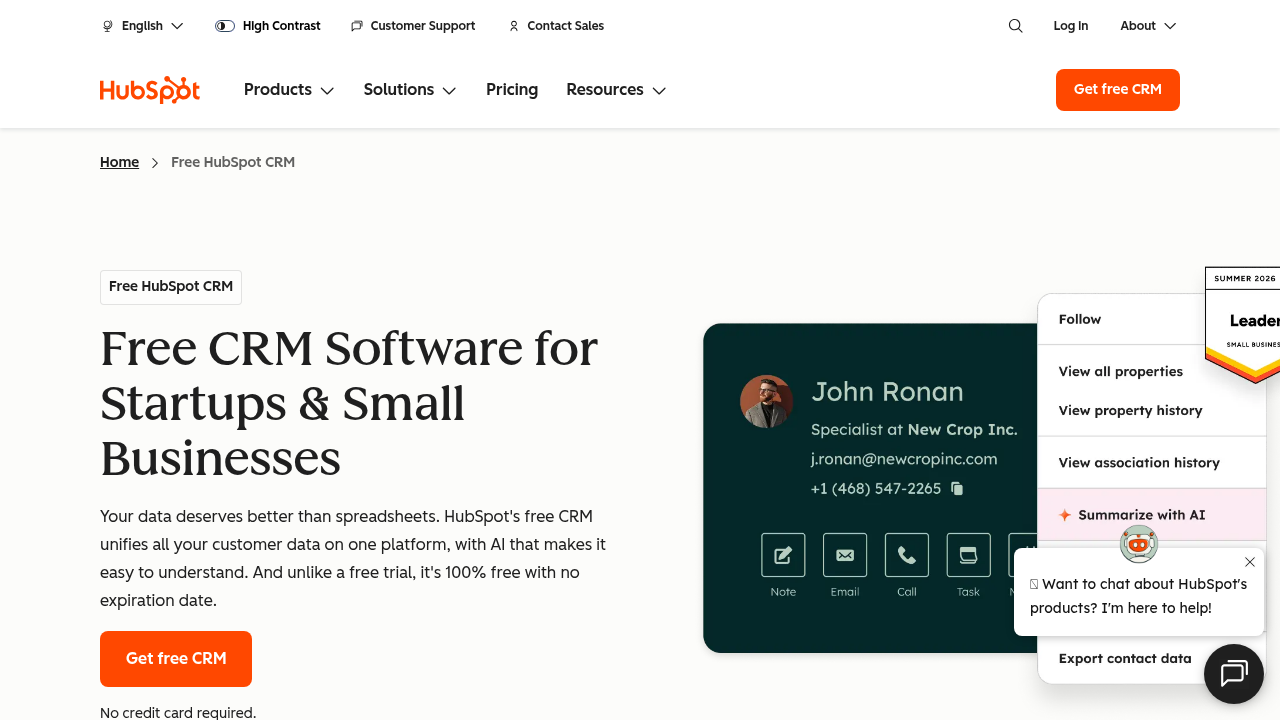
HubSpot is not built specifically for manufacturing, but it works well for smaller manufacturers with straightforward sales processes and a strong focus on inbound marketing and lead generation. Its free tier is genuinely capable, and the paid plans scale reasonably for growing teams.
Where it falls short for manufacturing: limited support for complex account hierarchies, no native CPQ functionality, and pipeline management that works best for shorter, simpler sales cycles. Teams that need distributor management or deep ERP integration will reach their ceiling quickly.
Best for: Small manufacturers and industrial distributors with simpler sales cycles and a focus on inbound lead conversion over complex account management.
6. Pipedrive
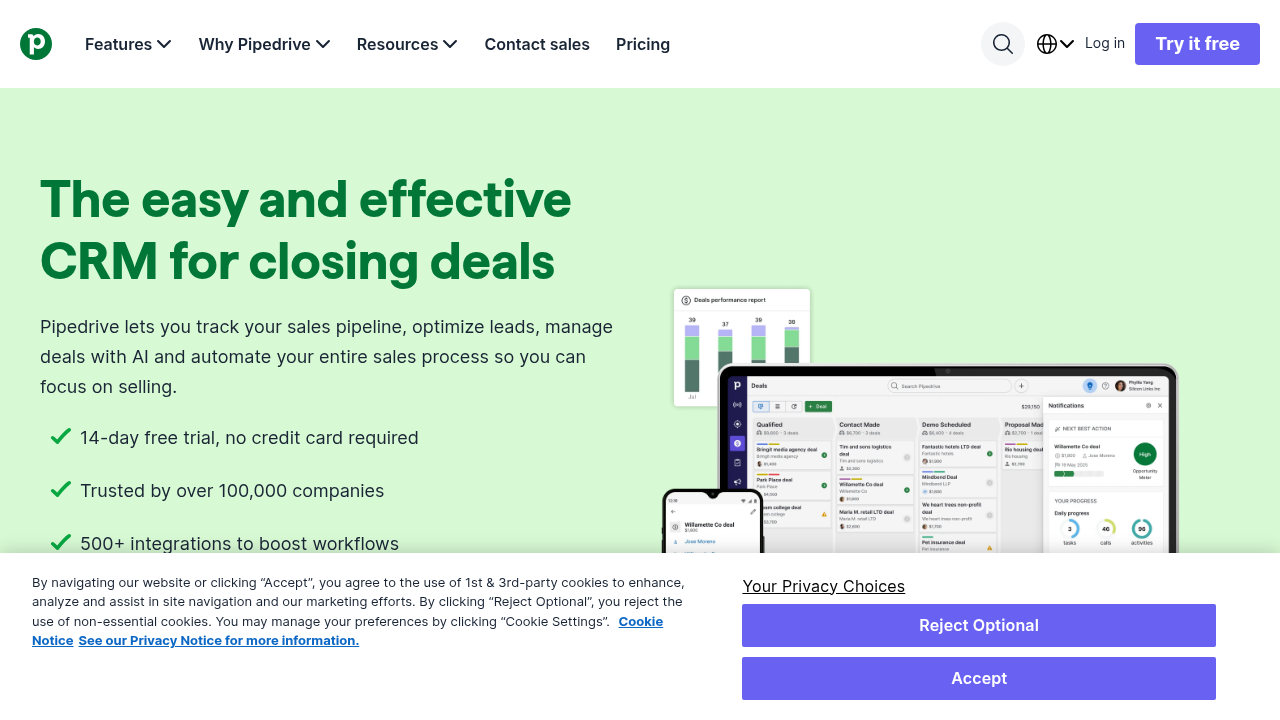
Pipedrive is a sales pipeline tool rather than a full CRM, but it performs well for smaller manufacturing sales teams that prioritize pipeline visibility and activity tracking over operational depth. Its interface is clean and fast, and it requires minimal setup to start generating value.
Like HubSpot, it lacks manufacturing-specific features. ERP integration requires third-party connectors, and complex account structures are not its strength. It is best suited as a lightweight tool for small teams that have outgrown spreadsheets but do not yet need the depth of a manufacturing-specific platform.
Best for: Small manufacturing sales teams that need a simple, visual pipeline tool with minimal administrative overhead.
How to Choose
The right manufacturing CRM depends on three factors: the complexity of your sales process, the size of your organization, and your existing technology stack.
For mid-market manufacturers with complex workflows who want flexibility without heavy IT involvement, Creatio is the strongest overall choice. For large enterprises already on Salesforce, Manufacturing Cloud is the logical extension of an existing investment. For SAP or Microsoft shops, SAP Sales Cloud and Dynamics 365 both offer native integration that reduces long-term friction, even if the initial implementation is demanding.
Smaller manufacturers are well served by HubSpot or Pipedrive, with the understanding that growing sales complexity will likely require migration to a more capable platform over time.
Whatever the shortlist, any serious evaluation should include a hands-on trial using a realistic manufacturing sales scenario rather than a generic vendor demo. The gap between a CRM that performs well in a demo and one that actually handles the day-to-day complexity of manufacturing sales is wider than vendors typically acknowledge.
Conclusion
The best manufacturing CRM is the one that aligns with your sales complexity, operational processes, and existing technology stack. While features like ERP integration, CPQ, and account hierarchy management are essential for many manufacturers, the ideal solution will also be flexible enough to support future growth. By evaluating your workflows, testing platforms with real-world scenarios, and prioritizing long-term scalability, manufacturers can select a CRM that improves sales efficiency, strengthens customer relationships, and supports sustainable business growth.
Comments
Comments are available to signed-in users and are moderated to keep the discussion useful and respectful. Spam, automated submissions, and low-value promotional comments are removed. Outbound links may be approved when they are relevant and genuinely helpful to readers, but they are displayed as plain text rather than clickable hyperlinks.
No comments have been published yet.
Please sign in to submit a comment.